Founding year: Wikidata; Wikipedia’s history section gives the same year. First post office: 1811.The full story ↓
History grade
What drives Burton’s History grade
On its age, its old homes and the National Register, Burton is more historic than 96% of U.S. towns. All 3 inputs are above most U.S. towns; its share of homes from before 1940 ranks highest and its age lowest.
A+
HistoryA character grade: shown, never part of Burton’s overall grade.
Ohio towns list about as much on the Register as the country (a typical Ohio town has 2.9 per 10,000 residents, the U.S. 2.4), so Burton’s 112 sits above most of its state (93% of Ohio towns have fewer) while its 17 historic buildings outnumber those of 79% of U.S. towns.
How sure. Graded on any two of the three inputs instead, the letter would range from A to A+. The pre-1940 share is a Census survey estimate (±11.5 points). Two sources give 1798.
Founding year: Wikidata (other dates in Quick answers). Homes: Census ACS 2020–24. National Register: National Park Service, May 2026 list; each listing counted once (boundary changes and added documentation belong to their listing), and a historic district counts its contributing buildings. How TownRatings grades history →
What stands out about Burton’s past
Read from the archive, the National Register and the record. The page puts what stands out first.
Burton was founded in 1798 and is Geauga County's oldest settlement. Like many other early settlements in the Connecticut Western Reserve, Burton has a town square patterned after the village greens of New England.
In 1972, an incident in Burton lead to a U.S. Supreme Court case. Hugo Zacchini performed a human cannonball act at Burton's annual Geauga County Fair, and WEWS-TV recorded and aired the entire act against his wishes and without compensating him, as was required by Ohio law. In Zacchini v. Scripps-Howard Broadcasting Co., the high court ruled in 1977 that the First Amendment did not shield the broadcaster from liability from common law copyright claims.
Passages that mention Burton, cut from the printed page as they were published.
Pioneer and General History of Geauga County, with Sketches of Some of the Pioneers and Prominent Men1880 · page 229Read the page →
Read the text
In the year 1817 the present township of Newbury was set off from the township of Burton by the commissioners, and an election ordered to be held at the house of Lemuel Punderson, on the first Monday of April, 1807, for the purpose of electing township officers. The following was the election: Lemuel Punderson, moderator; John Cobb; clerk; L. Punderson, Solomon Johnson, Joshua M. Burnett, trustees; Hamlet Coe, Thomas Manchester, overseers of the poor; Eliphalet Gay, Moses Bradley, fence viewers ; Seth Johnson, John Bacheldor, appraisers and listers.
Text read by machine from the scan; it may contain errors.
Pioneer and General History of Geauga County, with Sketches of Some of the Pioneers and Prominent Men1880 · page 503Read the page →
Read the text
July 4, 1800, the inhabitants of Burton, in number assembled, as mentioned by Judge Kirtland, amounted to 42. At the election in 1802, n families were claimed as settled for Burton proper. Marimon Cook has left a note saying: “Number of inhabitants in the township of Burton, January 20, 1809 — 237.
Text read by machine from the scan; it may contain errors.
Scans and text from the Internet Archive. Books published in 1930 or earlier, which are in the public domain.
Timeline
Burton, 1798 to 1905
Woven from the archive, old maps, post office records, the National Register and the people born here.
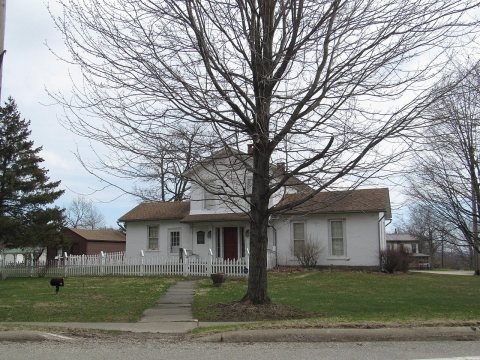
National Park Service, National Register of Historic Places. Photos from Wikimedia Commons, credited on each place’s page.
People over time
Burton, census by census
Between 480 and 1,452 people in every census since 1880.
15 censuses, 1880–2020.
U.S. Census Bureau decennial counts, from the census table on Burton’s Wikipedia page.
Questions about Burton’s history
What year was Burton founded?
In 1798, according to Wikidata and Wikipedia’s history of the town. Burton’s post office opened in 1811, and the census of 1880 counted 480 people here.
How does Burton rank for history?
Burton is more historic than 96% of U.S. towns. The History grade combines the town’s founding era, the share of homes built before 1940 and its National Register listings. It’s a character grade, so it isn’t part of the overall grade. How it works.
What is on the National Register in Burton?
Three places: the Dr. Erastus Goodwin House (listed 1975), the Domestic Arts Hall And Flower Hall (1979) and the Burton Village Historic District (1974).
How old are the homes in Burton?
43% of Burton’s homes were built before 1940 (Census estimate, ±11.5 points), against a typical 15% for an Ohio town; the median home was built in 1948.
Founding dates: Wikidata, Wikipedia, the U.S. post office records of Blevins & Helbock (CC0) and the Census. Homes by year built: Census ACS 2020–24. National Register of Historic Places: National Park Service (list of May 22, 2026). Old photos, postcards and papers: Wikimedia Commons, the Library of Congress and other public archives, credited on each item’s page. Maps: U.S. Geological Survey historical topographic maps (via Esri) and Sanborn fire-insurance maps (Library of Congress). History text and census tables: Wikipedia (CC BY-SA 4.0). Places that used to be: USGS Geographic Names Information System (2021).
From Wikimedia Commons (18), the National Register of Historic Places (3), Wikipedia, Wikidata and Wikipedia for famous people, U.S. Geological Survey historical maps, U.S. Census counts (via Wikipedia), the US Post Offices dataset (Blevins & Helbock), the USGS Geographic Names Information System and old county and town histories (Internet Archive). Archive images are copied here with their credits and licenses, shown on each photo’s page. Refreshed monthly.


 2014
 2014
 2014
 2014
 2014
 2014
 2014
 2014
 2014
 2014
 2014
 2014
 2014
 2014
 2014
 2014
 2011
 2004

