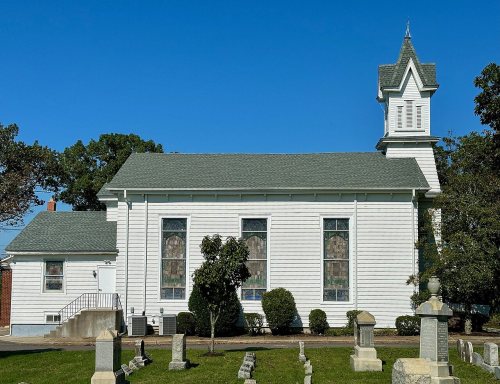
Harrison Township is one of the best-graded places in America: an A+, ranked 16th of 466 in New Jersey. The median household earns $166K, CDC estimates put its residents' health ahead of 92% of the country, and crime is low: it reports less per resident than 86% of U.S. towns. Its lowest mark, a B−, is in cost of living. Harrison Township’s median household income is $166,000, against $113,000 in New Jersey’s towns and $80,000 across U.S. towns. On cost of living, just 13 of New Jersey’s 530 towns do better. Harrison Township has 3 places on the National Register of Historic Places, among them Butler Farm and Richwood Methodist Church.
Butler Farm · National Register of Historic Places
Harrison Township’s story
182 years in pictures
Census counts: 1,984 in 1850, a low of 1,545 in 1890, 13,641 in 2020. The archive holds 6 old photos and papers going back to 1860 and 5 maps from 1890 on.
3 places on the National Register of Historic Places.
Harrison Township carries less natural-hazard risk than nearly all of New Jersey (mostly inland flooding), trades workers with Philadelphia and other neighbors and is healthy by national standards but mid-pack in New Jersey.
Within New Jersey it is healthier than 63% of the 468 graded towns: New Jersey sets a high bar. Its widest gap with New Jersey is no health insurance: 6.3% of those 18–64 have no health insurance, against 11.3% statewide.
18% of adults have been diagnosed with depression in Harrison Township. Harrison Township beats the New Jersey average on 12 of 32 CDC measures and trails it on 1. 13% of adults say their health is fair or poor in Harrison Township.
Its public schools are run by the Clearview Regional High School District. Three of its 5 schools are below, each with why it’s listed. The largest public high school is Clearview Regional High School, with 1,332 students.
FEMA rates its natural-hazard risk lower than 93% of New Jersey towns, with expected losses of about $239 per resident a year; that rating is what its A for hazard risk is built on.
The FEMA risk score in Harrison Township is 15 of 100. Since 1981, 3 flood insurance claims have been paid out in Harrison Township.
Harrison Township has chilly winters and warm summers. July afternoons reach 87°, January nights drop to 26° and about 23 inches of snow falls in a winter.
Harrison Township has about as many jobs (5,638) as working residents, but only 489 people both live and work here. Jobs based here grew from 2,507 in 2013 to 5,638.
Most working residents leave Harrison Township for work: only 8% work in town. 22% of Harrison Township workers work from home. Jobs based in Harrison Township grew to 5,638 in 2023, 3,131 more than in 2013.
8%work in town
Harrison Township
New Jersey towns
U.S. towns
Work from home
22%
16%
11%
Below the poverty line
4.8%
6.1%
9.6%
Average trip to work
27 minutes
30 minutes
25 minutes
Where working residents work
In Harrison Township8%
Philadelphia12%
Washington Township3%
Camden3%
Mantua Township3%
17 mi
median commute distance
5,638
jobs based in Harrison Township
Balanced
jobs vs. working residents
C+
Walkability grade: more walkable than 44% of U.S. towns
Harrison Township is a township in Gloucester County in the U.S. state of New Jersey. As of the 2020 United States census, the township's population was 13,641, an increase of 1,224 (+9.9%) from the 2010 census count of 12,417, which in turn reflected an increase of 3,629 (+41.3%) from the 8,788 counted in the 2000 census. Harrison Township was originally formed as Spicer Township by an act of the New Jersey Legislature on March 13, 1844, from portions of Greenwich Township and Woolwich Township. That name lasted for less than a year, with Harrison Township adopted as of April 1, 1845. The township was named for President William Henry Harrison. Mullica Hill is the historical center of the …
Yes, by almost any measure. Harrison Township grades A+ overall, better than 98% of U.S. towns and #16 of 466 in New Jersey. It grades A for health, A for safety and B+ for schools.
Is Harrison Township, NJ expensive?
Cost of living, which also weighs rents, property taxes and how many households pay 30% or more of their income for housing, grades B−.