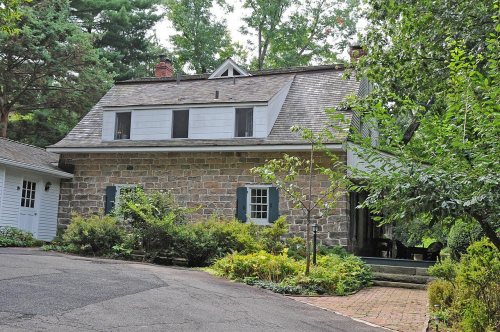
Founding year: the first Closter post office (Blevins & Helbock, CC0).The full story ↓
History grade
What drives Closter’s History grade
On its age, its old homes and the National Register, Closter is more historic than 72% of U.S. towns, #170 of 468 in New Jersey. Its National Register listings hold the grade up; its age pulls it down.
B+
HistoryA character grade: shown, never part of Closter’s overall grade.
New Jersey towns list more on the Register than most of the country (a typical New Jersey town has 3.7 per 10,000 residents, the U.S. 2.4), so Closter’s 18.6 sits above most of its state (75% of New Jersey towns have fewer) while its 16 historic buildings outnumber those of 78% of U.S. towns.
How sure. Graded on any two of the three inputs instead, the letter would range from B− to A. The pre-1940 share is a Census survey estimate (±4.7 points). The founding year is the first post office, not a stated founding date.
Founding year: the first post office (other dates in Quick answers). Homes: Census ACS 2020–24. National Register: National Park Service, May 2026 list; each listing counted once (boundary changes and added documentation belong to their listing), and a historic district counts its contributing buildings. How TownRatings grades history →
What stands out about Closter’s past
Read from the archive, the National Register and the record. The page puts what stands out first.
Every edition of the U.S. Geological Survey’s map of Closter. Tap a year, or press play to watch the town change.
1897Harlem sheet · 1:62,500
U.S. Geological Survey historical topographic maps (public domain), via Esri’s collection of the scans. The red ring marks the center of Closter.
Every building
Closter, building by building, 1902–1923
Fire insurance maps drew every building, what it was made of and what it was used for, so insurers could price the risk of fire. Pick a year, then a sheet.
1902Sheet 1 of 1
Edition
Sheets
BrickWoodStone
Sanborn Map Company, via the Library of Congress. Editions published in 1930 or earlier, which are in the public domain.
The Lenape Native Americans tilled the soil, hunted in the woods, and fished in the rivers and streams before the Dutch arrived in the early 18th Century. The Dutch settlers, though, left an indelible mark on the area. Early records show that after the English takeover of New Netherland, English Governor Philip Carteret in 1669 granted a real estate speculator named Balthaser De Hart a strip of property which extended east and west from the Hudson River to the Tiena Kill, and north and south from today's Cresskill into Palisades, New York. It is within these geographical boundaries that lies what is now known as Closter. The first land grant deed for the area today known as Closter was not written until April 13, 1671. The northern half of this tract of land consisting of 1,030 acres (420 ha) (extending from what is Closter Dock Road northward) was purchased by Barent and Resolvert Nage…
Passages that mention Closter, cut from the printed page as they were published.
History of Bergen county, New Jersey1900 · page 685Read the page →
Read the text
A Lutheran church was built in 1887 in the village of Closter, and dedicated in 1888. The membership is small. The Rev. Gustav H. Scheild is pastor.
Text read by machine from the scan; it may contain errors.
History of Bergen county, New Jersey1900 · page 682Read the page →
Read the text
The first school in Closter City District, No. 15, was a private enterprise begun in 1864 in the basement of the church and became a flourishing institution. The first public school in this district was opened in 1870, in a barn rented for the purpose, while the new building was in process of erection. This new house was of brick, thirty by seventyone feet and two stories high. .Alpine District, No. 16, had no school of importance until 1845.
Text read by machine from the scan; it may contain errors.
Scans and text from the Internet Archive. Books published in 1930 or earlier, which are in the public domain.
Timeline
Closter, 1740 to 1973
Woven from the archive, old maps, post office records, the National Register and the people born here.
The Closter post office opened in 1861, the earliest record of the town by name (U.S. post office records).
How does Closter rank for history?
Closter is more historic than 72% of U.S. towns, #170 of 468 in New Jersey. The History grade combines the town’s founding era, the share of homes built before 1940 and its National Register listings. It’s a character grade, so it isn’t part of the overall grade. How it works.
What is on the National Register in Closter?
10 listings: 10 buildings, among them the Abram Demaree House (listed 1979, the first). 16 historic buildings in all.
How old are the homes in Closter?
23% of Closter’s homes were built before 1940 (Census estimate, ±4.7 points), against a typical 15% for a New Jersey town; the median home was built in 1959.
Founding dates: Wikidata, Wikipedia, the U.S. post office records of Blevins & Helbock (CC0) and the Census. Homes by year built: Census ACS 2020–24. National Register of Historic Places: National Park Service (list of May 22, 2026). Old photos, postcards and papers: Wikimedia Commons, the Library of Congress and other public archives, credited on each item’s page. Maps: U.S. Geological Survey historical topographic maps (via Esri) and Sanborn fire-insurance maps (Library of Congress). History text and census tables: Wikipedia (CC BY-SA 4.0). Places that used to be: USGS Geographic Names Information System (2021).
From Wikimedia Commons (2), Wikidata (4), the National Register of Historic Places (10), Wikipedia, Wikidata and Wikipedia for famous people, U.S. Geological Survey historical maps, U.S. Census counts (via Wikipedia), the US Post Offices dataset (Blevins & Helbock), the USGS Geographic Names Information System, Sanborn fire insurance maps (Library of Congress) and old county and town histories (Internet Archive). Archive images are copied here with their credits and licenses, shown on each photo’s page. Refreshed monthly.


 2012
 2008