In 1878, Swedish immigrants mostly from the Essex, IA area, moved this way after the extension of the railroad from Sioux City. Concord was platted in 1883 soon after the Chicago, St. Paul, Minneapolis and Omaha Railway was extended to that point. The real reasoning behind its name is unknown. Old Timers said that it was named by a wife of a railroad worker who thought the area was quiet and peaceful. It may also be named after the Battle of Concord of the American Revolutionary War. The wife of the president of the railroad may have named it after a bridge in Massachusetts. Early immigrants of Concord were predominately of Lutheran Religious backgrounds as the Catholics settled in nearby Dixon. The sale of Alcohol has never been permitted in city limits. Farming was the main source of income for many nearby residents, but the town has boasted a lumber yard, barber shop, grocery store, …
Passages that mention Concord, cut from the printed page as they were published.
History of Dixon County, Nebraska. Its pioneers, settlement, growth and development, and its present condition--its villages, townships, enterprises and leading citizens, together with portraits and biographical sketches of some of its prominent men, inci1896 · page 264Read the page →
Read the text
Concord village contains about 150 inhabitants and has not been incorporated. The two villages. Concord and Dixon, are only two miles apart. Both are good business points.
Text read by machine from the scan; it may contain errors.
History of Dixon County, Nebraska. Its pioneers, settlement, growth and development, and its present condition--its villages, townships, enterprises and leading citizens, together with portraits and biographical sketches of some of its prominent men, inci1896 · page 35Read the page →
Read the text
As heretofore mentioned, two ambitious towns had been started near the mouth of Lime Creek in the northwestern part of that which afterwards became Dixon County. One of those towns, Concord, had a store, post office, a saw mill and four houses, and the other. North Bend, had a mill and a few houses, and in size and population about equalled Concord. Concord and North Bend were less than a mile apart and much rivalry existed between them. In the summer of
Text read by machine from the scan; it may contain errors.
Scans and text from the Internet Archive. Books published in 1930 or earlier, which are in the public domain.
Timeline
Concord, 1858 to 1967
Woven from the archive, old maps, post office records, the National Register and the people born here.
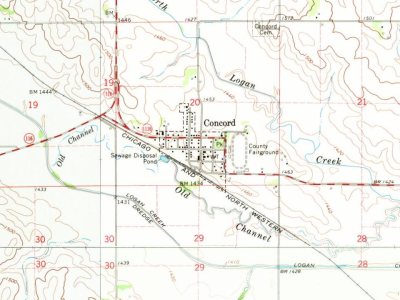
Founding dates: Wikidata, Wikipedia, the U.S. post office records of Blevins & Helbock (CC0) and the Census. Homes by year built: Census ACS 2020–24. National Register of Historic Places: National Park Service (list of May 22, 2026). Old photos, postcards and papers: Wikimedia Commons, the Library of Congress and other public archives, credited on each item’s page. Maps: U.S. Geological Survey historical topographic maps (via Esri) and Sanborn fire-insurance maps (Library of Congress). History text and census tables: Wikipedia (CC BY-SA 4.0). Places that used to be: USGS Geographic Names Information System (2021). How TownRatings grades history →
From Wikimedia Commons (2), Wikipedia, U.S. Geological Survey historical maps, U.S. Census counts (via Wikipedia), the US Post Offices dataset (Blevins & Helbock), the USGS Geographic Names Information System and old county and town histories (Internet Archive). Archive images are copied here with their credits and licenses, shown on each photo’s page. Refreshed monthly.


 2010
 2005

