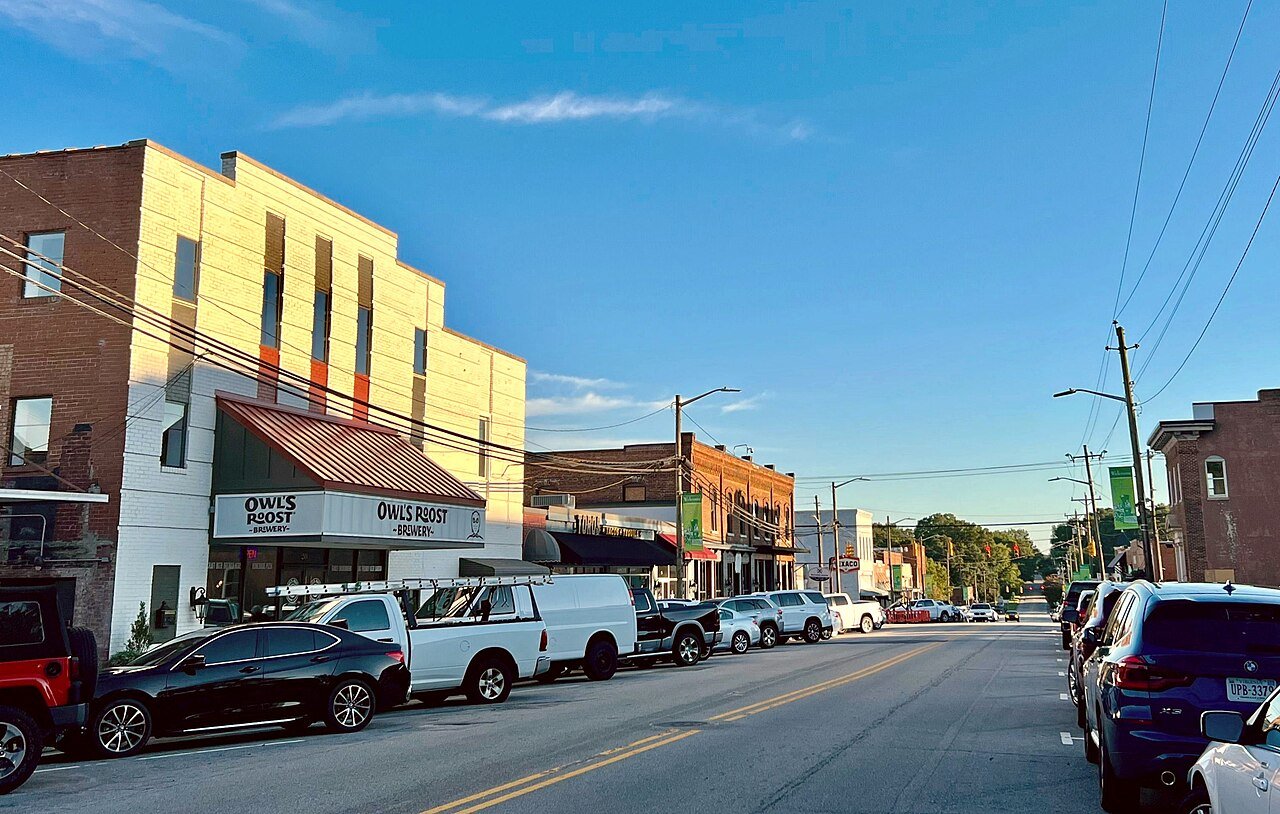
187 years in pictures
Census counts: 160 in 1860, 2,456 in 2020. The archive holds 12 old photos and papers going back to 1906 and 3 maps from 1978 on.
7 places on the National Register of Historic Places.
- 1839Franklinton is settled
Each edition grades its towns against each other only.

Franklinton gives you more for your money than most places: a typical home costs about $352K, 3.5 years of the Raleigh metro’s $100K median household income. It grades C+ overall, 141st among North Carolina's 286 graded towns. The low prices come with trade-offs. The median household income is $59K, and 17% of residents live below the poverty line. On the plus side, natural-hazard risk is low. Franklinton’s average trip to work is 33 minutes, against 24 minutes in North Carolina’s towns and 25 minutes across U.S. towns. On history, just 27 of North Carolina’s 451 towns do better. Franklinton's civic life (library use, community groups, volunteering) trails 91% of U.S. towns.
Where Franklinton beats most towns.
Shemuel Kearney HouseCensus counts: 160 in 1860, 2,456 in 2020. The archive holds 12 old photos and papers going back to 1906 and 3 maps from 1978 on.
7 places on the National Register of Historic Places.
Each subject compared with towns across the country (schools within North Carolina), ordered by how far Franklinton is from typical.
How TownRatings grades towns →
Who provides power, water and the rest in Franklinton, and how to reach them.
EPA SDWIS (Oct 9, 2026) · HIFLD + EIA-861 2025 · Census 2020 ZCTAs · NCES 2024–25 · registration: vote.gov, updated Nov 18, 2024.
Ordered by what stands out in Franklinton.
Franklinton trades lower home prices for longer drives to work, is healthier than towns with similar incomes and has a longer frost-free season than most of the country, though not than most of North Carolina.
Expected storm and flood damage is lower than in 82% of U.S. communities.
FEMA National Risk Index · OpenFEMA
Its public schools are run by the Franklin County Schools. One of its 2 schools is below, with why it’s listed.
| School | Level | Students | Letter |
|---|---|---|---|
| Franklinton ElementaryLargest public elementary schoolGrades PK–5 | Grades PK–5 | 470 | C− |
NCES · EDFacts · graded within NC on state tests and graduation
The average commute for its 1,515 working residents takes 33.4 minutes, against 25.1 across North Carolina. Jobs based here grew from 340 in 2013 to 455.
Most working residents leave Franklinton for work: only 2% work in town. Since 2013, Franklinton has added 115 jobs, to 455 in 2023. The top destinations are Raleigh (24%), Durham (9%) and Wake Forest (5%).
| Franklinton | North Carolina towns | U.S. towns | |
|---|---|---|---|
| Working residents who work in town | 1.5% | 6.8% | 8% |
| Median household income | $59,000 | $69,000 | $80,000 |
Census LEHD 2023 · ACS
The Louisburg weather station, 8 miles away, records that the frost-free season runs about 201 days: longer than most of the country, but shorter than 80% of North Carolina places with climate records.
Franklinton has mild winters and warm summers. Franklinton’s July high is 90°F.
NOAA U.S. Climate Normals, 1991–2020
Franklinton's reported crime rate is above North Carolina's. The property crime rate in Franklinton is 32.8 per 1,000 residents. Most reported incidents are property crimes, mainly thefts.
| Franklinton | North Carolina towns | U.S. towns | |
|---|---|---|---|
| Property crimes per 1,000 (2024) | 32.8 per 1,000 residents | 24 | 11.5 |
| Violent crimes per 1,000 (2024) | 2.9 per 1,000 residents | 3.1 | 1.7 |
FBI crime data, 2024 · crimes reported to police
Against the 8,767 U.S. towns with household incomes like Franklinton’s, it is healthier than 66%, so its C+ isn’t only a matter of income.
Franklinton beats the North Carolina average on 0 of 32 CDC measures and trails it on 7. 36% of adults feel lonely in Franklinton.
| Franklinton | North Carolina towns | U.S. towns | |
|---|---|---|---|
| Feel lonely (CDC PLACES) | 36% | 33% | 33% |
| Sleep under 7 hours (CDC PLACES) | 38% | 34% | 36% |
| Binge drink (CDC PLACES) | 14% | 15% | 16% |
| Obesity (CDC PLACES) | 39% | 36% | 35% |
| What stands out | Franklinton | NC |
|---|---|---|
| More older adults who have lost all their teeth | 20.7% | 13.9% |
| More adults facing housing insecurity | 14.9% | 12.2% |
| More adults facing a utility shut-off | 9.8% | 8.1% |
CDC PLACES 2025 · modeled estimates for adults · CMS · HRSA
Homes are within reach (about $352K for the typical one, A− for cost of living), but half of working residents commute more than 23 miles. 68.8% of renter households pay 30% or more of their income for housing, against 48.9% across North Carolina.
The typical Franklinton home is worth about $352,000, down 0.8% in a year, 6% above the North Carolina typical home. 62% of Franklinton households own their home.
| Franklinton | North Carolina towns | U.S. towns | |
|---|---|---|---|
| Households that own their home | 62% | 67% | 73% |
| Median rent | $963 a month | $1,086 a month | $1,185 a month |
Census ACS, 2020–24 · Zillow Home Value Index · Redfin Data Center
2 within 15 miles of the center of Franklinton
About 6 of every 100 Franklinton residents are enrolled in college, about the same as North Carolina.
2,023 counted in 2010 and 2,456 in 2020; an estimated 2,890 in 2025.
Growth hasn’t slowed: 17.7% since 2020, after 21.4% in the decade before.
U.S. Census 2010 & 2020 counts · Census Bureau estimate, July 1, 2025
7 places in Franklinton on the National Register of Historic Places.
5 notable people were born in Franklinton.


Town in North Carolina, United States
Franklinton is a town in Franklin County, North Carolina, United States. The population was 2,456 at the 2020 census.
From Wikipedia, licensed CC BY-SA 4.0 · facts via Wikidata (CC0)
Short answers, built from the data on this page.
Franklinton grades C+ overall, better than 36% of U.S. towns and #141 of 286 in North Carolina. It grades C+ for health and C+ for schools. Jobs & income is its weak spot, with a C−.
Not for the area. Cost of living, which also weighs rents, property taxes and how many households pay 30% or more of their income for housing, grades A−.
5 notable people were born here, including Soupy Sales and Henry Bibby.