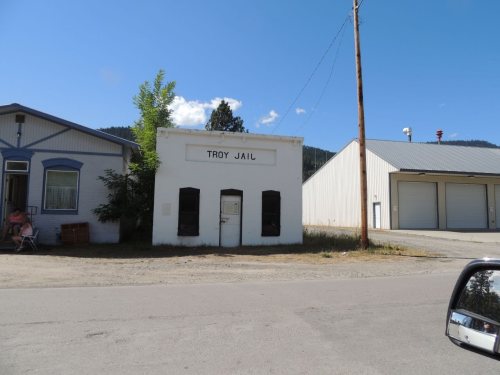
The Troy post office opened in 1893, the earliest record of the town by name. Another post office, Lake City (1891), opened inside today’s city and later closed.
2020 census: 797133 years
Founding year: the first Troy post office (Blevins & Helbock, CC0).The full story ↓
What stands out about Troy’s past
Read from the archive, the National Register and the record. The page puts what stands out first.
Before the westward expansion of the United States, various indigenous peoples lived in the area, with the Kutenai and Bitterroot Salish as the most recent and the Piegan Blackfeet earlier. They lived in base camps and seasonal camps based on the availability of plants and fish: "lower elevations in the winter and ... uplands in the summer and fall," with spring camps near camas prairies, which had edible bulbs. Due to the area's geography and settler fears of the Kutenai, the area remained unsettled until gold was discovered in the 1860s and galena and vermiculite in the 1880s. In 1886, the first miners arrived, prospecting on the Kootenai River at a tent camp first known as "Lake Camp, Lake Creek Camp, and Lake City", and making land claims on Grouse Mountain. In 1892, a William O'Brien surveyed the Lake City claim, renaming it Troy.
Nothing in the archives for these yearsWeddings on Main Street, storms, parades, school pictures, the old store. If it’s in your family album, it belongs here.
Founding dates: Wikidata, Wikipedia, the U.S. post office records of Blevins & Helbock (CC0) and the Census. Homes by year built: Census ACS 2020–24. National Register of Historic Places: National Park Service (list of May 22, 2026). Old photos, postcards and papers: Wikimedia Commons, the Library of Congress and other public archives, credited on each item’s page. Maps: U.S. Geological Survey historical topographic maps (via Esri) and Sanborn fire-insurance maps (Library of Congress). History text and census tables: Wikipedia (CC BY-SA 4.0). Places that used to be: USGS Geographic Names Information System (2021). How TownRatings grades history →
From Wikimedia Commons (5), the National Register of Historic Places (2), Wikipedia, the US Post Offices dataset (Blevins & Helbock) and the USGS Geographic Names Information System. Archive images are copied here with their credits and licenses, shown on each photo’s page. Refreshed monthly.


 2010
 2010
 2007
 2005