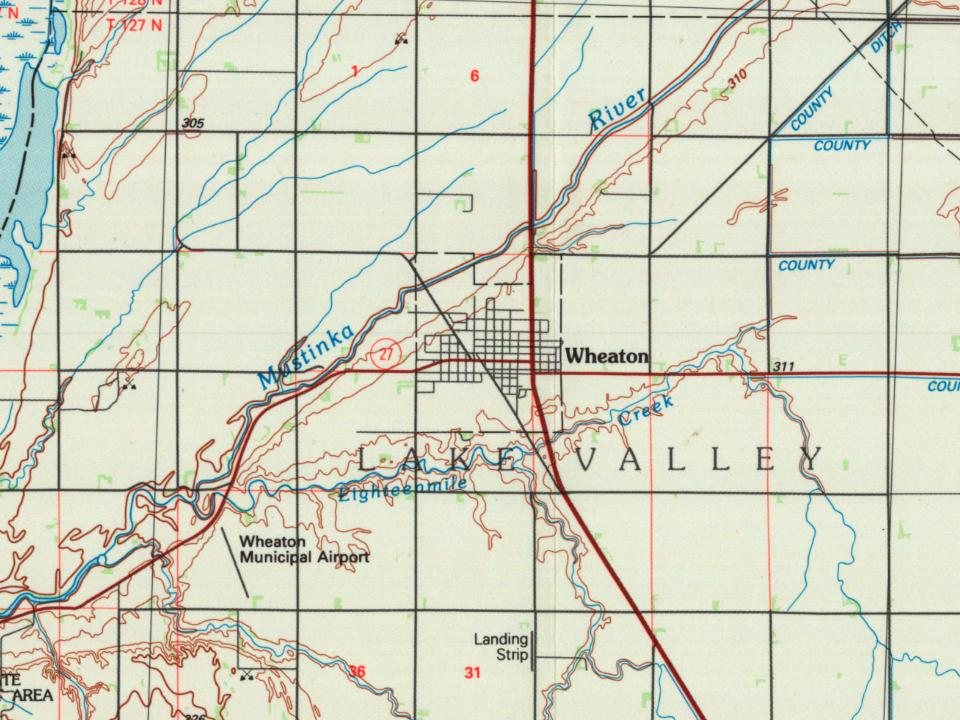
The Wheaton post office opened in 1884, the earliest record of the town by name. Another post office, Lake Valley (1879), opened inside today’s city and later closed.
First census: 883 in 18902020 census: 1,460142 years
How historic is Wheaton?
B
More historic than 61% of U.S. towns, on its age, its old homes and the National Register.
Founding year: the first Wheaton post office (Blevins & Helbock, CC0).The full story ↓
History grade
What drives Wheaton’s History grade
On its age, its old homes and the National Register, Wheaton is more historic than 61% of U.S. towns. Its share of homes from before 1940 holds the grade up; its age pulls it down.
B
HistoryA character grade: shown, never part of Wheaton’s overall grade.
Minnesota towns list about as much on the Register as the country (a typical Minnesota town has 2.1 per 10,000 residents, the U.S. 2.4), so Wheaton’s 7.2 sits above most of its state (70% of Minnesota towns have fewer) while its 1 listings outnumber those of 51% of U.S. towns.
How sure. Graded on any two of the three inputs instead, the letter would range from C+ to B+. The pre-1940 share is a Census survey estimate (±4.3 points). The founding year is the first post office, not a stated founding date.
Founding year: the first post office (other dates in Quick answers). Homes: Census ACS 2020–24. National Register: National Park Service, May 2026 list; each listing counted once (boundary changes and added documentation belong to their listing), and a historic district counts its contributing buildings. How TownRatings grades history →
What stands out about Wheaton’s past
Read from the archive, the National Register and the record. The page puts what stands out first.
A post office called Wheaton has been in operation since 1884. Wheaton was designated county seat in 1886. The city was named for Daniel Thompson Wheaton, a railroad surveyor. One property in the city is listed on the National Register of Historic Places: the Wheaton Depot, built circa 1906.
Lost post offices, old corners, places now gone and burying grounds
Wheaton’s post office has been open since 1884. Another post office, Lake Valley, opened and closed inside today’s town.
Lake Valley
1879–1884
Wheaton
1884–today
18701950today
Hamlets and corners on the map
Bergs Mobile Home ParkSchultz Trailer Park
Gone or out of use
Wheatonlocale
1cemetery inside Wheaton
Wildwood
US Post Offices dataset (Blevins & Helbock, CC0). Places and cemeteries from the USGS Geographic Names Information System (2021).
Questions about Wheaton’s history
What year was Wheaton founded?
The Wheaton post office opened in 1884, the earliest record of the town by name (U.S. post office records).
How does Wheaton rank for history?
Wheaton is more historic than 61% of U.S. towns. The History grade combines the town’s founding era, the share of homes built before 1940 and its National Register listings. It’s a character grade, so it isn’t part of the overall grade. How it works.
What is on the National Register in Wheaton?
One place: the Chicago, Milwaukee, and St. Paul Depot (listed 1985).
How old are the homes in Wheaton?
21% of Wheaton’s homes were built before 1940 (Census estimate, ±4.3 points), against a typical 8.1% for a Minnesota town; the median home was built in 1961.
Founding dates: Wikidata, Wikipedia, the U.S. post office records of Blevins & Helbock (CC0) and the Census. Homes by year built: Census ACS 2020–24. National Register of Historic Places: National Park Service (list of May 22, 2026). Old photos, postcards and papers: Wikimedia Commons, the Library of Congress and other public archives, credited on each item’s page. Maps: U.S. Geological Survey historical topographic maps (via Esri) and Sanborn fire-insurance maps (Library of Congress). History text and census tables: Wikipedia (CC BY-SA 4.0). Places that used to be: USGS Geographic Names Information System (2021).
From Wikimedia Commons (4), Wikidata (1), the National Register of Historic Places (1), Wikipedia, Wikidata and Wikipedia for famous people, U.S. Geological Survey historical maps, U.S. Census counts (via Wikipedia), the US Post Offices dataset (Blevins & Helbock) and the USGS Geographic Names Information System. Archive images are copied here with their credits and licenses, shown on each photo’s page. Refreshed monthly.


 2023
 2013
 2011
 2005