Founding year: the first Preston post office (Blevins & Helbock, CC0).The full story ↓
History grade
What drives Preston’s History grade
On its age, its old homes and the National Register, Preston is more historic than 80% of U.S. towns. Its share of homes from before 1940 holds the grade up; its age pulls it down.
A−
HistoryA character grade: shown, never part of Preston’s overall grade.
Minnesota towns list about as much on the Register as the country (a typical Minnesota town has 2.1 per 10,000 residents, the U.S. 2.4), so Preston’s 29.4 sits above most of its state (90% of Minnesota towns have fewer) while its 4 listings outnumber those of 68% of U.S. towns.
How sure. Graded on any two of the three inputs instead, the letter would range from B to A. The pre-1940 share is a Census survey estimate (±6.1 points). The founding year is the first post office, not a stated founding date.
Founding year: the first post office (other dates in Quick answers). Homes: Census ACS 2020–24. National Register: National Park Service, May 2026 list; each listing counted once (boundary changes and added documentation belong to their listing), and a historic district counts its contributing buildings. How TownRatings grades history →
What stands out about Preston’s past
Read from the archive, the National Register and the record. The page puts what stands out first.
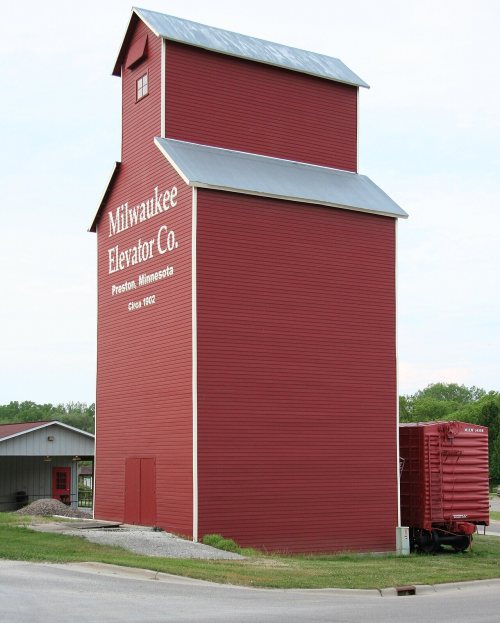
Preston was platted in 1855. The community was named for Luther Preston, a millwright and postmaster. The old Preston grain elevator used to be known as the Milwaukee Elevator Company Grain Elevator. It was built around 1890 for holding grain for shipment by railroad to the Eastern cities of the United States. The elevator was last used in the 1980s. It was built with "cribbed" construction, which has to do with interlocking bins. At the time it was a lot stronger and a lot more expensive to build it this way than to build it in stud construction. Now the Preston Historical Society is trying to restore the structure.
Passages that mention Preston, cut from the printed page as they were published.
History of Fillmore County, Minnesota (Volume 1)1912 · page 168Read the page →
Read the text
long bridge accepted the pressing invitation to move on. The woolen mill also sustained considerable damage. The railroad lost bridges all up and down the river. The new bridge at the west end of the village of Preston went out at about 11 o'clock on Friday, March 8. It moved down the stream under the first bridge and the people made a rush to the next bridge, the iron one, to see how it would receive the shock. When it struck the structure trembled but nobly stood the onslaught, and the enemy himself
Text read by machine from the scan; it may contain errors.
History of Fillmore County, Minnesota (Volume 1)1912 · page 188Read the page →
Read the text
Preston is a busy village in the geographical center of the county, and is honored with the distinction of being the county seat. It was first settled in 1853, platted in 1855 and incorporated in 1871. It is 109 miles from Minneapolis and has communication with the outside world through two railroad branches, one extending to Reno and the other to Isinours. The south branch of the Root river, on which the village is located, furnishes limited water power, which has still greater possibilities.
Text read by machine from the scan; it may contain errors.
Scans and text from the Internet Archive. Books published in 1930 or earlier, which are in the public domain.
Timeline
Preston, 1856 to 1938
Woven from the archive, old maps, post office records, the National Register and the people born here.
Nothing in the archives for these yearsWeddings on Main Street, storms, parades, school pictures, the old store. If it’s in your family album, it belongs here.
The Preston post office opened in 1856, the earliest record of the town by name (U.S. post office records).
How does Preston rank for history?
Preston is more historic than 80% of U.S. towns. The History grade combines the town’s founding era, the share of homes built before 1940 and its National Register listings. It’s a character grade, so it isn’t part of the overall grade. How it works.
What is on the National Register in Preston?
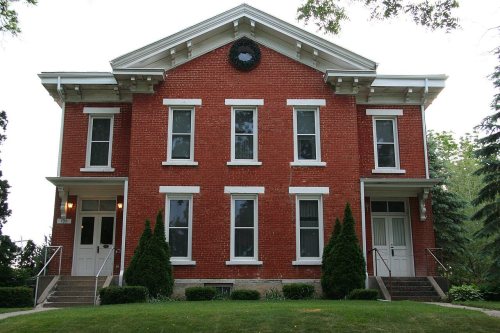
4 listings: 2 buildings, among them the Fillmore County Jail and Carriage House (listed 1982, the first), 1 site, and 1 structure.
How old are the homes in Preston?
33% of Preston’s homes were built before 1940 (Census estimate, ±6.1 points), against a typical 8.1% for a Minnesota town; the median home was built in 1963.
Founding dates: Wikidata, Wikipedia, the U.S. post office records of Blevins & Helbock (CC0) and the Census. Homes by year built: Census ACS 2020–24. National Register of Historic Places: National Park Service (list of May 22, 2026). Old photos, postcards and papers: Wikimedia Commons, the Library of Congress and other public archives, credited on each item’s page. Maps: U.S. Geological Survey historical topographic maps (via Esri) and Sanborn fire-insurance maps (Library of Congress). History text and census tables: Wikipedia (CC BY-SA 4.0). Places that used to be: USGS Geographic Names Information System (2021).
From Wikimedia Commons (4), the Library of Congress (1), Wikidata (1), the National Register of Historic Places (4), Wikipedia, Wikidata and Wikipedia for famous people, the US Post Offices dataset (Blevins & Helbock), the USGS Geographic Names Information System and old county and town histories (Internet Archive). Archive images are copied here with their credits and licenses, shown on each photo’s page. Refreshed monthly.





 2009
 2009
 2006
 2006