The Mound post office opened in 1894, the earliest record of the town by name. Two smaller post offices, Phelps Island (1915) and Island Park (1925), opened inside today’s city and later closed.
First census: 206 in 19302020 census: 9,398132 years
How historic is Mound?
C
More historic than 28% of U.S. towns, on its age, its old homes and the National Register.
Founding year: the first Mound post office (Blevins & Helbock, CC0).The full story ↓
History grade
What drives Mound’s History grade
On its age, its old homes and the National Register, Mound is more historic than 28% of U.S. towns, #179 of 273 in Minnesota. Its share of homes from before 1940 holds the grade up; its National Register listings pull it down.
C
HistoryA character grade: shown, never part of Mound’s overall grade.
Minnesota towns list about as much on the Register as the country (a typical Minnesota town has 2.1 per 10,000 residents, the U.S. 2.4), so Mound’s 0.0 sits below most of its state (23% of Minnesota towns have fewer) while its 0 listings outnumber those of 23% of U.S. towns.
How sure. Graded on any two of the three inputs instead, the letter would range from C− to C. The pre-1940 share (±2.8 points) is firm at this size. The founding year is the first post office, not a stated founding date.
Founding year: the first post office (other dates in Quick answers). Homes: Census ACS 2020–24. National Register: National Park Service, May 2026 list; each listing counted once (boundary changes and added documentation belong to their listing), and a historic district counts its contributing buildings. How TownRatings grades history →
What stands out about Mound’s past
Read from the archive, the National Register and the record. The page puts what stands out first.
According to Melvin Gimmestad's Historical Backgrounds of Mound, Minnesota, "Mound derived its name from the Indian mounds once found within the present day city limits. They were not built by the Dakota Indians, but were made by prehistoric Indians".
The former municipality of Island Park, which contained Phelps Island, merged with Mound in 1960.
Passages that mention Mound, cut from the printed page as they were published.
History of Anoka County and the towns of Champlin and Dayton in Hennepin County, Minnesota1905 · page 164Read the page →
Read the text
The bill passed by both houses embraced, in addition to the territory comprising the present town of Fridley, the town of Mound View, both taken from Ramsey county ; but by skulduggery, presumably by a Ramsey county politician. Mound View was omitted in the enrollment of the bill presented to the Governor (an uncle of mine), who approved it without discovering the emasculation. Of course, a county of so small an area and sparsely populated was unable to maintain an organ-
Text read by machine from the scan; it may contain errors.
History of Hennepin county and the city of Minneapolis, including the Explorers and pioneers of Minnesota1881 · page 261Read the page →
Read the text
north of the village in 1873. Minnetrista postoffice was established in 1861, on section 6, and Norman Shook appointed postmaster. A postoffice was established in 1876 at ;Mound City, and a Mr. Pearl ajipointed postmaster. STORES.
Text read by machine from the scan; it may contain errors.
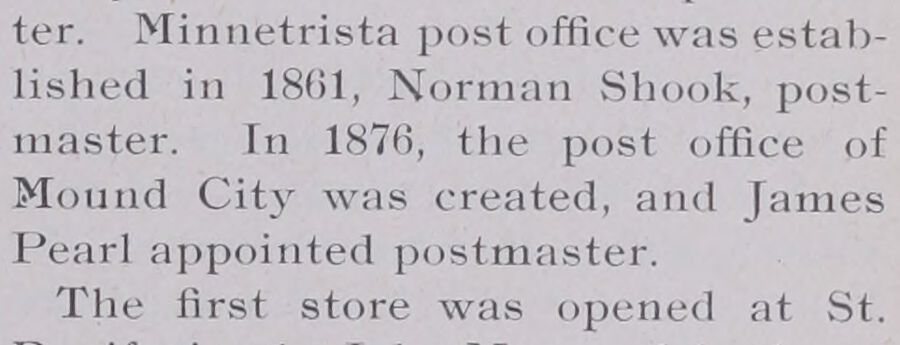
ter. Minnetrista post office was estab¬ lished in 18(51, Norman Shook, post¬ master. In 187(5, the post office of Mound Cit}" was created, and fames Pearl appointed postmaster. The first store was opened at St.
Text read by machine from the scan; it may contain errors.
Scans and text from the Internet Archive. Books published in 1930 or earlier, which are in the public domain.
Timeline
Mound, 1892 to 1999
Woven from the archive, old maps, post office records, the National Register and the people born here.
Nothing in the archives for these yearsWeddings on Main Street, storms, parades, school pictures, the old store. If it’s in your family album, it belongs here.
The Mound post office opened in 1894, the earliest record of the town by name (U.S. post office records).
How does Mound rank for history?
Mound is more historic than 28% of U.S. towns, #179 of 273 in Minnesota. The History grade combines the town’s founding era, the share of homes built before 1940 and its National Register listings. It’s a character grade, so it isn’t part of the overall grade. How it works.
How old are the homes in Mound?
10% of Mound’s homes were built before 1940 (Census estimate, ±2.8 points), against a typical 8.1% for a Minnesota town; the median home was built in 1973.
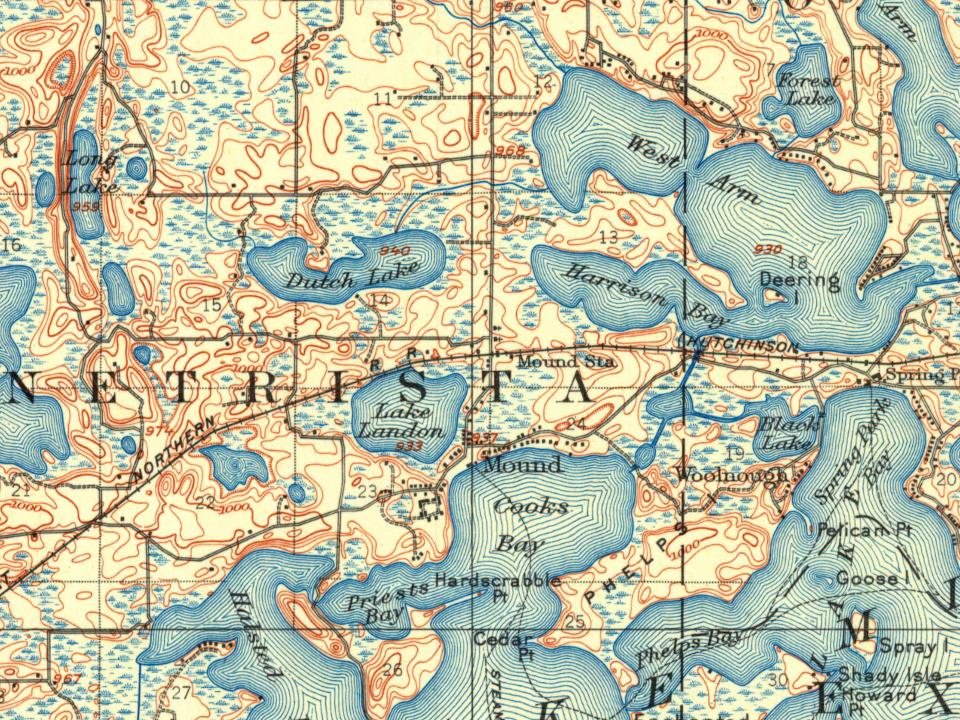
Founding dates: Wikidata, Wikipedia, the U.S. post office records of Blevins & Helbock (CC0) and the Census. Homes by year built: Census ACS 2020–24. National Register of Historic Places: National Park Service (list of May 22, 2026). Old photos, postcards and papers: Wikimedia Commons, the Library of Congress and other public archives, credited on each item’s page. Maps: U.S. Geological Survey historical topographic maps (via Esri) and Sanborn fire-insurance maps (Library of Congress). History text and census tables: Wikipedia (CC BY-SA 4.0). Places that used to be: USGS Geographic Names Information System (2021).
From Wikimedia Commons (6), Wikipedia, Wikidata and Wikipedia for famous people, U.S. Geological Survey historical maps, U.S. Census counts (via Wikipedia), the US Post Offices dataset (Blevins & Helbock), the USGS Geographic Names Information System and old county and town histories (Internet Archive). Archive images are copied here with their credits and licenses, shown on each photo’s page. Refreshed monthly.







 1969
 1971
 1972
 1973

