4 places in town are on the National Register, among them a historic district with 32 buildings. Below: 6 old photos and papers from 1906 on and old-book passages.
Founding year: the first Excelsior post office (Blevins & Helbock, CC0). Wikidata: 1877.The full story ↓
History grade
What drives Excelsior’s History grade
On its age, its old homes and the National Register, Excelsior is more historic than 76% of U.S. towns. Its National Register listings hold the grade up; its age pulls it down.
A−
HistoryA character grade: shown, never part of Excelsior’s overall grade.
Minnesota towns list about as much on the Register as the country (a typical Minnesota town has 2.1 per 10,000 residents, the U.S. 2.4), so Excelsior’s 132 sits above most of its state (98% of Minnesota towns have fewer) while its 34 historic buildings outnumber those of 82% of U.S. towns.
How sure. Graded on any two of the three inputs instead, the letter would range from B− to A. The pre-1940 share is a Census survey estimate (±9.3 points). The founding year is the first post office, not a stated founding date; Wikidata’s 1877 falls in the same era, so the grade doesn’t depend on which one is used.
Founding year: the first post office (other dates in Quick answers). Homes: Census ACS 2020–24. National Register: National Park Service, May 2026 list; each listing counted once (boundary changes and added documentation belong to their listing), and a historic district counts its contributing buildings. How TownRatings grades history →
What stands out about Excelsior’s past
Read from the archive, the National Register and the record. The page puts what stands out first.
The first Euro-Americans known to have visited Lake Minnetonka were two teenage boys, Joe Brown and Will Snelling, who canoed up Minnehaha Creek from Fort Saint Anthony in 1822.
Minnesota's territorial governor Alexander Ramsey officially named Lake Minnetonka in 1852. He had been informed that the Dakota called the lake Mní iá Tháŋka ("the-water-they-speak-of-is-large"). The next year, a group of settlers from upstate New York established Excelsior, the lake's first white settlement. The former Excelsior Township was named after the hamlet.
During the late 19th century, the Excelsior and Lake Minnetonka area was home to several popular summer lake resorts.
The village of Excelsior, as previ¬ ously stated, was the site of the first settlement of the town, and has since remained the market and business point for the surrounding country. It was platted in 1853, and remained under the town government until 1877, when it was incorporated by
Text read by machine from the scan; it may contain errors.
History of Hennepin county and the city of Minneapolis, including the Explorers and pioneers of Minnesota1881 · page 248Read the page →
Read the text
town. The town of Excelsior owes its name ami settlement to a colony, under the title of tlie "Excelsior Pioneer Association. "" They were headed by George M. Bertram and arrived in the summer of 1853. The following "Preamble" to the constitution adojited November 12tli. 18.52.
Text read by machine from the scan; it may contain errors.
History of Hennepin county and the city of Minneapolis, including the Explorers and pioneers of Minnesota1881 · page 247Read the page →
Read the text
Excelsior was among the first townships in the county, to attract the attention of the prospector in search of a home. The first visit of whites to Lake Minnetonka. was in 1822. when a party from Fort Snelling explored its shores. The first settler in Excelsior was Stephen Hull, who located his claim in February. 18.53, selecting for his home the site now known as the Lake Park
Text read by machine from the scan; it may contain errors.
Scans and text from the Internet Archive. Books published in 1930 or earlier, which are in the public domain.
Timeline
Excelsior, 1854 to 1993
Woven from the archive, old maps, post office records, the National Register and the people born here.
Nothing in the archives for these yearsWeddings on Main Street, storms, parades, school pictures, the old store. If it’s in your family album, it belongs here.
The Excelsior post office opened in 1854, the earliest record of the town by name (U.S. post office records). Wikidata gives 1877.
How does Excelsior rank for history?
Excelsior is more historic than 76% of U.S. towns. The History grade combines the town’s founding era, the share of homes built before 1940 and its National Register listings. It’s a character grade, so it isn’t part of the overall grade. How it works.
What is on the National Register in Excelsior?
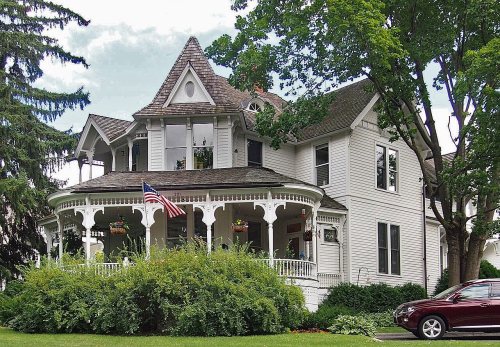
4 listings: 2 buildings, among them the Allemarinda and James Wyer House (listed 1977, the first), 1 historic district, the Excelsior Commercial Historic District, with 32 contributing buildings, and 1 structure. 34 historic buildings in all.
How old are the homes in Excelsior?
20% of Excelsior’s homes were built before 1940 (Census estimate, ±9.3 points), against a typical 8.1% for a Minnesota town; the median home was built in 1970.
Founding dates: Wikidata, Wikipedia, the U.S. post office records of Blevins & Helbock (CC0) and the Census. Homes by year built: Census ACS 2020–24. National Register of Historic Places: National Park Service (list of May 22, 2026). Old photos, postcards and papers: Wikimedia Commons, the Library of Congress and other public archives, credited on each item’s page. Maps: U.S. Geological Survey historical topographic maps (via Esri) and Sanborn fire-insurance maps (Library of Congress). History text and census tables: Wikipedia (CC BY-SA 4.0). Places that used to be: USGS Geographic Names Information System (2021).
From Wikimedia Commons (6), the National Register of Historic Places (4), Wikipedia, Wikidata and Wikipedia for famous people, the US Post Offices dataset (Blevins & Helbock), the USGS Geographic Names Information System and old county and town histories (Internet Archive). Archive images are copied here with their credits and licenses, shown on each photo’s page. Refreshed monthly.




 1906
 1907
 1907