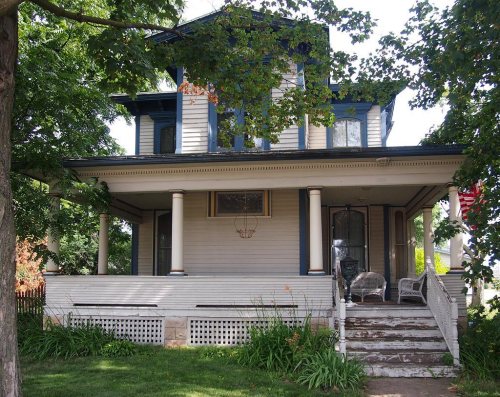
Austin dates to 1853, and 20% of its homes were built before 1940
More historic than 59% of U.S. towns · #80 of 273 in Minnesota. What drives it
Its Register listings are the Cook-Hormel House, the Arthur W. Wright House and the Paramount Theater. Its Register listings are the Cook-Hormel House, the Arthur W. Wright House and the Paramount Theater. Below: 12 old photos and papers, maps from 1884 on, and the census since 1860.
On its age, its old homes and the National Register, Austin is more historic than 59% of U.S. towns, #80 of 273 in Minnesota. Its share of homes from before 1940 holds the grade up; its age pulls it down.
B
HistoryA character grade: shown, never part of Austin’s overall grade.
Minnesota towns list about as much on the Register as the country (a typical Minnesota town has 2.1 per 10,000 residents, the U.S. 2.4), so Austin’s 1.1 sits near the middle of its state (51% of Minnesota towns have fewer) while its 3 listings outnumber those of 65% of U.S. towns.
How sure. Graded on any two of the three inputs instead, the letter would range from C+ to B+. The pre-1940 share (±2.8 points) is firm at this size. Two sources give 1853.
Founding year: Wikidata (other dates in Quick answers). Homes: Census ACS 2020–24. National Register: National Park Service, May 2026 list; each listing counted once (boundary changes and added documentation belong to their listing), and a historic district counts its contributing buildings. How TownRatings grades history →
What stands out about Austin’s past
Read from the archive, the National Register and the record. The page puts what stands out first.
Fire insurance maps drew every building, what it was made of and what it was used for, so insurers could price the risk of fire. Pick a year, then a sheet.
1884Sheet 1 of 1
Edition
Sheets
BrickWoodStone
Sanborn Map Company, via the Library of Congress. Editions published in 1930 or earlier, which are in the public domain.
Places that used to be
Lost post offices, old corners, places now gone and burying grounds
Austin’s post office has been open since 1855. Another post office, Ramsey, opened and closed inside today’s town.
Austin
1855–today
Ramsey
1874–1875
18501940today
Hamlets and corners on the map
Austin AcresAustin Mobile Home ParkCountryside Mobile Home ParkRamsey
Gone or out of use
Ramsey Post Officepost office
2cemeteries and burying grounds inside Austin
CalvaryOakwood
US Post Offices dataset (Blevins & Helbock, CC0). Places and cemeteries from the USGS Geographic Names Information System (2021).
By decade
Austin, decade by decade
6 decades in the archive, from the 1890s to the 1940s. Scroll each row; tap a photo for its story.
Nothing in the archives for these yearsWeddings on Main Street, storms, parades, school pictures, the old store. If it’s in your family album, it belongs here.
Fertile land, trapping, and ease of access brought first trappers and then the early pioneers to this region. The rich gameland attracted Austin Nichols, a trapper who built the first log cabin in 1853. At that time there were "about twenty families in the area." In 1855, more settlers began to arrive by wagon train from New England, upstate New York, and northern Pennsylvania. By 1856 enough people were present to organize Mower County. In 1856 the settlement adopted the name "Austin", in honor of its first settler. That year the first hotel opened to travelers and the first physician, Dr. Ormanzo Allen, moved to town. The first newspaper, the Mower County Mirror, was started in 1858.
Passages that mention Austin, cut from the printed page as they were published.
The history of Mower County, Minnesota1911 · page 155Read the page →
Read the text
FIRST SETTLEMENT The first settler on the present site of the city of Austin was Austin Nichols, who located here in 1853. He sold his claim in 1854 to Chauncey Leverich.
Text read by machine from the scan; it may contain errors.
The history of Mower County, Minnesota1911 · page 144Read the page →
Read the text
Tlie folloAving i'l'oiu tlic pen of S. D. ^lead, Avhile difl:'ering from generally accepted historical accounts, is nevertheless interesting as coming in evident sincerity from one Avho claimed to have visited the present site of Austin in 1853. The "Austin Nickles" spoken of therein is evidently the Austin Nichols Avho Avas the first settler on the present townsite of Austin.
Text read by machine from the scan; it may contain errors.
Scans and text from the Internet Archive. Books published in 1930 or earlier, which are in the public domain.
Timeline
Austin, 1853 to 1984
Woven from the archive, old maps, post office records, the National Register and the people born here.
In 1853, according to Wikidata. Austin’s post office opened in 1855, and the census of 1860 counted 200 people here.
How does Austin rank for history?
Austin is more historic than 59% of U.S. towns, #80 of 273 in Minnesota. The History grade combines the town’s founding era, the share of homes built before 1940 and its National Register listings. It’s a character grade, so it isn’t part of the overall grade. How it works.
What is on the National Register in Austin?
Three places: the Cook-Hormel House (listed 1982), the Arthur W. Wright House (1986) and the Paramount Theater (1986).
How old are the homes in Austin?
20% of Austin’s homes were built before 1940 (Census estimate, ±2.8 points), against a typical 8.1% for a Minnesota town; the median home was built in 1957.
Founding dates: Wikidata, Wikipedia, the U.S. post office records of Blevins & Helbock (CC0) and the Census. Homes by year built: Census ACS 2020–24. National Register of Historic Places: National Park Service (list of May 22, 2026). Old photos, postcards and papers: Wikimedia Commons, the Library of Congress and other public archives, credited on each item’s page. Maps: U.S. Geological Survey historical topographic maps (via Esri) and Sanborn fire-insurance maps (Library of Congress). History text and census tables: Wikipedia (CC BY-SA 4.0). Places that used to be: USGS Geographic Names Information System (2021).
From Wikimedia Commons (5), the Library of Congress (7), the National Register of Historic Places (3), Wikipedia, Wikidata and Wikipedia for famous people, U.S. Geological Survey historical maps, U.S. Census counts (via Wikipedia), the US Post Offices dataset (Blevins & Helbock), the USGS Geographic Names Information System, Sanborn fire insurance maps (Library of Congress) and old county and town histories (Internet Archive). Archive images are copied here with their credits and licenses, shown on each photo’s page. Refreshed monthly.


 1890
 1902
 c. 1907
 1911
 1920
 1936
 1941
 1941
 1941
 1941
 1941
 1941