Founding year: the first Quincy post office (Blevins & Helbock, CC0).The full story ↓
History grade
What drives Quincy’s History grade
On its age, its old homes and the National Register, Quincy is more historic than 75% of U.S. towns. Its share of homes from before 1940 holds the grade up; its National Register listings pull it down.
A−
HistoryA character grade: shown, never part of Quincy’s overall grade.
Few Michigan towns list much on the Register (a typical Michigan town has 0.0 per 10,000 residents, the U.S. 2.4), so Quincy’s 0.0 sits below most of its state (32% of Michigan towns have fewer) while its 0 listings outnumber those of 23% of U.S. towns.
How sure. Graded on any two of the three inputs instead, the letter would range from B− to A. The pre-1940 share is a Census survey estimate (±5.9 points). The founding year is the first post office, not a stated founding date.
Founding year: the first post office (other dates in Quick answers). Homes: Census ACS 2020–24. National Register: National Park Service, May 2026 list; each listing counted once (boundary changes and added documentation belong to their listing), and a historic district counts its contributing buildings. How TownRatings grades history →
What stands out about Quincy’s past
Read from the archive, the National Register and the record. The page puts what stands out first.
Fire insurance maps drew every building, what it was made of and what it was used for, so insurers could price the risk of fire. Pick a year, then a sheet.
1884Sheet 1 of 1
Edition
Sheets
BrickWoodStone
Sanborn Map Company, via the Library of Congress. Editions published in 1930 or earlier, which are in the public domain.
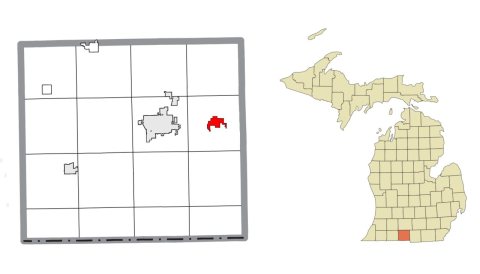
The area was first settled by Horace Wilson, who first purchased land in 1830. He purchased 360 acres (150 ha) of land from the government. John Cornish became the first permanent resident when he built his house here in 1833. The area would be set aside from Coldwater Township and organized as Quincy Township in 1836. The township and community were named Quincy on the suggestion from Dr. Hiram Allen, who recently moved to the area from Quincy, Massachusetts. A post office named Quincy began operating on December 16, 1836. The Lake Shore and Michigan Southern Railway built a depot in Quincy, and the community incorporated as a village in 1858.
Passages that mention Quincy, cut from the printed page as they were published.
History of Branch county, Michigan, with illustrations and biographical sketches of some of its prominent men and pioneers1879 · page 194Read the page →
Read the text
tions he has been engaged in, and in the energy and perseverance with which he carries through to success whatever he undertakes. His whole life has been characterized by determination and push. The village of Quincy owes much to his energy and foresight, for soon after the construction of the Michigan Southern Railroad, the question of whether a railroad station would be located at Quincy or at a point three miles east depended upon the ability of the people to
Text read by machine from the scan; it may contain errors.
History of Branch county, Michigan, with illustrations and biographical sketches of some of its prominent men and pioneers1879 · page 189Read the page →
Read the text
In 1839 he sold out his original purchase, and bought one hundred acres in the township of Quincy, which is now embraced in the corporate limits of the village of Quincy, where he has ever since resided. His occupation throughout his long and useful life has always been that of a farmer, and his plain and unassuming manners and upright dealings with all men, large-hearted generosity, and kindness of disposition have won for him a most enviable and conspicuous
Text read by machine from the scan; it may contain errors.
Scans and text from the Internet Archive. Books published in 1930 or earlier, which are in the public domain.
Timeline
Quincy, 1843 to 1960
Woven from the archive, old maps, post office records, the National Register and the people born here.
The Quincy post office opened in 1836, the earliest record of the town by name (U.S. post office records).
How does Quincy rank for history?
Quincy is more historic than 75% of U.S. towns. The History grade combines the town’s founding era, the share of homes built before 1940 and its National Register listings. It’s a character grade, so it isn’t part of the overall grade. How it works.
How old are the homes in Quincy?
36% of Quincy’s homes were built before 1940 (Census estimate, ±5.9 points), against a typical 12% for a Michigan town; the median home was built in 1952.
Founding dates: Wikidata, Wikipedia, the U.S. post office records of Blevins & Helbock (CC0) and the Census. Homes by year built: Census ACS 2020–24. National Register of Historic Places: National Park Service (list of May 22, 2026). Old photos, postcards and papers: Wikimedia Commons, the Library of Congress and other public archives, credited on each item’s page. Maps: U.S. Geological Survey historical topographic maps (via Esri) and Sanborn fire-insurance maps (Library of Congress). History text and census tables: Wikipedia (CC BY-SA 4.0). Places that used to be: USGS Geographic Names Information System (2021).
From Wikimedia Commons (19), Wikipedia, Wikidata and Wikipedia for famous people, U.S. Geological Survey historical maps, U.S. Census counts (via Wikipedia), Sanborn fire insurance maps (Library of Congress) and old county and town histories (Internet Archive). Archive images are copied here with their credits and licenses, shown on each photo’s page. Refreshed monthly.


 2023
 2023
 2019
 2019
 2019
 2019
 2019
 2019
 2019
 2019
 2019
 2019
 2019
 2019
 2019
 2019
 2019
 2018
 2005


