Founding year: Wikidata. First post office: 1856.The full story ↓
History grade
What drives Fremont’s History grade
On its age, its old homes and the National Register, Fremont is more historic than 56% of U.S. towns, #315 of 701 in Michigan. Its share of homes from before 1940 holds the grade up; its age pulls it down.
B
HistoryA character grade: shown, never part of Fremont’s overall grade.
Few Michigan towns list much on the Register (a typical Michigan town has 0.0 per 10,000 residents, the U.S. 2.4), so Fremont’s 2.2 sits above most of its state (69% of Michigan towns have fewer) while its 1 listings outnumber those of 51% of U.S. towns.
How sure. Graded on any two of the three inputs instead, the letter would range from C+ to B+. The pre-1940 share is a Census survey estimate (±6.2 points). Two sources give 1855.
Founding year: Wikidata (other dates in Quick answers). Homes: Census ACS 2020–24. National Register: National Park Service, May 2026 list; each listing counted once (boundary changes and added documentation belong to their listing), and a historic district counts its contributing buildings. How TownRatings grades history →
What stands out about Fremont’s past
Read from the archive, the National Register and the record. The page puts what stands out first.
Lost post offices, old corners, places now gone and burying grounds
Fremont’s post office has been open since 1882. Two other post offices opened and closed inside today’s town.
Weaversville
1856–1862
Fremont Centre
1862–1882
Fremont
1882–today
18501940today
Hamlets and corners on the map
Country View Estates Mobile Home ParkHill's Mobile Home ParkMeadowview Village Mobile Home Park
Gone or out of use
Fremont Stationlocale
1cemetery inside Fremont
Maple Grove
US Post Offices dataset (Blevins & Helbock, CC0). Places and cemeteries from the USGS Geographic Names Information System (2021).
Every building
Fremont, building by building, 1894–1921
Fire insurance maps drew every building, what it was made of and what it was used for, so insurers could price the risk of fire. Pick a year, then a sheet.
The first inhabitants of the Fremont area were Native Americans. A group of settlers led by Daniel Weaver first settled the area in 1855, with the Weaver homestead serving as the first post office and public school. In November 1855, Fremont Township was established and named in honor of John C. Frémont, western explorer and Republican Party candidate for United States President. Weaver and his fellow settlers cleared the dense timber in order to farm. Early in the 1870s, Dutch immigrant families came from Holland and Muskegon, Michigan; and Fremont continues to recognize its early Dutch heritage in local festivals and pageants.
Passages that mention Fremont, cut from the printed page as they were published.
Portrait and biographical album of Newaygo County, Michigan1884 · page 566Read the page →
Read the text
Rather more than half of the village of Fremont is situated in Sheridan Township, on section 2. The Chicago & West Michigan railroad crosses sections 2, 3, 4, 9, 8 and 7.
Text read by machine from the scan; it may contain errors.
Scans and text from the Internet Archive. Books published in 1930 or earlier, which are in the public domain.
Timeline
Fremont, 1855 to 1982
Woven from the archive, old maps, post office records, the National Register and the people born here.
In 1855, according to Wikidata. Fremont’s post office opened in 1856, and the census of 1880 counted 902 people here.
How does Fremont rank for history?
Fremont is more historic than 56% of U.S. towns, #315 of 701 in Michigan. The History grade combines the town’s founding era, the share of homes built before 1940 and its National Register listings. It’s a character grade, so it isn’t part of the overall grade. How it works.
What is on the National Register in Fremont?
One place: the Fremont High School (listed 2013).
How old are the homes in Fremont?
17% of Fremont’s homes were built before 1940 (Census estimate, ±6.2 points), against a typical 12% for a Michigan town; the median home was built in 1960.
Founding dates: Wikidata, Wikipedia, the U.S. post office records of Blevins & Helbock (CC0) and the Census. Homes by year built: Census ACS 2020–24. National Register of Historic Places: National Park Service (list of May 22, 2026). Old photos, postcards and papers: Wikimedia Commons, the Library of Congress and other public archives, credited on each item’s page. Maps: U.S. Geological Survey historical topographic maps (via Esri) and Sanborn fire-insurance maps (Library of Congress). History text and census tables: Wikipedia (CC BY-SA 4.0). Places that used to be: USGS Geographic Names Information System (2021).
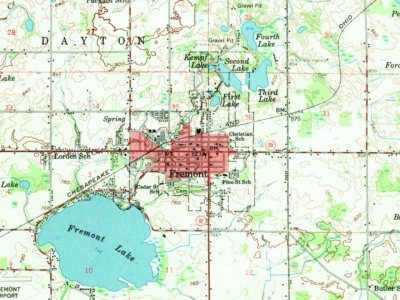
From Wikimedia Commons (12), the National Register of Historic Places (1), Wikipedia, Wikidata and Wikipedia for famous people, U.S. Geological Survey historical maps, U.S. Census counts (via Wikipedia), the US Post Offices dataset (Blevins & Helbock), the USGS Geographic Names Information System, Sanborn fire insurance maps (Library of Congress) and old county and town histories (Internet Archive). Archive images are copied here with their credits and licenses, shown on each photo’s page. Refreshed monthly.



 2018
 2017
 2017
 2015
 2014
 2014
 2013
 2011
 2010
 2010
 2009
 2003


