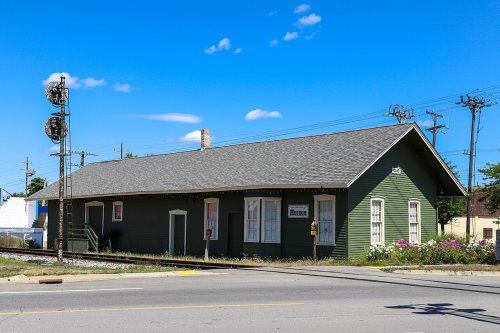
Its Register listings are the Clio Depot and the Mauk & Hammer/Houghton Elevator. Below: 2 old photos and papers, maps from 1902 on, and the census since 1880.
Founding year: Wikidata. First post office: 1866.The full story ↓
History grade
What drives Clio’s History grade
On its age, its old homes and the National Register, Clio is more historic than 86% of U.S. towns. All 3 inputs are above most U.S. towns; its National Register listings ranks highest and its share of homes from before 1940 lowest.
A
HistoryA character grade: shown, never part of Clio’s overall grade.
Few Michigan towns list much on the Register (a typical Michigan town has 0.0 per 10,000 residents, the U.S. 2.4), so Clio’s 27.5 sits above most of its state (88% of Michigan towns have fewer) while its 6 historic buildings outnumber those of 72% of U.S. towns.
NoteThe founding year comes from Wikidata alone; no second source gives 1837.
How sure. Graded on any two of the three inputs instead, the letter would still be A−. The pre-1940 share is a Census survey estimate (±8.7 points).
Founding year: Wikidata (other dates in Quick answers). Homes: Census ACS 2020–24. National Register: National Park Service, May 2026 list; each listing counted once (boundary changes and added documentation belong to their listing), and a historic district counts its contributing buildings. How TownRatings grades history →
What stands out about Clio’s past
Read from the archive, the National Register and the record. The page puts what stands out first.
It was originally named Varna after one of the city's first settlers. Pere Marquette Railroad came through and put a station there in 1861. Its name was changed in 1866 to Clio, the muse of history.
National Hugging Day was celebrated for the first time globally in 1986 in Clio, Michigan.
On July 23, 2007, Governor Jennifer Granholm announced Clio as a community chosen by the Michigan State Housing Development Authority (MSHDA), to take part in the Blueprints for Downtowns program. Clio would receive a comprehensive, market-driven strategy toward developing an
action-oriented downtown that would result in economic growth, job creation
Passages that mention Clio, cut from the printed page as they were published.
History of Genesee county Michigan1916 · page 589Read the page →
Read the text
Thomas Olitt" came to America and to Michigan very young. He found employment at railroading and later bought a farm and engaged in the brickand tile-manufacturihg business in Milford, Michigan, in 1873. He moved to Clio, Genesee county, in 1890 and established the Clio brick plant.
Text read by machine from the scan; it may contain errors.
History of Genesee county Michigan1916 · page 634Read the page →
Read the text
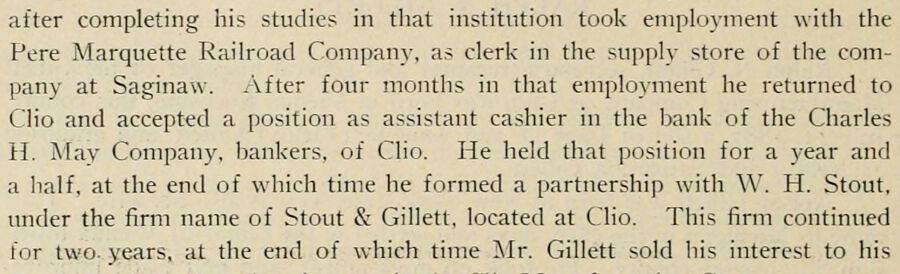
after completing his studies in that institution took employment with the Pere Marquette Railroad Company, as clerk in the supply store of the company at Saginaw. After four months in that employment he returned to Clio and accepted a position as assistant cashier in the bank of the Charles H. May Company, !)ankers, of Clio. He held that position for a year and a lialf, at the end of which time he formed a partnership with W. H. Stout, under the firm name of Stout & Gillett, located at Clio. This firm continued for twoyears, at the end of which time Mr. Gillett sold his interest to his
Text read by machine from the scan; it may contain errors.
Scans and text from the Internet Archive. Books published in 1930 or earlier, which are in the public domain.
By decade
Clio, decade by decade
2 decades in the archive, from the 1890s to the 1980s. Scroll each row; tap a photo for its story.
Nothing in the archives for these yearsWeddings on Main Street, storms, parades, school pictures, the old store. If it’s in your family album, it belongs here.
Nothing in the archives for these yearsWeddings on Main Street, storms, parades, school pictures, the old store. If it’s in your family album, it belongs here.
Fire insurance maps drew every building, what it was made of and what it was used for, so insurers could price the risk of fire. Pick a year, then a sheet.
1902Sheet 1 of 1
Edition
Sheets
BrickWoodStone
Sanborn Map Company, via the Library of Congress. Editions published in 1930 or earlier, which are in the public domain.
Then & now
Stand where they stood
No then-and-now pairs yet. Take a photo from the same spot as an old one and they appear here side by side.
Retake this viewMauk and Hammer-Houghton Elevator, 1982
Find the spot, match the angle, and add your photo. It becomes the first then-and-now pair on Clio’s page.
In 1837, according to Wikidata. Clio’s post office opened in 1866, and the census of 1880 counted 489 people here.
How does Clio rank for history?
Clio is more historic than 86% of U.S. towns. The History grade combines the town’s founding era, the share of homes built before 1940 and its National Register listings. It’s a character grade, so it isn’t part of the overall grade. How it works.
What is on the National Register in Clio?
Two places: the Clio Depot (listed 1983) and the Mauk & Hammer/Houghton Elevator (1982).
How old are the homes in Clio?
18% of Clio’s homes were built before 1940 (Census estimate, ±8.7 points), against a typical 12% for a Michigan town; the median home was built in 1972.
Founding dates: Wikidata, Wikipedia, the U.S. post office records of Blevins & Helbock (CC0) and the Census. Homes by year built: Census ACS 2020–24. National Register of Historic Places: National Park Service (list of May 22, 2026). Old photos, postcards and papers: Wikimedia Commons, the Library of Congress and other public archives, credited on each item’s page. Maps: U.S. Geological Survey historical topographic maps (via Esri) and Sanborn fire-insurance maps (Library of Congress). History text and census tables: Wikipedia (CC BY-SA 4.0). Places that used to be: USGS Geographic Names Information System (2021).
From Wikimedia Commons (3), Wikidata (2), the National Register of Historic Places (2), Wikipedia, Wikidata and Wikipedia for famous people, U.S. Geological Survey historical maps, U.S. Census counts (via Wikipedia), the US Post Offices dataset (Blevins & Helbock), the USGS Geographic Names Information System, Sanborn fire insurance maps (Library of Congress) and old county and town histories (Internet Archive). Archive images are copied here with their credits and licenses, shown on each photo’s page. Refreshed monthly.





 2019
