Frankfort’s post office opened in 1830, and 40% of its homes were built before 1940
More historic than 98% of U.S. towns · #27 of 593 in Indiana. What drives it
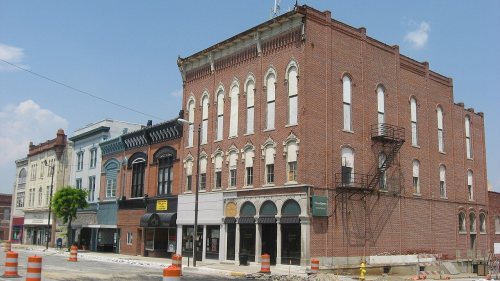
7 places in town are on the National Register, among them four historic districts with 645 buildings between them. Below: 3 old photos and papers, maps from 1887 on, and the census since 1850.
The Frankfort post office opened in 1830, the earliest record of the town by name. Another post office, Jefferson (1830), opened inside today’s city and later closed.
First census: 582 in 18502020 census: 16,715196 years
How historic is Frankfort?
A+
More historic than 98% of U.S. towns, on its age, its old homes and the National Register.
Founding year: the first Frankfort post office (Blevins & Helbock, CC0).The full story ↓
History grade
What drives Frankfort’s History grade
On its age, its old homes and the National Register, Frankfort is more historic than 98% of U.S. towns, #27 of 593 in Indiana. All 3 inputs are above most U.S. towns; its National Register listings ranks highest and its age lowest.
A+
HistoryA character grade: shown, never part of Frankfort’s overall grade.
Indiana towns list more on the Register than most of the country (a typical Indiana town has 7.9 per 10,000 residents, the U.S. 2.4), so Frankfort’s 408 sits above most of its state (94% of Indiana towns have fewer) while its 649 historic buildings outnumber those of 98% of U.S. towns.
How sure. Graded on any two of the three inputs instead, the letter would range from A to A+. The pre-1940 share is a Census survey estimate (±4.7 points). The founding year is the first post office, not a stated founding date.
Founding year: the first post office (other dates in Quick answers). Homes: Census ACS 2020–24. National Register: National Park Service, May 2026 list; each listing counted once (boundary changes and added documentation belong to their listing), and a historic district counts its contributing buildings. How TownRatings grades history →
What stands out about Frankfort’s past
Read from the archive, the National Register and the record. The page puts what stands out first.
Brothers John, William and Nicholas Pence, previously of Warren County, Ohio, settled on the land on which Frankfort now stands in 1829, having entered it from the government in 1827 and 1828. In 1830, the brothers donated 60 acres (240,000 m2) of the land to the county commissioners, a donation which led to the establishment of the county seat at that site rather than in Jefferson, a community which had also been vying for the honor. The new town was named Frankfort at the brothers' request and honors their German great-grandparents' home of Frankfurt am Main.
accomplished, and we meet to celebrate the incorporation of the town of Winterport. In my efforts the past winter, I labored to promote, as I believed, the interest of Frankfort as well as of Winterport. But perhaps the citizens of Frankfort are not prepared to appreciate my labors ag you do this evening. But I l)elieve the tinie will come when they will rise uj) and call those blessed that ha\'^ been instrumental in sev-
Text read by machine from the scan; it may contain errors.
Scans and text from the Internet Archive. Books published in 1930 or earlier, which are in the public domain.
Timeline
Frankfort, 1830 to 1961
Woven from the archive, old maps, post office records, the National Register and the people born here.
Nothing in the archives for these yearsWeddings on Main Street, storms, parades, school pictures, the old store. If it’s in your family album, it belongs here.
Every edition of the U.S. Geological Survey’s map of Frankfort. Tap a year, or press play to watch the town change.
1961Frankfort sheet · 1:24,000
U.S. Geological Survey historical topographic maps (public domain), via Esri’s collection of the scans. The red ring marks the center of Frankfort.
Every building
Frankfort, building by building, 1887–1912
Fire insurance maps drew every building, what it was made of and what it was used for, so insurers could price the risk of fire. Pick a year, then a sheet.
The Frankfort post office opened in 1830, the earliest record of the town by name (U.S. post office records).
How does Frankfort rank for history?
Frankfort is more historic than 98% of U.S. towns, #27 of 593 in Indiana. The History grade combines the town’s founding era, the share of homes built before 1940 and its National Register listings. It’s a character grade, so it isn’t part of the overall grade. How it works.
What is on the National Register in Frankfort?
7 listings: 3 buildings, among them the Clinton County Courthouse (listed 1978, the first), and 4 historic districts with 645 contributing buildings. 649 historic buildings in all.
How old are the homes in Frankfort?
40% of Frankfort’s homes were built before 1940 (Census estimate, ±4.7 points), against a typical 14% for an Indiana town; the median home was built in 1952.
Founding dates: Wikidata, Wikipedia, the U.S. post office records of Blevins & Helbock (CC0) and the Census. Homes by year built: Census ACS 2020–24. National Register of Historic Places: National Park Service (list of May 22, 2026). Old photos, postcards and papers: Wikimedia Commons, the Library of Congress and other public archives, credited on each item’s page. Maps: U.S. Geological Survey historical topographic maps (via Esri) and Sanborn fire-insurance maps (Library of Congress). History text and census tables: Wikipedia (CC BY-SA 4.0). Places that used to be: USGS Geographic Names Information System (2021).
From Wikimedia Commons (6), the Library of Congress (2), Wikidata (2), the National Register of Historic Places (7), Wikipedia, Wikidata and Wikipedia for famous people, U.S. Geological Survey historical maps, U.S. Census counts (via Wikipedia), the US Post Offices dataset (Blevins & Helbock), the USGS Geographic Names Information System, Sanborn fire insurance maps (Library of Congress) and old county and town histories (Internet Archive). Archive images are copied here with their credits and licenses, shown on each photo’s page. Refreshed monthly.







 Date?
 2012
 2007
 2007
 2007
 2007


