Fairmount dates to 1850, and 37% of its homes were built before 1940
More historic than 84% of U.S. towns · #197 of 593 in Indiana. What drives it
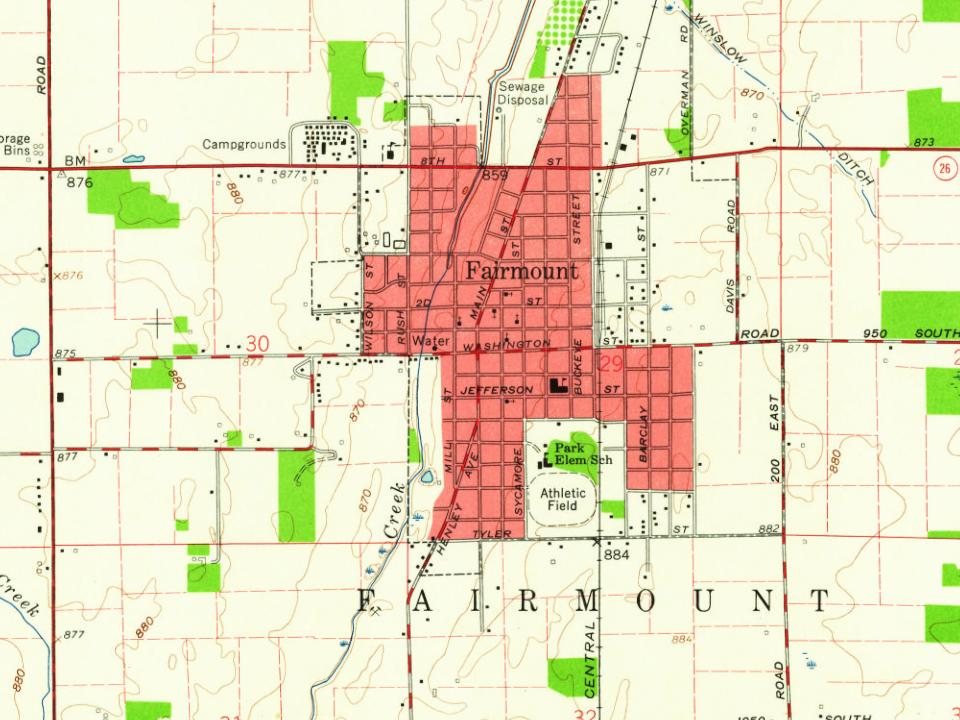
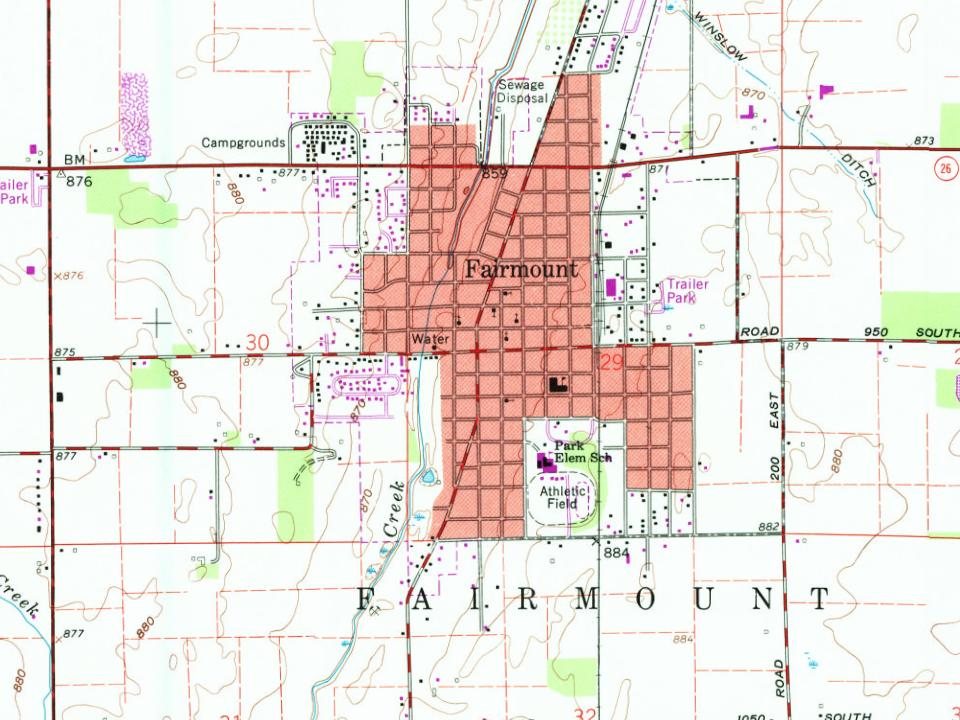
3 places in town are on the National Register, among them two historic districts with 45 buildings between them. Below: maps from 1893 on and the census since 1870.
Founding year: Wikipedia. First post office: 1864.The full story ↓
History grade
What drives Fairmount’s History grade
On its age, its old homes and the National Register, Fairmount is more historic than 84% of U.S. towns, #197 of 593 in Indiana. Its share of homes from before 1940 holds the grade up; its age pulls it down.
A−
HistoryA character grade: shown, never part of Fairmount’s overall grade.
Indiana towns list more on the Register than most of the country (a typical Indiana town has 7.9 per 10,000 residents, the U.S. 2.4), so Fairmount’s 177 sits above most of its state (86% of Indiana towns have fewer) while its 47 historic buildings outnumber those of 84% of U.S. towns.
How sure. Graded on any two of the three inputs instead, the letter would range from B to A+. The pre-1940 share is a Census survey estimate (±10.4 points). Two sources give 1850.
Founding year: Wikipedia (other dates in Quick answers). Homes: Census ACS 2020–24. National Register: National Park Service, May 2026 list; each listing counted once (boundary changes and added documentation belong to their listing), and a historic district counts its contributing buildings. How TownRatings grades history →
What stands out about Fairmount’s past
Read from the archive, the National Register and the record. The page puts what stands out first.
National Park Service, National Register of Historic Places. Photos from Wikimedia Commons, credited on each place’s page.
Every building
Fairmount, building by building, 1893–1916
Fire insurance maps drew every building, what it was made of and what it was used for, so insurers could price the risk of fire. Pick a year, then a sheet.
The Fairmount area was settled in the 1830s mostly by Quakers from North Carolina. The town was laid out in 1850 and named for Fairmount Park in Philadelphia; it was formally incorporated in 1870.
After a large deposit of natural gas was found in 1887, Fairmount became part of the Indiana Gas Boom and a center of the glass industry for the rest of the 19th century. Shortly after the depletion of the gas in 1900 the automobile industry set up factories in the nearby large cities, and Fairmount became a bedroom community, restoring some of its lost prosperity.
Passages that mention Fairmount, cut from the printed page as they were published.
The making of a township, being an account of the early settlement and subsequent development of Fairmount Township, Grant County, Indiana, 1829 to 1917, based upon data secured by personal interviews, from numerous communications and various other reliab1917 · page 122Read the page →
Read the text
January, 1894, at his home in Clay County, Nebraska; Jacob, born November 30, 1845; Edward, born September 22, 1847; William L., born August 6, 1851, who died June 22, 1873, at his father's home, and Mrs. Elda A. Trader, born September i, 1857. wife of Harvey Trader. They reside in Fairmount. Jacob lives in Fairmount, and Edward owns and manages a farm about three miles southwest of Fairmount. August 13, 1886, the wife and mother, after a prolonged illness, passed away. On the 14th day of December, 1887, William Woollen was married to Miss Lizzie McConnell, of Marion, who was a
Text read by machine from the scan; it may contain errors.
The making of a township, being an account of the early settlement and subsequent development of Fairmount Township, Grant County, Indiana, 1829 to 1917, based upon data secured by personal interviews, from numerous communications and various other reliab1917 · page 302Read the page →
Read the text
son, nephew of Baldwin, quit school and at the age of thirteen succeeded his uncle in the work. Patterson continued to haul merchandise from Harrisburg until 1875, when the Cincinnati, Wabash & Michigan Railroad was luiilt to Fairmount, this line then taking over the freight business. In. 1875 Patterson purchased a dray outfit and continued to carry on this business in Fairmount until 1878, when he sold the dray line to Eli J. Scott and Uriah Ballard.
Text read by machine from the scan; it may contain errors.
Centennial History of Grant County Indiana1914 · page 752Read the page →
Read the text
Buller family, the first members of which came to Grant county eightyfive years ago, among the earliest pioneers, and three years before the county was organized. In the third generation of the family is Harmon, for so many years prominent as a farmer and stockman in Fairmount township and the owner of a splendid rural estate just outside the city of Fairmount. His fellow citizens have paid him many tributes for his thrift and excellent judgment in business affairs, and he has been remarkably successful in stock trading and dealing. Mr. Buller is a
Text read by machine from the scan; it may contain errors.
Scans and text from the Internet Archive. Books published in 1930 or earlier, which are in the public domain.
Timeline
Fairmount, 1850 to 1960
Woven from the archive, old maps, post office records, the National Register and the people born here.
In 1850, according to Wikipedia’s history of the town. Fairmount’s post office opened in 1864, and the census of 1870 counted 337 people here.
How does Fairmount rank for history?
Fairmount is more historic than 84% of U.S. towns, #197 of 593 in Indiana. The History grade combines the town’s founding era, the share of homes built before 1940 and its National Register listings. It’s a character grade, so it isn’t part of the overall grade. How it works.
What is on the National Register in Fairmount?
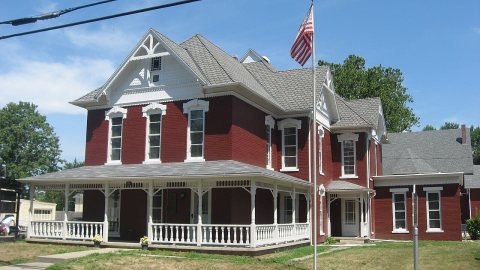
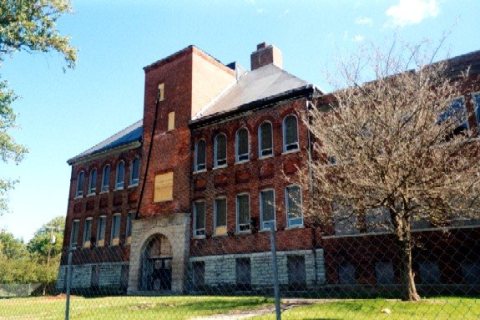
3 listings: 2 buildings, among them the J.W. Patterson House (listed 1979, the first), and 2 historic districts, the Fairmount Commercial Historic District and the Baldwin Addition Historic District, with 45 contributing buildings. 47 historic buildings in all.
How old are the homes in Fairmount?
37% of Fairmount’s homes were built before 1940 (Census estimate, ±10.4 points), against a typical 14% for an Indiana town; the median home was built in 1952.
Founding dates: Wikidata, Wikipedia, the U.S. post office records of Blevins & Helbock (CC0) and the Census. Homes by year built: Census ACS 2020–24. National Register of Historic Places: National Park Service (list of May 22, 2026). Old photos, postcards and papers: Wikimedia Commons, the Library of Congress and other public archives, credited on each item’s page. Maps: U.S. Geological Survey historical topographic maps (via Esri) and Sanborn fire-insurance maps (Library of Congress). History text and census tables: Wikipedia (CC BY-SA 4.0). Places that used to be: USGS Geographic Names Information System (2021).
From Wikimedia Commons (6), the National Register of Historic Places (4), Wikipedia, Wikidata and Wikipedia for famous people, U.S. Geological Survey historical maps, U.S. Census counts (via Wikipedia), the US Post Offices dataset (Blevins & Helbock), the USGS Geographic Names Information System, Sanborn fire insurance maps (Library of Congress) and old county and town histories (Internet Archive). Archive images are copied here with their credits and licenses, shown on each photo’s page. Refreshed monthly.




 2012
 2012
 2012
 2012
 2007
 2006