Founding year: Wikidata; Wikipedia’s history section gives the same year. First post office: 1872.The full story ↓
History grade
What drives Berne’s History grade
On its age, its old homes and the National Register, Berne is more historic than 39% of U.S. towns, #437 of 593 in Indiana. Its share of homes from before 1940 holds the grade up; its National Register listings pull it down.
C+
HistoryA character grade: shown, never part of Berne’s overall grade.
Indiana towns list more on the Register than most of the country (a typical Indiana town has 7.9 per 10,000 residents, the U.S. 2.4), so Berne’s 0.0 sits below most of its state (22% of Indiana towns have fewer) while its 0 listings outnumber those of 23% of U.S. towns.
How sure. Graded on any two of the three inputs instead, the letter would range from D to B−. The pre-1940 share is a Census survey estimate (±4.8 points). Two sources give 1852.
Founding year: Wikidata (other dates in Quick answers). Homes: Census ACS 2020–24. National Register: National Park Service, May 2026 list; each listing counted once (boundary changes and added documentation belong to their listing), and a historic district counts its contributing buildings. How TownRatings grades history →
What stands out about Berne’s past
Read from the archive, the National Register and the record. The page puts what stands out first.
Fire insurance maps drew every building, what it was made of and what it was used for, so insurers could price the risk of fire. Pick a year, then a sheet.
1902Sheet 1 of 1
Edition
Sheets
BrickWoodStone
Sanborn Map Company, via the Library of Congress. Editions published in 1930 or earlier, which are in the public domain.
Berne was settled in 1852 by Mennonite immigrants who came directly from Switzerland (Münsterberg, in the Jura Mountains near Moutier) and named the community after their homeland's capital.
Berne initially formed around a rail depot placed on the Grand Rapids and Indiana Railroad lines. On Christmas Day 1871, the first train arrived at the local depot. A post office was established in Berne in 1872. After the population of the town exceeded 2,500, on a petition of two-thirds of the residents, the town decided to become a city in 1887. By 1895 the community was the second-largest city in the county.
Sam Kuntz rallied from the shock and with proud resentment asked : "What do you take us for, anyhow? As long as there is a town of Berne there will be beer sold in Berne." I replied that I mean just what I say, and then sprang another surprise on them by giving out the information that I had been watching them on law
Text read by machine from the scan; it may contain errors.
Sam Kuntz rallied from the shock and with proud resentment asked : "What do you take us for, anyhow? As long as there is a town of Berne there will be beer sold in Berne." 1 replied that I mean just what I say. and then sprang another surprise on them by giving out the information that I had been watching them on law
Text read by machine from the scan; it may contain errors.
to "sit up and take notice," and on February 20, 1908, the "Geneva Herald" made the following editorial comment : "The Berne Witness contains a reprint from the Indiana Issue, relative to "How the Removal of Saloons Affected Berne, Ind." Saloons have been put out of Berne for the past five years and Berne is proud of her growth and development socially and finan-
Text read by machine from the scan; it may contain errors.
This, the first paper published in Berne, appeared as a seven-column folio and was printed on an old Washington hand press. A good friend of mine predicted that in a year the name of the paper would be changed from "Berne Witness" to "Berne Quitness", but instead of doing that it was enlarged to a fivecolumn quarto, and the force of two increased to three. In April 1899 it was changed to a six-column
Text read by machine from the scan; it may contain errors.
Scans and text from the Internet Archive. Books published in 1930 or earlier, which are in the public domain.
Timeline
Berne, 1852 to 1962
Woven from the archive, old maps, post office records, the National Register and the people born here.
In 1852, according to Wikidata and Wikipedia’s history of the town. Berne’s post office opened in 1872, and the census of 1890 counted 544 people here.
How does Berne rank for history?
Berne is more historic than 39% of U.S. towns, #437 of 593 in Indiana. The History grade combines the town’s founding era, the share of homes built before 1940 and its National Register listings. It’s a character grade, so it isn’t part of the overall grade. How it works.
How old are the homes in Berne?
20% of Berne’s homes were built before 1940 (Census estimate, ±4.8 points), against a typical 14% for an Indiana town; the median home was built in 1973.
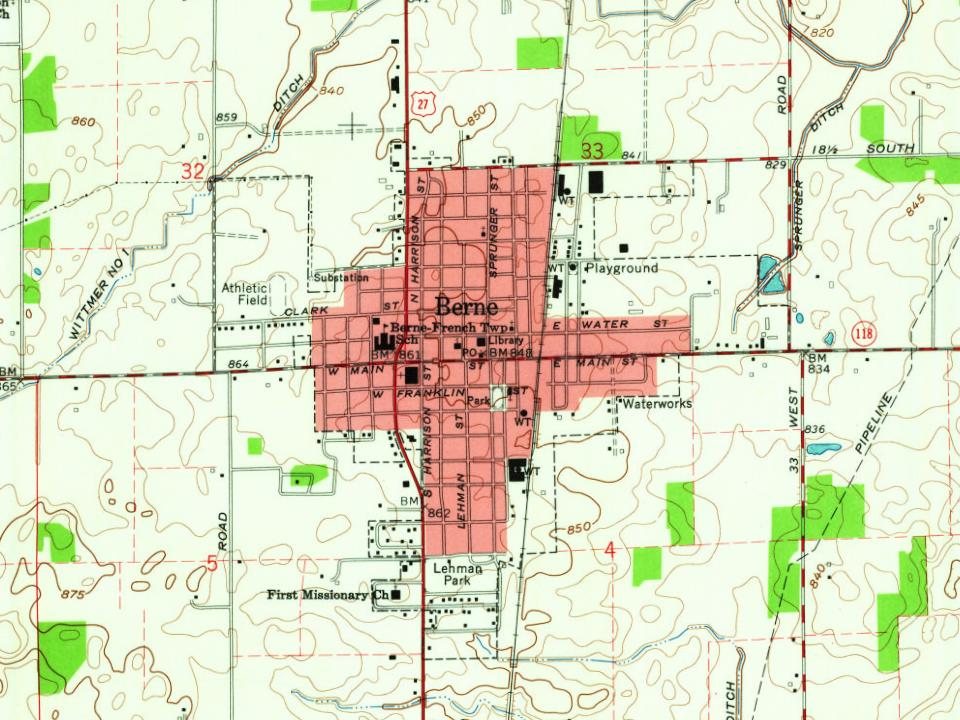
Founding dates: Wikidata, Wikipedia, the U.S. post office records of Blevins & Helbock (CC0) and the Census. Homes by year built: Census ACS 2020–24. National Register of Historic Places: National Park Service (list of May 22, 2026). Old photos, postcards and papers: Wikimedia Commons, the Library of Congress and other public archives, credited on each item’s page. Maps: U.S. Geological Survey historical topographic maps (via Esri) and Sanborn fire-insurance maps (Library of Congress). History text and census tables: Wikipedia (CC BY-SA 4.0). Places that used to be: USGS Geographic Names Information System (2021).
From Wikimedia Commons (5), Wikipedia, Wikidata and Wikipedia for famous people, U.S. Geological Survey historical maps, U.S. Census counts (via Wikipedia), the US Post Offices dataset (Blevins & Helbock), the USGS Geographic Names Information System, Sanborn fire insurance maps (Library of Congress) and old county and town histories (Internet Archive). Archive images are copied here with their credits and licenses, shown on each photo’s page. Refreshed monthly.


 Date?
 2022
 2019
 2012
 2011