Founding year: Wikidata; Wikipedia’s history section gives the same year. First post office: 1853.The full story ↓
History grade
What drives Akron’s History grade
On its age, its old homes and the National Register, Akron is more historic than 98% of U.S. towns. All 3 inputs are above most U.S. towns; its share of homes from before 1940 ranks highest and its age lowest.
A+
HistoryA character grade: shown, never part of Akron’s overall grade.
Indiana towns list more on the Register than most of the country (a typical Indiana town has 7.9 per 10,000 residents, the U.S. 2.4), so Akron’s 964 sits above most of its state (98% of Indiana towns have fewer) while its 92 historic buildings outnumber those of 89% of U.S. towns.
How sure. Graded on any two of the three inputs instead, the letter would range from A to A+. The pre-1940 share is a Census survey estimate (±12.3 points). Two sources give 1836.
Founding year: Wikidata (other dates in Quick answers). Homes: Census ACS 2020–24. National Register: National Park Service, May 2026 list; each listing counted once (boundary changes and added documentation belong to their listing), and a historic district counts its contributing buildings. How TownRatings grades history →
What stands out about Akron’s past
Read from the archive, the National Register and the record. The page puts what stands out first.
Akron was originally named Newark by settlers from Newark, Ohio; the name was changed to Akron in 1855, for the Ohio city. It was founded by Dr. Joseph Sippy on July 4, 1836 when he brought a group of settlers to what was then the crossing of the Pottawatomie and Miami Indian trails. The first building was constructed where the Methodist church stands now. Dr. Sippy's house, which once stood across the street from Viking Foods, was a stop on the Underground Railroad.
Passages that mention Akron, cut from the printed page as they were published.
Fifty years and over of Akron and Summit County1892 · page 121Read the page →
Read the text
lature, providing: "That ever}' incorporated town or city in this State shall have the provisions of the act entitled 'an act for the support and better regulation of the common schools in the town of Akron' and the amendatory acts thereto, passed I)}' the Fortysixth General Assembh' of this State, extended to all or any of said incorporated towns or cities, whenever two-thirds of the cpialilied voters thereof shall ])etition the towai or citj' council in favor of having the provisions of said act so extended," thus establishing
Text read by machine from the scan; it may contain errors.
Fifty years and over of Akron and Summit County1892 · page 189Read the page →
Read the text
existence, the few Presbyterians and Cotigregationalists of the new village of Akron, used to meet from week to week for conference, prayer and praise at private residences, school houses, etc.
Text read by machine from the scan; it may contain errors.
Scans and text from the Internet Archive. Books published in 1930 or earlier, which are in the public domain.
Timeline
Akron, 1836 to 1962
Woven from the archive, old maps, post office records, the National Register and the people born here.
U.S. Geological Survey historical topographic maps (public domain), via Esri’s collection of the scans. The red ring marks the center of Akron.
People over time
Akron, census by census
Between 193 and 1,167 people in every census since 1880.
13 censuses, 1880–2020.
U.S. Census Bureau decennial counts, from the census table on Akron’s Wikipedia page.
Questions about Akron’s history
What year was Akron founded?
In 1836, according to Wikidata and Wikipedia’s history of the town. Akron’s post office opened in 1853, and the census of 1880 counted 193 people here.
How does Akron rank for history?
Akron is more historic than 98% of U.S. towns. The History grade combines the town’s founding era, the share of homes built before 1940 and its National Register listings. It’s a character grade, so it isn’t part of the overall grade. How it works.
What is on the National Register in Akron?
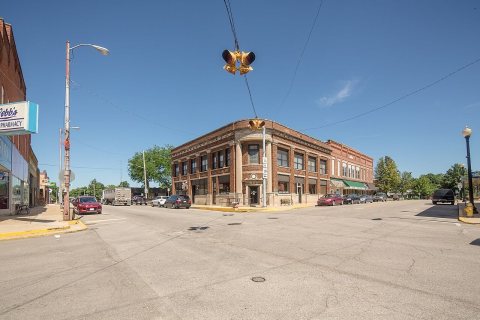
One place: the Akron Historic District (listed 2024).
How old are the homes in Akron?
44% of Akron’s homes were built before 1940 (Census estimate, ±12.3 points), against a typical 14% for an Indiana town; the median home was built in 1945.
Founding dates: Wikidata, Wikipedia, the U.S. post office records of Blevins & Helbock (CC0) and the Census. Homes by year built: Census ACS 2020–24. National Register of Historic Places: National Park Service (list of May 22, 2026). Old photos, postcards and papers: Wikimedia Commons, the Library of Congress and other public archives, credited on each item’s page. Maps: U.S. Geological Survey historical topographic maps (via Esri) and Sanborn fire-insurance maps (Library of Congress). History text and census tables: Wikipedia (CC BY-SA 4.0). Places that used to be: USGS Geographic Names Information System (2021).
From Wikimedia Commons (6), the National Register of Historic Places (1), Wikipedia, Wikidata and Wikipedia for famous people, U.S. Geological Survey historical maps, U.S. Census counts (via Wikipedia), the US Post Offices dataset (Blevins & Helbock), the USGS Geographic Names Information System and old county and town histories (Internet Archive). Archive images are copied here with their credits and licenses, shown on each photo’s page. Refreshed monthly.


 2019
 2019
 2019
 2016
 2011
 2005
