Plainfield Township dates to 1816, and 4 of its places are on the National Register
More historic than 65% of U.S. towns · #290 of 768 in Illinois. What drives it
Most of Plainfield Township was built recently: 3% of its homes predate 1940 and the median home dates from 1999. Below: 13 old photos and papers, maps from 1892 on, and the census since 1870.
Founding year: Wikipedia. First post office: 1834.The full story ↓
History grade
What drives Plainfield Township’s History grade
On its age, its old homes and the National Register, Plainfield Township is more historic than 65% of U.S. towns, #290 of 768 in Illinois. Its National Register listings hold the grade up; its share of homes from before 1940 pulls it down.
B+
HistoryA character grade: shown, never part of Plainfield Township’s overall grade.
Few Illinois towns list much on the Register (a typical Illinois town has 0.5 per 10,000 residents, the U.S. 2.4), so Plainfield Township’s 5.8 sits above most of its state (77% of Illinois towns have fewer) while its 48 historic buildings outnumber those of 85% of U.S. towns.
How sure. Graded on any two of the three inputs instead, the letter would range from C+ to A−. The pre-1940 share (±0.9 points) is firm at this size. Two sources give 1816.
Founding year: Wikipedia (other dates in Quick answers). Homes: Census ACS 2020–24. National Register: National Park Service, May 2026 list; each listing counted once (boundary changes and added documentation belong to their listing), and a historic district counts its contributing buildings. How TownRatings grades history →
What stands out about Plainfield Township’s past
Read from the archive, the National Register and the record. The page puts what stands out first.
Lost post offices, old corners, places now gone and burying grounds
Another post office, Caton Farm, opened and closed inside today’s town.
Hamlets and corners on the map
Caton FarmCoynesCrystal LawnsFond du LacLily CacheMcKenna WoodsPark PlaceRiver Edge EstatesSunnylandSunset RidgeWalkerWilliamsburgWinding Creek
Gone or out of use
Smith SchoolschoolVan Horn Schoolschool
1cemetery inside Plainfield Township
Saint Mary's Immaculate
US Post Offices dataset (Blevins & Helbock, CC0). Places and cemeteries from the USGS Geographic Names Information System (2021).
On the map
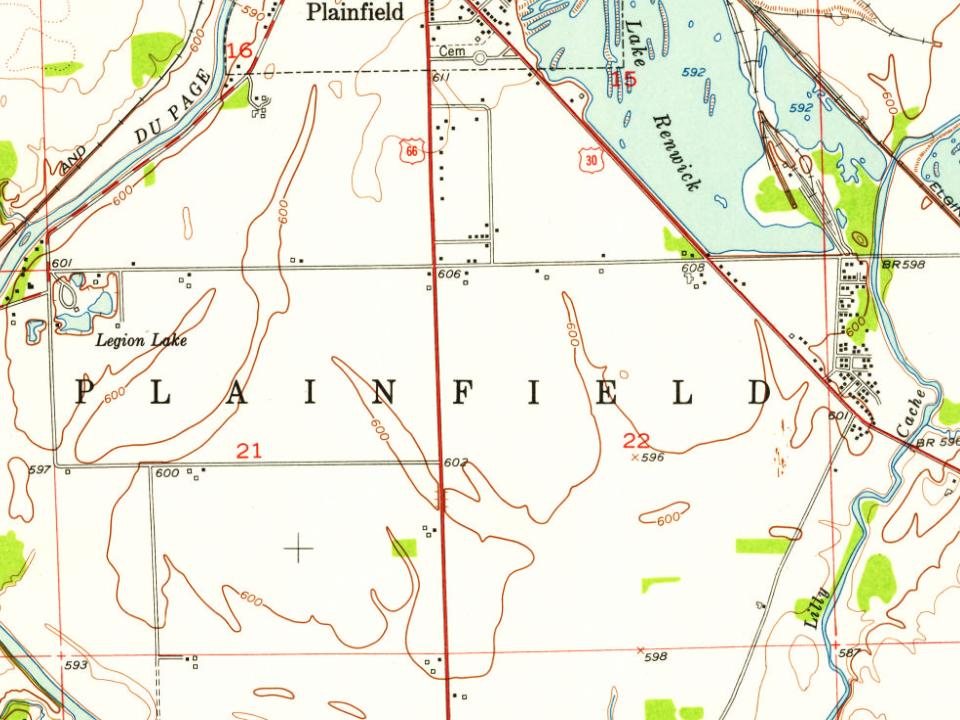
Plainfield Township on the map, 1892 to 1993
Every edition of the U.S. Geological Survey’s map of Plainfield Township. Tap a year, or press play to watch the town change.
1892Joliet sheet · 1:62,500
U.S. Geological Survey historical topographic maps (public domain), via Esri’s collection of the scans. The red ring marks the center of Plainfield Township.
By decade
Plainfield Township, decade by decade
6 decades in the archive, from the 1900s to the 1990s. Scroll each row; tap a photo for its story.
Nothing in the archives for these yearsWeddings on Main Street, storms, parades, school pictures, the old store. If it’s in your family album, it belongs here.
The area was called "Walkers' Grove" until it was platted as "Plainfield" in 1841. It was originally settled by a large community of Potawatomi people, and the land was later bequeathed to the United States as part of the Treaty of St. Louis (1816) with the Council of the Three Fires. Indian Boundary Road aligns with the western border of the tract of land originally ceded.
What they wrote about Plainfield Township, 1878–1928
Passages that mention Plainfield Township, cut from the printed page as they were published.
The history of Will County, Illinois, containing a history of the county ... a directory of its real estate owners1878 · page 536Read the page →
Read the text
minister or not, although the prefix of Rev. is used, and he was generally termed "Priest" Foster. There are none, however, who I'emember to have heard him preach. He now sleeps with his fathers. Chester Ingersoll, who first settled in Plainfield Township, settled in Wheatland about the year 1839. He laid off the village of Plainfield, as mentioned in that part of this work, and as his history is there given at some length, we deem it unnecessary to repeat it here. Joseph B.
Text read by machine from the scan; it may contain errors.
The history of Will County, Illinois, containing a history of the county ..1878 · page 536Read the page →
Read the text
minister or not, although the prefix of Rev. is used, and he was generally termed "Priest " Foster. There are none, however, who remember to have heard him preach. He now sleeps with his fathers. Chester Ingersoll, who first settled in Plainfield Township, settled in Wheatland about the year 1839. He laid off the village of Plainfield, as mentioned in that part of this work, and as his history is there given at some length, we deem it unnecessary to repeat it here. Joseph B.
Text read by machine from the scan; it may contain errors.
The history of Will County, Illinois, containing a history of the county ... a directory of its real estate owners1878 · page 486Read the page →
Read the text
The first mill built in Plainfield Township, or Walker's Grove, was by James Walker. It was a horse-power mill, which he brought with him from Ottawa, and at once set to work. But he built without delay both a saw and grist mill on the Du Page, which was swept away by a flood in 1838. At this mill was sawed the lumber of which a man named Peck built the first frame house erected in Chicago, and which stood on the corner of La Salle and South Water streets.
Text read by machine from the scan; it may contain errors.
History of Will County, Illinois1928 · page 934Read the page →
Read the text
Plainfield Township, having rented the farm of Elisha Brown, which he occupied for 20 years. Mr. Hartong became widely known throughout Will County as a breeder of hogs. From 1924 until 1926 he was associated in the contracting business with H. A. Goodson, and in 1926 became identified with the lumber and building department of the Plainfield Grain Company. He was made secretary and treasurer of the business, at the time of the organization in 1911, which office he now holds.
Text read by machine from the scan; it may contain errors.
Scans and text from the Internet Archive. Books published in 1930 or earlier, which are in the public domain.
Timeline
Plainfield Township, 1816 to 1991
Woven from the archive, old maps, post office records, the National Register and the people born here.
In 1816, according to Wikipedia’s history of the town. Plainfield Township’s post office opened in 1834, and the census of 1870 counted 723 people here.
How does Plainfield Township rank for history?
Plainfield Township is more historic than 65% of U.S. towns, #290 of 768 in Illinois. The History grade combines the town’s founding era, the share of homes built before 1940 and its National Register listings. It’s a character grade, so it isn’t part of the overall grade. How it works.
How old are the homes in Plainfield Township?
3% of Plainfield Township’s homes were built before 1940 (Census estimate), against a typical 11% for an Illinois town; the median home was built in 1999.
Founding dates: Wikidata, Wikipedia, the U.S. post office records of Blevins & Helbock (CC0) and the Census. Homes by year built: Census ACS 2020–24. National Register of Historic Places: National Park Service (list of May 22, 2026). Old photos, postcards and papers: Wikimedia Commons, the Library of Congress and other public archives, credited on each item’s page. Maps: U.S. Geological Survey historical topographic maps (via Esri) and Sanborn fire-insurance maps (Library of Congress). History text and census tables: Wikipedia (CC BY-SA 4.0). Places that used to be: USGS Geographic Names Information System (2021).
From Wikimedia Commons (17), the Library of Congress (1), Wikipedia, U.S. Geological Survey historical maps, U.S. Census counts (via Wikipedia), the US Post Offices dataset (Blevins & Helbock), the USGS Geographic Names Information System and old county and town histories (Internet Archive). Archive images are copied here with their credits and licenses, shown on each photo’s page. Refreshed monthly.




 1907
 1907
 1907
 1919
 1933
 1933
 1933
 1933
 1933
 1933
 1941
 1988
 1991
 2012
 2012
 2012
 2009
 2009


