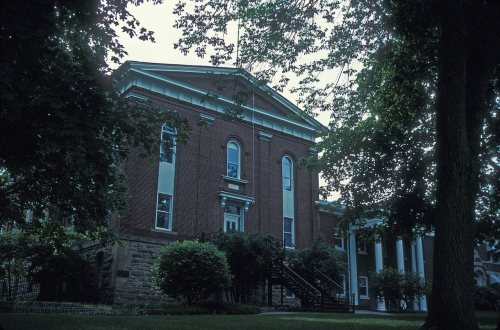
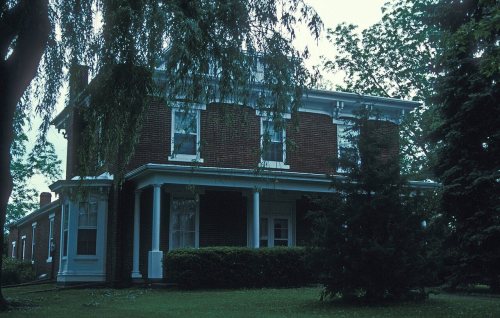
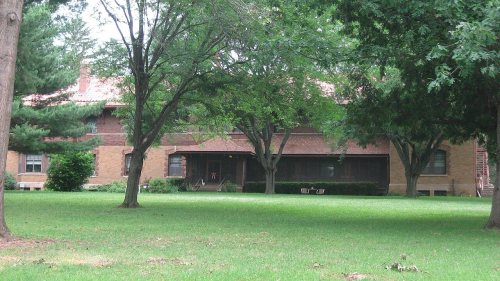
4 places in town are on the National Register, among them a historic district with 172 buildings. Below: 3 old photos and papers from 1906 on and old-book passages.
Founding year: the first Mount Carroll post office (Blevins & Helbock, CC0).The full story ↓
History grade
What drives Mount Carroll’s History grade
On its age, its old homes and the National Register, Mount Carroll is more historic than 98% of U.S. towns. All 3 inputs are above most U.S. towns; its share of homes from before 1940 ranks highest and its age lowest.
A+
HistoryA character grade: shown, never part of Mount Carroll’s overall grade.
Few Illinois towns list much on the Register (a typical Illinois town has 0.5 per 10,000 residents, the U.S. 2.4), so Mount Carroll’s 1,193 sits above most of its state (100% of Illinois towns have fewer) while its 179 historic buildings outnumber those of 93% of U.S. towns.
How sure. Graded on any two of the three inputs instead, the letter would still be A+. The pre-1940 share is a Census survey estimate (±8.5 points). The founding year is the first post office, not a stated founding date.
Founding year: the first post office (other dates in Quick answers). Homes: Census ACS 2020–24. National Register: National Park Service, May 2026 list; each listing counted once (boundary changes and added documentation belong to their listing), and a historic district counts its contributing buildings. How TownRatings grades history →
What stands out about Mount Carroll’s past
Read from the archive, the National Register and the record. The page puts what stands out first.
Mount Carroll began as a mill town around 1841. In 1843, a referendum moved the county seat from nearby Savanna to Mount Carroll. The town was incorporated in 1855 and became a city in 1867; the first mayor was Nathaniel Halderman, a prominent local businessman and co-founder of the mill.
Shimer College was established in Mt. Carroll in 1853, but mounting debts forced a move to Waukegan in 1979 and subsequently to Chicago in 2006. The campus now is home to several organizations, most notably the Campbell Center for Historic Preservation Studies.
Passages that mention Mount Carroll, cut from the printed page as they were published.
The history of Carroll county, Illinois, containing a history of the county-its cities, towns, etc., a biographical directory ... war record ... statistics, portraits of early settlers and prominent men ... history of the Northwest ... Illinois ... miscel1878 · page 330Read the page →
Read the text
Mount Carroll was named by the commissioners who located the county seat here, in 1843. They drove the stake designating the location on the highest point of ground here, a point that had sometimes been called Baby Mountain, and christened the place Mount Carroll.
Text read by machine from the scan; it may contain errors.
The history of Carroll county, Illinois, containing a history of the county-its cities, towns, etc., a biographical directory ... war record ... statistics, portraits of early settlers and prominent men ... history of the Northwest ... Illinois ... miscel1878 · page 284Read the page →
Read the text
Disbursed for uniforms for volunteers by " " ..- 1,600 00 Disbursed for support of families of soldiers by O. S. Beardsley... 12,975 00 Total - $162,935 00 Of the fourteen townships in the county, Mount Carroll is the only one inckided in tlie above statement, it being the township in which the city of Mount Carroll is located. The township authorities were equally liberal, and to their several clerks we are indebted for the following statement, as we are indebted to Thomas D. Davis, deputy county clerk, for the above state-
Text read by machine from the scan; it may contain errors.
Scans and text from the Internet Archive. Books published in 1930 or earlier, which are in the public domain.
Timeline
Mount Carroll, 1845 to 1966
Woven from the archive, old maps, post office records, the National Register and the people born here.
Nothing in the archives for these yearsWeddings on Main Street, storms, parades, school pictures, the old store. If it’s in your family album, it belongs here.
Nothing in the archives for these yearsWeddings on Main Street, storms, parades, school pictures, the old store. If it’s in your family album, it belongs here.
The Mount Carroll post office opened in 1845, the earliest record of the town by name (U.S. post office records).
How does Mount Carroll rank for history?
Mount Carroll is more historic than 98% of U.S. towns. The History grade combines the town’s founding era, the share of homes built before 1940 and its National Register listings. It’s a character grade, so it isn’t part of the overall grade. How it works.
What is on the National Register in Mount Carroll?
4 listings: 3 buildings, among them the Carroll County Courthouse (listed 1973, the first), and 1 historic district, the Mount Carroll Historic District, with 172 contributing buildings. 179 historic buildings in all.
How old are the homes in Mount Carroll?
46% of Mount Carroll’s homes were built before 1940 (Census estimate, ±8.5 points), against a typical 11% for an Illinois town; the median home was built in 1946.
Founding dates: Wikidata, Wikipedia, the U.S. post office records of Blevins & Helbock (CC0) and the Census. Homes by year built: Census ACS 2020–24. National Register of Historic Places: National Park Service (list of May 22, 2026). Old photos, postcards and papers: Wikimedia Commons, the Library of Congress and other public archives, credited on each item’s page. Maps: U.S. Geological Survey historical topographic maps (via Esri) and Sanborn fire-insurance maps (Library of Congress). History text and census tables: Wikipedia (CC BY-SA 4.0). Places that used to be: USGS Geographic Names Information System (2021).
From Wikimedia Commons (6), the National Register of Historic Places (4), Wikipedia, Wikidata and Wikipedia for famous people, the US Post Offices dataset (Blevins & Helbock), the USGS Geographic Names Information System and old county and town histories (Internet Archive). Archive images are copied here with their credits and licenses, shown on each photo’s page. Refreshed monthly.







 2010
 2010
 2010