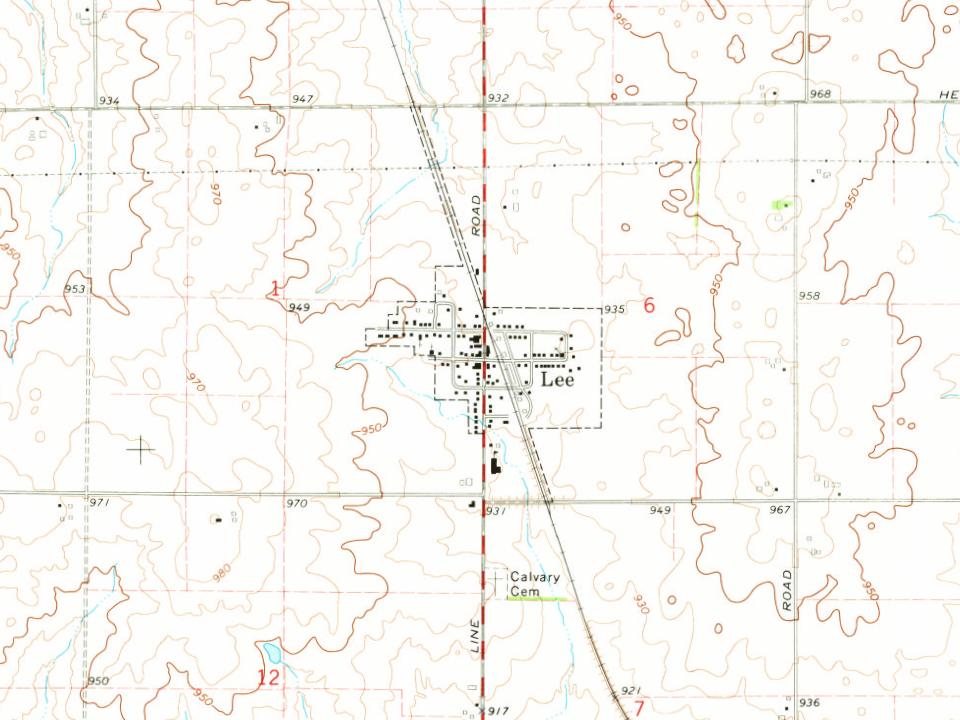
Lee is noted for its strong ties to Norwegian American culture. In fact, all of the streets in the village have Norwegian names. In 1974, in honor of the town's centennial, a contest was held to rename the streets and Mary Ellen Prestegaard's entry was chosen. She ran a shop in the village called the Hardanger Hus that sold Norwegian gifts. Many of the original citizens of the community came from the Hardanger region of Norway, and there are still many community members that can trace their ancestry back to that region.
Passages that mention Lee, cut from the printed page as they were published.
History of Lee County, Illinois1914 · page 159Read the page →
Read the text
as an objective point. From ones and twos the numbers increased, in each instance, the Hillison home receiving and directing the strangers into new homes and as the sequel proved, very profitable ones. Not one of them left Lee county, and thus in course of time, Lee county, and later, the village of Lee became the focal point for the Hardanger emigrant and from Lee the younger generation went out into Iowa, Wisconsin, the Dakotas, Minnesota until their number now is legion. Lee is regarded with almost as much vener-
Text read by machine from the scan; it may contain errors.
History of Lee County, Illinois1914 · page 60Read the page →
Read the text
seat. On May 31, 1839, they selected Dixon. Following is their report : "The undersigned, commissioners appointed by the act creating the county of Lee, approved Feb. 27, 1839, having been duly sworn and after due examination, having due regard to the settlements and the convenience of the present and future population of said coimty of Lee, do hereby locate the seat of justice for the aforesaid county of Lee at the town of Dixon, and have stuck the
Text read by machine from the scan; it may contain errors.
Scans and text from the Internet Archive. Books published in 1930 or earlier, which are in the public domain.
Timeline
Lee, 1872 to 1996
Woven from the archive, old maps, post office records, the National Register and the people born here.
Founding dates: Wikidata, Wikipedia, the U.S. post office records of Blevins & Helbock (CC0) and the Census. Homes by year built: Census ACS 2020–24. National Register of Historic Places: National Park Service (list of May 22, 2026). Old photos, postcards and papers: Wikimedia Commons, the Library of Congress and other public archives, credited on each item’s page. Maps: U.S. Geological Survey historical topographic maps (via Esri) and Sanborn fire-insurance maps (Library of Congress). History text and census tables: Wikipedia (CC BY-SA 4.0). Places that used to be: USGS Geographic Names Information System (2021). How TownRatings grades history →
From Wikimedia Commons (3), Wikipedia, U.S. Geological Survey historical maps, U.S. Census counts (via Wikipedia), the US Post Offices dataset (Blevins & Helbock), the USGS Geographic Names Information System and old county and town histories (Internet Archive). Archive images are copied here with their credits and licenses, shown on each photo’s page. Refreshed monthly.


 1996
 1999