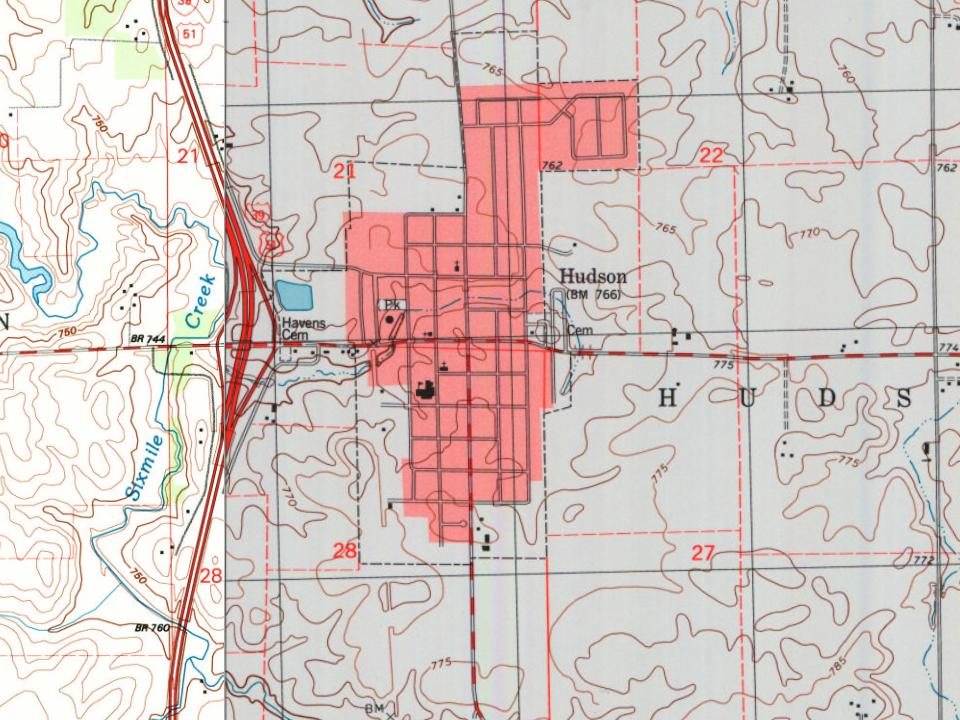
Most of Hudson was built recently: 8% of its homes predate 1940 and the median home dates from 1988. Its Register listing is the Hubbard House. Below: maps from 1926 on and the census since 1880.
Founding year: the first Hudson post office (Blevins & Helbock, CC0).The full story ↓
History grade
What drives Hudson’s History grade
On its age, its old homes and the National Register, Hudson is more historic than 67% of U.S. towns. Its age holds the grade up; its share of homes from before 1940 pulls it down.
B+
HistoryA character grade: shown, never part of Hudson’s overall grade.
Few Illinois towns list much on the Register (a typical Illinois town has 0.5 per 10,000 residents, the U.S. 2.4), so Hudson’s 5.2 sits above most of its state (76% of Illinois towns have fewer) while its 1 listings outnumber those of 51% of U.S. towns.
How sure. Graded on any two of the three inputs instead, the letter would range from B− to A−. The pre-1940 share is a Census survey estimate (±4.9 points). The founding year is the first post office, not a stated founding date.
Founding year: the first post office (other dates in Quick answers). Homes: Census ACS 2020–24. National Register: National Park Service, May 2026 list; each listing counted once (boundary changes and added documentation belong to their listing), and a historic district counts its contributing buildings. How TownRatings grades history →
What stands out about Hudson’s past
Read from the archive, the National Register and the record. The page puts what stands out first.
Hudson was laid out by Horatio Petit on August 13, 1836. It was one of eight towns founded in McLean County during the great real estate boom that swept through central Illinois between 1835 and 1837. It also shares the distinction of being one of two "colonial" settlements in the county; the other was the Rhode Island colony in the southwestern part of the county. Traditional sources say that the town was named for the town of Hudson in Columbia County, New York, which, so it was said, was the home of its early settlers. However, in her book on the Hudson Colony, Ruth Biting Hamm has pointed out that, while some settlers were from Queens County, New York, none came from near the town of Hudson. She suggests that it is more likely town was simply named for the Hudson River.
Hudson Township. — The township and village of Hudson took their names from Hudson, New York, which had formerly been the home of some of the men who organized a colony and entered most of the land
Text read by machine from the scan; it may contain errors.
Scans and text from the Internet Archive. Books published in 1930 or earlier, which are in the public domain.
By decade
No old photos in the archives yet
Weddings on Main Street, storms, parades, school pictures, the old store. If it’s in your family album, it belongs here.
Be the first to add onePhotograph a print flat, in daylight, no flash.
The Hudson post office opened in 1836, the earliest record of the town by name (U.S. post office records).
How does Hudson rank for history?
Hudson is more historic than 67% of U.S. towns. The History grade combines the town’s founding era, the share of homes built before 1940 and its National Register listings. It’s a character grade, so it isn’t part of the overall grade. How it works.
What is on the National Register in Hudson?
One place: the Hubbard House (listed 1979).
How old are the homes in Hudson?
8% of Hudson’s homes were built before 1940 (Census estimate, ±4.9 points), against a typical 11% for an Illinois town; the median home was built in 1988.
Founding dates: Wikidata, Wikipedia, the U.S. post office records of Blevins & Helbock (CC0) and the Census. Homes by year built: Census ACS 2020–24. National Register of Historic Places: National Park Service (list of May 22, 2026). Old photos, postcards and papers: Wikimedia Commons, the Library of Congress and other public archives, credited on each item’s page. Maps: U.S. Geological Survey historical topographic maps (via Esri) and Sanborn fire-insurance maps (Library of Congress). History text and census tables: Wikipedia (CC BY-SA 4.0). Places that used to be: USGS Geographic Names Information System (2021).
From the National Register of Historic Places (1), Wikipedia, Wikidata and Wikipedia for famous people, U.S. Geological Survey historical maps, U.S. Census counts (via Wikipedia), the US Post Offices dataset (Blevins & Helbock), the USGS Geographic Names Information System and old county and town histories (Internet Archive). Archive images are copied here with their credits and licenses, shown on each photo’s page. Refreshed monthly.