Founding year: the first Cuba post office (Blevins & Helbock, CC0).The full story ↓
History grade
What drives Cuba’s History grade
On its age, its old homes and the National Register, Cuba is more historic than 73% of U.S. towns. Its share of homes from before 1940 holds the grade up; its National Register listings pull it down.
B+
HistoryA character grade: shown, never part of Cuba’s overall grade.
Few Illinois towns list much on the Register (a typical Illinois town has 0.5 per 10,000 residents, the U.S. 2.4), so Cuba’s 0.0 sits below most of its state (28% of Illinois towns have fewer) while its 0 listings outnumber those of 23% of U.S. towns.
How sure. Graded on any two of the three inputs instead, the letter would range from B− to A. The pre-1940 share is a Census survey estimate (±11.4 points). The founding year is the first post office, not a stated founding date.
Founding year: the first post office (other dates in Quick answers). Homes: Census ACS 2020–24. National Register: National Park Service, May 2026 list; each listing counted once (boundary changes and added documentation belong to their listing), and a historic district counts its contributing buildings. How TownRatings grades history →
What stands out about Cuba’s past
Read from the archive, the National Register and the record. The page puts what stands out first.
Cuba was founded in 1837 when the two rival towns of Centerville and Middleton merged. The new town was named after the island of Cuba. The name could be in reference to the town of Havana, roughly 15 miles to the southeast. A post office has been in operation at Cuba since 1837.
Passages that mention Cuba, cut from the printed page as they were published.
History of the Fourth Illinois Volunteers in their relation to the Spanish-American War for the liberation of Cuba and other island possessions of Spain ..1899 · page 99Read the page →
Read the text
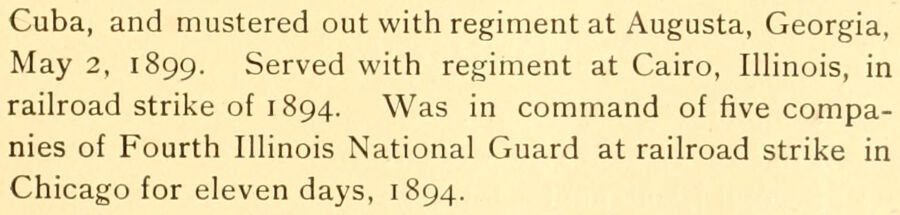
Cuba, and mustered out with regiment at Augusta, Georgia, May 2, 1899. Served with regiment at Cairo, Illinois, in railroad strike of 1894. Was in command of five companies of Fourth Illinois National Guard at railroad strike in Chicago for eleven days, 1894.
Text read by machine from the scan; it may contain errors.
History of the Fourth Illinois Volunteers in their relation to the Spanish-American War for the liberation of Cuba and other island possessions of Spain ..1899 · page 185Read the page →
Read the text
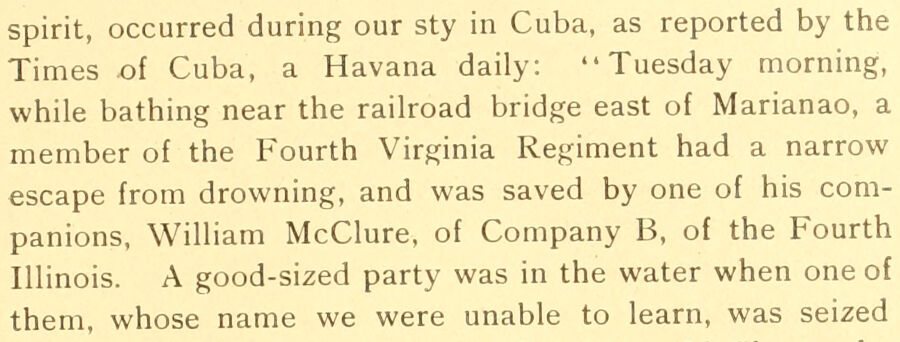
spirit, occurred during our sty in Cuba, as reported by the Times of Cuba, a Havana daily: "Tuesday morning, while bathing near the railroad bridge east of Marianao, a member of the Fourth Virginia Regiment had a narrow escape from drowning, and was saved by one of his companions, William McClure, of Company B, of the Fourth Illinois. A good-sized party was in the water when one of them, whose name we were unable to learn, was seized
Text read by machine from the scan; it may contain errors.
Scans and text from the Internet Archive. Books published in 1930 or earlier, which are in the public domain.
Timeline
Cuba, 1837 to 1948
Woven from the archive, old maps, post office records, the National Register and the people born here.
Nothing in the archives for these yearsWeddings on Main Street, storms, parades, school pictures, the old store. If it’s in your family album, it belongs here.
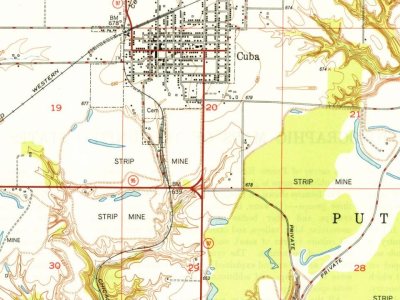
Every edition of the U.S. Geological Survey’s map of Cuba. Tap a year, or press play to watch the town change.
1948Lewistown sheet · 1:24,000
U.S. Geological Survey historical topographic maps (public domain), via Esri’s collection of the scans. The red ring marks the center of Cuba.
Every building
Cuba, building by building, 1893–1898
Fire insurance maps drew every building, what it was made of and what it was used for, so insurers could price the risk of fire. Pick a year, then a sheet.
1893Sheet 1 of 1
Edition
Sheets
BrickWoodStone
Sanborn Map Company, via the Library of Congress. Editions published in 1930 or earlier, which are in the public domain.
Then & now
Stand where they stood
No then-and-now pairs yet. Take a photo from the same spot as an old one and they appear here side by side.
Retake this viewThe United Electric Coal Co's Cuba Mine, Cuba, Fulton County, Illinois. Distant view of coal shovel in strip mine at, 1946
Find the spot, match the angle, and add your photo. It becomes the first then-and-now pair on Cuba’s page.
The Cuba post office opened in 1837, the earliest record of the town by name (U.S. post office records).
How does Cuba rank for history?
Cuba is more historic than 73% of U.S. towns. The History grade combines the town’s founding era, the share of homes built before 1940 and its National Register listings. It’s a character grade, so it isn’t part of the overall grade. How it works.
How old are the homes in Cuba?
34% of Cuba’s homes were built before 1940 (Census estimate, ±11.4 points), against a typical 11% for an Illinois town; the median home was built in 1954.
Founding dates: Wikidata, Wikipedia, the U.S. post office records of Blevins & Helbock (CC0) and the Census. Homes by year built: Census ACS 2020–24. National Register of Historic Places: National Park Service (list of May 22, 2026). Old photos, postcards and papers: Wikimedia Commons, the Library of Congress and other public archives, credited on each item’s page. Maps: U.S. Geological Survey historical topographic maps (via Esri) and Sanborn fire-insurance maps (Library of Congress). History text and census tables: Wikipedia (CC BY-SA 4.0). Places that used to be: USGS Geographic Names Information System (2021).
From Wikimedia Commons (2), Wikipedia, Wikidata and Wikipedia for famous people, U.S. Geological Survey historical maps, U.S. Census counts (via Wikipedia), the US Post Offices dataset (Blevins & Helbock), the USGS Geographic Names Information System, Sanborn fire insurance maps (Library of Congress) and old county and town histories (Internet Archive). Archive images are copied here with their credits and licenses, shown on each photo’s page. Refreshed monthly.




 1946


