Dubuque dates to 1833, and 30% of its homes were built before 1940
More historic than 96% of U.S. towns · #9 of 140 in Iowa. What drives it
64 places in town are on the National Register, among them 2 National Historic Landmarks and ten historic districts with 1,200 buildings between them. Below: 5 old photos and papers, maps from 1884 on, and the census since 1850.
On its age, its old homes and the National Register, Dubuque is more historic than 96% of U.S. towns, #9 of 140 in Iowa. All 3 inputs are above most U.S. towns; its National Register listings ranks highest and its age lowest.
A+
HistoryA character grade: shown, never part of Dubuque’s overall grade.
Iowa towns list more on the Register than most of the country (a typical Iowa town has 9.1 per 10,000 residents, the U.S. 2.4), so Dubuque’s 210 sits above most of its state (93% of Iowa towns have fewer) while its 1,244 historic buildings outnumber those of 99% of U.S. towns.
How sure. Graded on any two of the three inputs instead, the letter would range from A to A+. The pre-1940 share (±1.5 points) is firm at this size. Two sources give 1833.
Founding year: Wikipedia (other dates in Quick answers). Homes: Census ACS 2020–24. National Register: National Park Service, May 2026 list; each listing counted once (boundary changes and added documentation belong to their listing), and a historic district counts its contributing buildings. How TownRatings grades history →
What stands out about Dubuque’s past
Read from the archive, the National Register and the record. The page puts what stands out first.
The country’s official list of buildings and places worth saving. 2 are National Historic Landmarks, the highest tier. Boundary changes and added documentation are counted with their listing.
Spain gained control of the Louisiana Territory west of the Mississippi River following the 1763 defeat of the French; the British took over all territory to the east. The first permanent European settler in what is now Dubuque was Quebecois pioneer Julien Dubuque, who arrived in 1785. In 1788, he received permission from the Spanish government and the local Meskwaki people to mine the area's rich lead deposits. Control of Louisiana and Dubuque's mines shifted briefly back to France in 1800, then to the United States in 1803, following the Louisiana Purchase. The Meskwaki continued to mine with the full support of the U.S. government until 1830 when the Meskwaki were illegally pushed out of the mine region by American prospectors.
Passages that mention Dubuque, cut from the printed page as they were published.
Portrait and biographical record of Dubuque, Jones and Clayton counties, Iowa. Containing biographical sketches of prominent1894 · page 514Read the page →
Read the text
the road from Cedar Rapids to Vinton, Iowa. In this capacity he was employed for a term of seven years; at the expiration of the tune he came to Dubuque, having been transferred to the Illinois Central Railroad, running between Dubuque and Sioux City and three years later to the route between Dubuque and Chicago. In December, 1889, he was made chief clerk, with headquarters in this
Text read by machine from the scan; it may contain errors.
Portrait and biographical record of Dubuque, Jones and Clayton counties, Iowa. Containing biographical sketches of prominent1894 · page 397Read the page →
Read the text
lieving that he could do this better in the west, he proceeded as far as Michigan, where he re¬ mained for one year. Coming further west, he arrived in Dubuque March 2, 1837, where he began mining operations, which he conducted for several years, meeting with fair success. During the years of 1841 and 1842 he ran the ferry across the Mississippi River at Dubuque. It was in 1846
Text read by machine from the scan; it may contain errors.
to the priesthood and was first assigned to mission work in the western part of Iowa, continuing thus to establish and organize new parishes for a period of seven years. By direction of Archbishop Hennessy, of Dubuque, he organized the Sacred Heart parish at Dubuque, built the first church and school and was pastor of the same for three years.
Text read by machine from the scan; it may contain errors.
he went to St. Louis, Missouri, and in 1881 was graduated from the Washington University. He then went to Texas and for a time was master mechanic of his father's railroad, the Austin & Northwestern hne, but in 1885 returned to Dubuque to assume the position of general manager and superintendent of t'he Dubuque street railway, then controlled and operated by his father. In 1898, however, he built and was one of the organizers of the Dubuque Star Brewing Company, one of the largest concerns of its kind in the
Text read by machine from the scan; it may contain errors.
Scans and text from the Internet Archive. Books published in 1930 or earlier, which are in the public domain.
Timeline
Dubuque, 1833 to 1989
Woven from the archive, old maps, post office records, the National Register and the people born here.
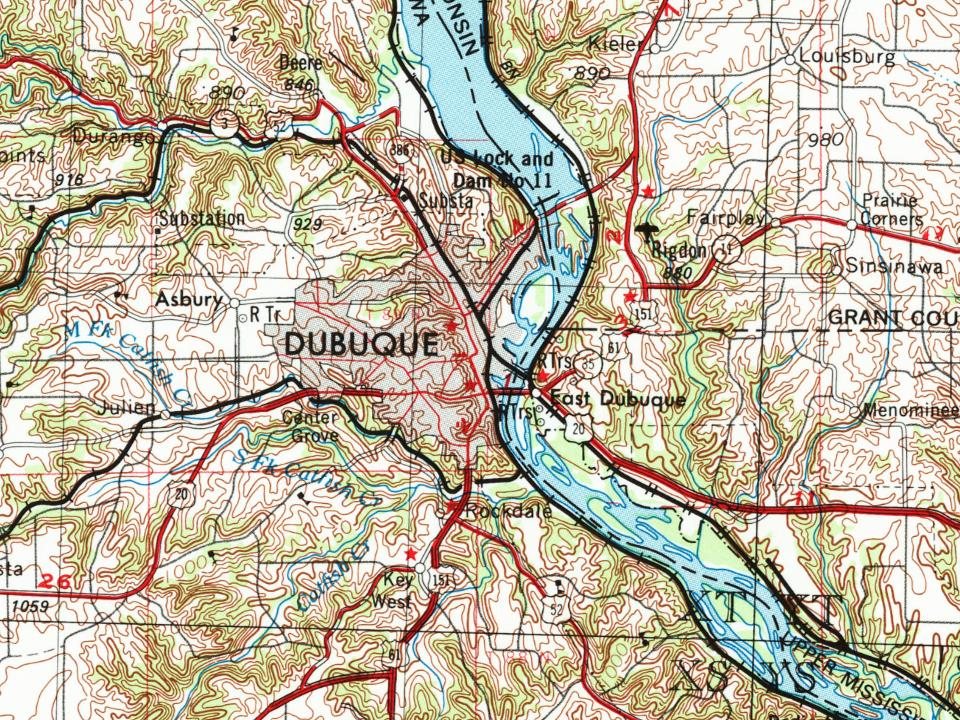
Every edition of the U.S. Geological Survey’s map of Dubuque. Tap a year, or press play to watch the town change.
1961Dubuque sheet · 1:250,000
U.S. Geological Survey historical topographic maps (public domain), via Esri’s collection of the scans. The red ring marks the center of Dubuque.
Every building
Dubuque, building by building, 1884–1909
Fire insurance maps drew every building, what it was made of and what it was used for, so insurers could price the risk of fire. Pick a year, then a sheet.
In 1833, according to Wikipedia’s history of the town. Dubuque’s post office opened in 1833, and the census of 1850 counted 3,108 people here.
How does Dubuque rank for history?
Dubuque is more historic than 96% of U.S. towns, #9 of 140 in Iowa. The History grade combines the town’s founding era, the share of homes built before 1940 and its National Register listings. It’s a character grade, so it isn’t part of the overall grade. How it works.
What is on the National Register in Dubuque?
64 listings, 2 of them National Historic Landmarks: 38 buildings, among them the Dubuque County Jail (a National Historic Landmark since 1987) and the Dubuque County Courthouse (listed 1971, the first), 21 historic districts with 1,200 contributing buildings, 1 site, 5 structures, and 1 object. 1,244 historic buildings in all.
How old are the homes in Dubuque?
30% of Dubuque’s homes were built before 1940 (Census estimate, ±1.5 points), against a typical 22% for an Iowa town; the median home was built in 1963.
Founding dates: Wikidata, Wikipedia, the U.S. post office records of Blevins & Helbock (CC0) and the Census. Homes by year built: Census ACS 2020–24. National Register of Historic Places: National Park Service (list of May 22, 2026). Old photos, postcards and papers: Wikimedia Commons, the Library of Congress and other public archives, credited on each item’s page. Maps: U.S. Geological Survey historical topographic maps (via Esri) and Sanborn fire-insurance maps (Library of Congress). History text and census tables: Wikipedia (CC BY-SA 4.0). Places that used to be: USGS Geographic Names Information System (2021).
From Wikimedia Commons (5), Wikidata (1), the National Register of Historic Places (66), Wikipedia, Wikidata and Wikipedia for famous people, U.S. Geological Survey historical maps, U.S. Census counts (via Wikipedia), the US Post Offices dataset (Blevins & Helbock), the USGS Geographic Names Information System, Sanborn fire insurance maps (Library of Congress) and old county and town histories (Internet Archive). Archive images are copied here with their credits and licenses, shown on each photo’s page. Refreshed monthly.


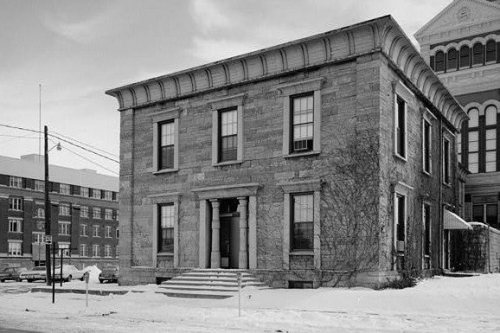 ★ Landmark
 ★ Landmark


 1859
 1865
 c. 1867