The Buffalo post office opened in 1857, the earliest record of the town by name. Six smaller post offices, Clarks Ferry (1836), Glendale (1839) and West Buffalo (1841), opened inside today’s city and later closed.
First census: 368 in 18702020 census: 1,176169 years
How historic is Buffalo?
B+
More historic than 65% of U.S. towns, on its age, its old homes and the National Register.
Founding year: the first Buffalo post office (Blevins & Helbock, CC0).The full story ↓
History grade
What drives Buffalo’s History grade
On its age, its old homes and the National Register, Buffalo is more historic than 65% of U.S. towns. Its share of homes from before 1940 holds the grade up; its age pulls it down.
B+
HistoryA character grade: shown, never part of Buffalo’s overall grade.
Iowa towns list more on the Register than most of the country (a typical Iowa town has 9.1 per 10,000 residents, the U.S. 2.4), so Buffalo’s 9.1 sits near the middle of its state (55% of Iowa towns have fewer) while its 1 listings outnumber those of 51% of U.S. towns.
How sure. Graded on any two of the three inputs instead, the letter would range from C+ to A−. The pre-1940 share is a Census survey estimate (±10.1 points). The founding year is the first post office, not a stated founding date.
Founding year: the first post office (other dates in Quick answers). Homes: Census ACS 2020–24. National Register: National Park Service, May 2026 list; each listing counted once (boundary changes and added documentation belong to their listing), and a historic district counts its contributing buildings. How TownRatings grades history →
What stands out about Buffalo’s past
Read from the archive, the National Register and the record. The page puts what stands out first.
Steamship captain Benjamin W. Clark settled the area of Buffalo in 1833. It was claimed following the 1833 Black Hawk Purchase which opened the region to non-native settlers. In 1836, Clark sold a 2/3 interest in 90 acres of land to Captain E.A. Mix and Dr. Pillsbury and collectively the three men platted the town of Buffalo after Buffalo, New York. This was the first town to be platted in Scott County. The town was hopeful for a county seat but found itself on the Western edge of Scott County after its districting in 1837. This made the town unsuitable for the county seat compared to the centrally located Davenport.
Passages that mention Buffalo, cut from the printed page as they were published.
History of Davenport and Scott County Iowa1910 · page 247Read the page →
Read the text
Scott county, Iowa, numbers him among her native sons, his birth occurring in Buffalo township on the 28th of October, 1861, a son of H. C. and Mary Moorhead. The former came to Scott county in 1835, from Zanesville, Ohio, and here purchased what was then known as the Campbell place, consisting of three hundred and twelve acres of land in Buffalo township, just west of the village of Buffalo. There he reared his family and spent his remaining days.
Text read by machine from the scan; it may contain errors.
biographical history and portrait gallery of scott county, iowa1895 · page 540Read the page →
Read the text
e Township. In the spring of 1826 the town of Buffalo was laid out and W. L. took the contract for putting up the first storehouse. Ile had for a partner in the enterprise S. €. Hastings, who was afterward Judge of the Supreme Court of Iowa, and member of Congress, and also Chief Justice of California. Ile had also the management of the noted “Clarks ferry,” and now resides on the tract of land which he “claimed” at that time, just west of the village of Buffalo. He attended a school
Text read by machine from the scan; it may contain errors.
biographical history and portrait gallery of scott county, iowa1895 · page 20Read the page →
Read the text
The first school was taught in the town of Buffalo by Erastus H. Bassett, in the winter of 1836-37. The first religious services were held in the Township in 1836 by a Methodist Episcopal minister, whose name appears to have passed out of mind of all the pioneers. Rev. Martin Baker, a clergyman of the Christian denomination, preached in the town of Buffalo in 1837. The village of Buffalo was laid out by Captain Clark in 1836, and the first hotel was built by him the same year. The first stock of goods brought to the place was placed on sale by Messrs.
Text read by machine from the scan; it may contain errors.
History of Davenport and Scott County Iowa1910 · page 649Read the page →
Read the text
August Henry Dorman, a representative of financial interests in Scott county, is now bending his efforts to administrative direction and executive control as the cashier of the Buffalo Savings Bank. He is one of the best known residents of the town of Buffalo, whither he came with his father, Henry Dorman, in 1855. The latter, well known as one of the pioneer business men here, erected a home and store building and conducted a mercantile enterprise, continuing in the same until a few years ago, when he retired. Reared under the parental roof, August H. Dorman benefited by the instruction of-
Text read by machine from the scan; it may contain errors.
Scans and text from the Internet Archive. Books published in 1930 or earlier, which are in the public domain.
Timeline
Buffalo, 1836 to 1912
Woven from the archive, old maps, post office records, the National Register and the people born here.
Nothing in the archives for these yearsWeddings on Main Street, storms, parades, school pictures, the old store. If it’s in your family album, it belongs here.
The Buffalo post office opened in 1857, the earliest record of the town by name (U.S. post office records).
How does Buffalo rank for history?
Buffalo is more historic than 65% of U.S. towns. The History grade combines the town’s founding era, the share of homes built before 1940 and its National Register listings. It’s a character grade, so it isn’t part of the overall grade. How it works.
What is on the National Register in Buffalo?
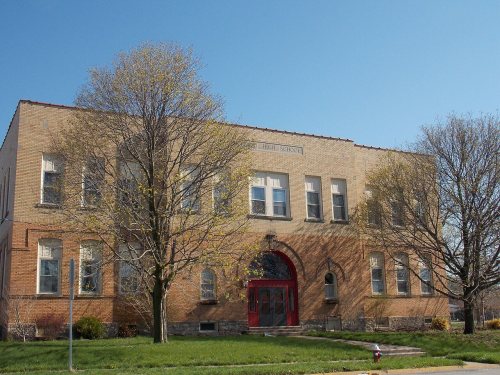
One place: the Buffalo High School (listed 2005).
How old are the homes in Buffalo?
31% of Buffalo’s homes were built before 1940 (Census estimate, ±10.1 points), against a typical 22% for an Iowa town; the median home was built in 1958.
Founding dates: Wikidata, Wikipedia, the U.S. post office records of Blevins & Helbock (CC0) and the Census. Homes by year built: Census ACS 2020–24. National Register of Historic Places: National Park Service (list of May 22, 2026). Old photos, postcards and papers: Wikimedia Commons, the Library of Congress and other public archives, credited on each item’s page. Maps: U.S. Geological Survey historical topographic maps (via Esri) and Sanborn fire-insurance maps (Library of Congress). History text and census tables: Wikipedia (CC BY-SA 4.0). Places that used to be: USGS Geographic Names Information System (2021).
From Wikimedia Commons (8), Wikidata (1), the National Register of Historic Places (1), Wikipedia, U.S. Geological Survey historical maps, U.S. Census counts (via Wikipedia), the US Post Offices dataset (Blevins & Helbock), the USGS Geographic Names Information System and old county and town histories (Internet Archive). Archive images are copied here with their credits and licenses, shown on each photo’s page. Refreshed monthly.




 2021
 2015
 2014
 2013
 2013
 2010
 2004


