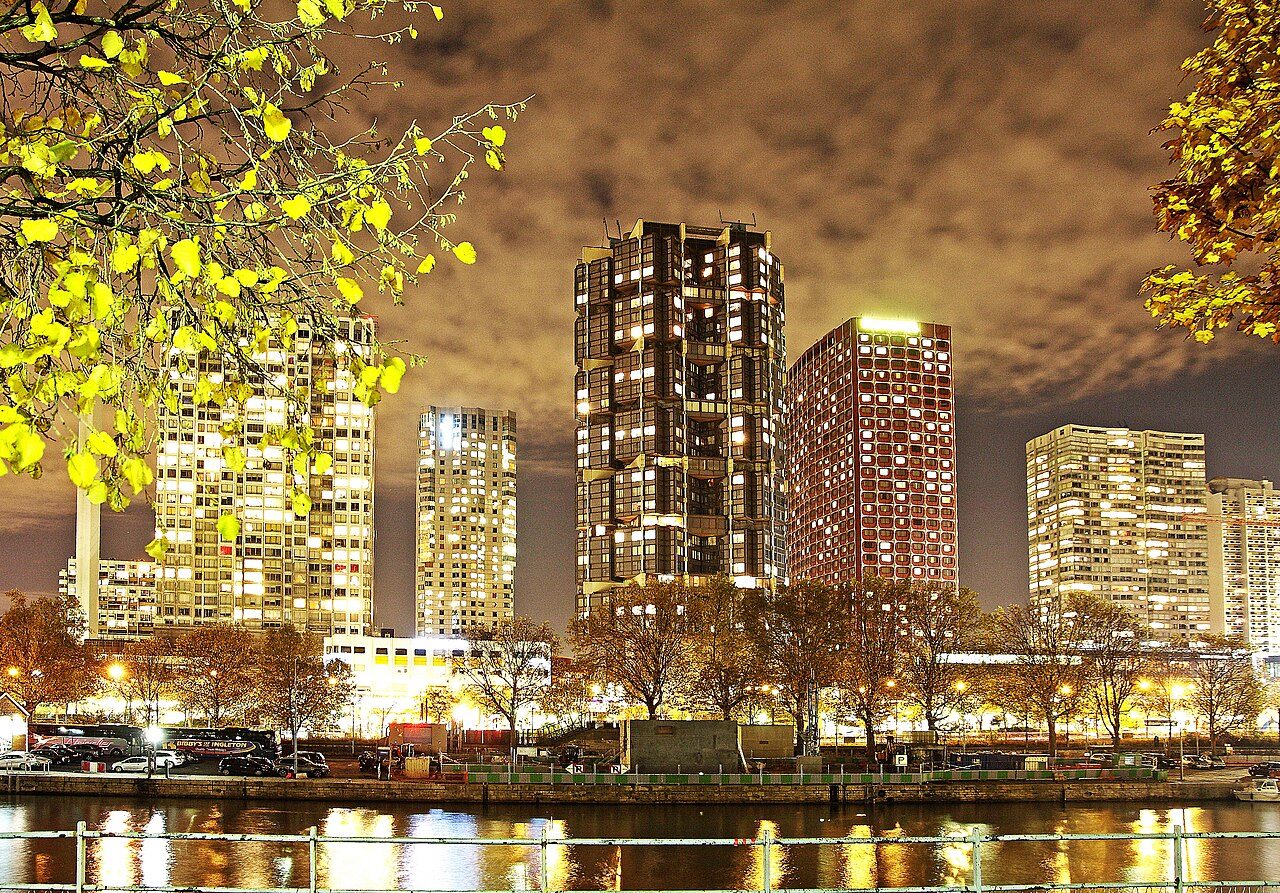
 Photo: Jean-François Gornet from Paris, France · CC BY-SA 2.0
Paris 15e sits above 99% of compared French towns for flats (98%)
The share of households headed by a retired person trails 92% of compared French towns: 22%. 8.8% of homes are second homes. Few places have so few couples with children: 16% here, fewer than in 89% of compared French towns. The 2023 Census counted 229,713 residents in 124,800 households.
Throughout this page, the Paris median and the France median are the median of compared communes (those with an overall grade), each figure its own median. Source: INSEE, census 2023.
What stands out about the people of Paris 15e
Immigrants
INSEE counts 48,300 immigrants in Paris 15e (people born abroad who weren’t French at birth, whatever their nationality now): 21% of residents, against 20% for the median compared commune in Paris. 15% are foreign nationals. Immigrants and foreign nationals ↓
Many people living alone
54% of Paris 15e’s households are one person: higher than in 98% of compared French towns; 46% of residents 65 and over live alone. Households ↓
Many graduates
69% of residents 15 and over who have left education hold a diploma above the bac, 47% a master’s or more (bac+5). Qualifications ↓
A young town
Half of Paris 15e’s residents are under 37.7 and half over; the median of compared French towns is 44. 13% are under 15 and 18% are 65 or older. Ages ↓
Written from INSEE’s census 2023 on this page, against compared French towns.
Slower than most: −4% since 2012, behind 83% of compared French towns
Residents at INSEE’s last three censuses, each recast in the 2026 commune boundaries. France has no yearly estimate by commune between censuses.
2012 to 2023
2017 to 2023
Between 2012 and 2017 the population moved −2%, then −2% to 2023. Over those years, the median Paris town changed −6% and the median compared French town +5%.
A median age of 37.7: Paris 15e is younger than 89% of compared French towns
Shares of residents by age at the 2023 census.
Age groups · share of residents
Median age of the 3,798 compared French towns
■ Paris 15e 37.7. The median compared French town: 44.
Compared with 11% in the typical compared French town, 15% of residents are 15 to 24 here. On the census count, 18% of residents are 65 or over.
Women and men · all residents
55% women, 45% men
About 83 men for every 100 women. Median share of women: Paris 52.7%, France 51.8%.
A higher share of one-person households than 98% of compared French towns, at 54%
A household is everyone who shares a main home (résidence principale). Household types come from INSEE’s fuller sample of a quarter of census forms.
Against the Paris median and the France median
Living alone · share
Average household size: 1.8 people. The benchmark for one-person households in the typical compared French town: 35%. Single-parent households are rarer here than in 83% of compared French towns.
More households without a car than 99% of compared French towns: 65%
Every home the census counted: main residences, second homes and occasional dwellings (INSEE counts them together), and empty homes. Owning and renting are on Cost of living.
All homes · share of homes
Type of home
Cars per household · share of households
The share of households in social housing tops 68% of compared French towns: 17%. By way of comparison, 11% of households have no car in the typical compared French town. Here, 9.4% of homes stand empty.
€37,160 a year is the median standard of living here
The standard of living (niveau de vie) is a household’s disposable income after taxes and benefits, divided by its consumption units (UC) to allow for its size and make-up: 1 for the first adult, 0.5 for each other person 14 or older, 0.3 for each child under 14.
Medians of compared communes. Source: INSEE, Filosofi 2023.
At €37,160 a year per consumption unit, the median standard of living here is higher than in 97% of compared French towns. 13.8% of residents live below the poverty line INSEE uses.
More households headed by a manager or professional than 99% of compared French towns: 37%
Households by the socio-professional group (PCS) of their reference person, INSEE’s own categories. Jobs and commuting are on the Work & commute page.
Households by reference person’s group · share of households
Households headed by a manual worker make up 3.3%, against 14% in the typical compared French town. For comparison, 9.4% of households are headed by a manager or professional in the typical compared French town.
Each household is counted once, by the occupation of its reference person (usually the oldest working adult).
A higher share of immigrants than 94% of compared French towns, at 21%
INSEE publishes two measures, which overlap but aren’t the same. Neither is the UK’s “born abroad”.
Share of residents · census 2023
Immigrant (immigré)
Born abroad, not French at birth. Someone stays an immigrant after becoming French. A French citizen born abroad (for example in Algeria before 1962) is not one.
Foreign national (étranger)
Not a French citizen today, wherever born. A child born in France to foreign parents can be a foreign national without being an immigrant.
15% of residents are foreign nationals, against 4.3% in the typical compared French town. The median compared commune in Paris has 20%; immigrants here make up a share higher than in 94% of compared French towns. Measured more widely, 6.5% of residents are immigrants in the typical compared French town.
INSEE publishes no country of birth or ethnicity by commune in these tables, and the census doesn’t ask about religion.
Paris 15e sits above 98% of compared French towns for single residents (41%)
Residents 15 and over by how they live: the census asks both the legal status and whether people live as a couple.
Residents 15 and over · share
32% of residents 15 and over are married; in the typical compared French town the figure is 43%. Single residents: 25% in the typical compared French town, for comparison.
A higher share of graduates of higher education than 99% of compared French towns, at 69%
Highest diploma of residents 15 and over who have left education, in French terms: the levels don’t map one-to-one to UK or U.S. ones.
Highest diploma · 15 and over, out of education
Compared with 19% in the typical compared French town, 9.1% of adults out of school have no qualification here. Across the comparison, 30% of adults out of school hold a higher-education qualification in the typical compared French town.
Among 41 French towns of 117,662 to 357,737 people, the 16th oldest
The 40 compared French towns nearest in population, by median age. Hover for each one’s second homes and immigrants; click for its page.
At the ends of the range sit Lille (29.4), the youngest, and Paris 16e (43.7), the oldest.
Paris 15e and its 6 nearest towns: 5 of them are older
The nearest towns of 2,500 or more, colored by median age. Source: INSEE, census 2023.
Health, work, housing and schools
What this data can and can’t tell you
- Census 2023. INSEE’s census is a rolling survey: a fifth of small communes each year, 8% of homes in large ones each year. “2023” pools the surveys of 2021 to 2025, so the figures describe the town around 2023, not on one day.
- Medians of compared communes. The comparisons are the median of the département’s compared communes and of France’s (those with an overall grade), each figure its own median: not the total for the département or for France, which large cities pull towards their own figures.
- Immigrants and foreign nationals. INSEE’s two measures: an immigrant was born abroad without French nationality; a foreign national isn’t French today. Neither is a count of people born abroad, which INSEE doesn’t publish by commune.
- Second homes. Homes used for holidays or weekends, with occasional dwellings (kept for work, for example), which INSEE counts together. Their owners are counted where they live, not here.
- Standard of living. INSEE’s Filosofi: disposable income per consumption unit, from tax and benefit files, 2023. The poverty rate is the share of residents below 60% of France’s median. Not published for the smallest communes.
- What France doesn’t ask. The French census asks nothing about ethnicity, religion, language or health, so this page has no such section.
Questions about who lives in Paris 15e
What is the population of Paris 15e?
229,713 at INSEE’s 2023 census, 4% fewer than in 2012 (238,190).
How old are Paris 15e’s residents?
The median age is 37.7, younger than 89% of compared French towns. 15% are under 18 and 18% 65 or older.
How many second homes are there in Paris 15e?
13,500, with occasional dwellings: 8.8% of all homes, against 2.1% for the median compared French town.
How many immigrants live in Paris 15e?
INSEE counts 48,290 immigrants (born abroad, not French at birth), 21% of residents, and 34,640 foreign nationals (15%). The medians of compared French towns are 6.5% and 4.3%.
What is the median income in Paris 15e?
€37,160 a year per consumption unit in 2023 (median of compared French towns €25,970); 13.8% of residents live below the poverty line. Source: INSEE, Filosofi.
Sources: INSEE, census 2023 (population, ages, households, homes, marital status, diplomas, immigrants, foreign nationals, employment), 2026 geography · INSEE, Filosofi 2023 (standard of living, poverty) · IGN Admin Express (boundaries) · Medians and percentiles: TownRatings, over compared French towns, updated November 9, 2026. Under the Licence Ouverte / Open Licence 2.0 (Etalab).
Contains public sector information under the Licence Ouverte / Open Licence 2.0 (Etalab): INSEE, DGFiP, the Interior Ministry’s statistics service (SSMSI), the Ministry of Education (DEPP), the Health Ministry’s statistics service (DREES) and the Housing Ministry (Carte des loyers). Commune boundaries: IGN Admin Express.