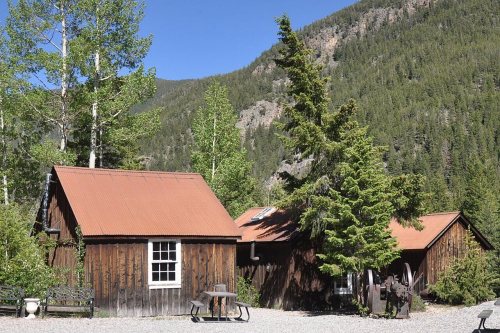
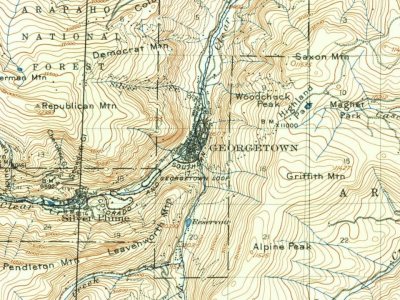
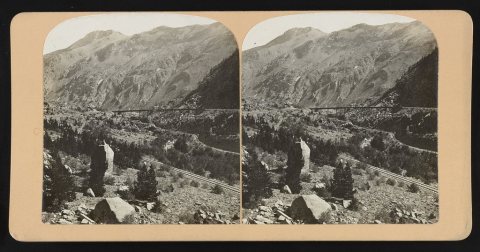
9 places in town are on the National Register, among them the Georgetown-Silver Plume Historic District, a National Historic Landmark, and a historic district with 16 buildings. Below: 16 old photos and papers, maps from 1886 on, and the census since 1870.
Founding year: Wikidata. First post office: 1866.The full story ↓
History grade
What drives Georgetown’s History grade
On its age, its old homes and the National Register, Georgetown is more historic than 79% of U.S. towns. Its National Register listings hold the grade up; its age pulls it down.
A−
HistoryA character grade: shown, never part of Georgetown’s overall grade.
Few Colorado towns list much on the Register (a typical Colorado town has 1.1 per 10,000 residents, the U.S. 2.4), so Georgetown’s 256 sits above most of its state (98% of Colorado towns have fewer) while its 27 historic buildings outnumber those of 81% of U.S. towns.
How sure. Graded on any two of the three inputs instead, the letter would range from B to A. The pre-1940 share is a Census survey estimate (±8.6 points). Two sources give 1859.
Founding year: Wikidata (other dates in Quick answers). Homes: Census ACS 2020–24. National Register: National Park Service, May 2026 list; each listing counted once (boundary changes and added documentation belong to their listing), and a historic district counts its contributing buildings. How TownRatings grades history →
What stands out about Georgetown’s past
Read from the archive, the National Register and the record. The page puts what stands out first.
National Park Service, National Register of Historic Places. Photos from Wikimedia Commons, credited on each place’s page.
Every building
Georgetown, building by building, 1886–1907
Fire insurance maps drew every building, what it was made of and what it was used for, so insurers could price the risk of fire. Pick a year, then a sheet.
The area was first settled in 1859 during the Pike's Peak Gold Rush. George and David Griffith were members of a mining party which decided to separate from the others in the Central City and Idaho Springs areas. They found gold in Clear Creek (near the present-day site of the Alpine Inn) and decided to settle in the area for the rest of the summer and fall. The Griffith Mining District incorporated in June 1860. Soon after the formation of the Griffith Mining District, several early residents joined to form the "Georgetown Company," claiming 640 acres for a townsite. The townsite would be overseen by the Griffith Mining District. The commercial district was tagged "Main Street," a name which would continue into the 20th century. The center of the nascent town was roughly in the area of the I-70 interchange, close to the present-day Rutherford stables.
Passages that mention Georgetown, cut from the printed page as they were published.
The Rocky Mountain directory and Colorado gazetteer, for 1871, comprising a brief history of Colorado ... together with a complete and accurate directory of Denver, Golden City, Black Hawk, Central City, Nevada, Idaho, Georgetown ... First year of publica1870 · page 43Read the page →
Read the text
importance of the county. Idaho Springs was the first town surveyed in the county. This very soon became the most populous portion of the county, and the county seat and archives and offices were located here until 1867, when they were removed to the more populous town of Georgetown, near the head waters of Clear creek. This town was first settled in 1860, by the Griffith family, but did not commence a healthy and rapid growth until the discovery of silver in the extensive belt of lodes that traverse the surrounding mountains. This event secured the future prosperity of George-
Text read by machine from the scan; it may contain errors.
The Rocky Mountain directory and Colorado gazetteer, for 1871, comprising a brief history of Colorado ... together with a complete and accurate directory of Denver, Golden City, Black Hawk, Central City, Nevada, Idaho, Georgetown ... First year of publica1870Read the page →
Read the text
From this period dates the real success of silver mining in Colorado, and the permanent growth and prosperity of Georgetown, which has already secured the position of second mining and mercantile town in the Territory, and will, no doubt, very soon rank among the first in wealth, number of inhabitants, and mining, milling and mercantile importance. We spent considerable time in Georgetown in the summer and fall of 1870, and know, from actual observation, that the climate is unusually mild for its elevation, and exceedingly pleasant and healthful; the location of the town and its sur-
Text read by machine from the scan; it may contain errors.
Scans and text from the Internet Archive. Books published in 1930 or earlier, which are in the public domain.
Timeline
Georgetown, 1859 to 1966
Woven from the archive, old maps, post office records, the National Register and the people born here.
Nothing in the archives for these yearsWeddings on Main Street, storms, parades, school pictures, the old store. If it’s in your family album, it belongs here.
In 1859, according to Wikidata. Georgetown’s post office opened in 1866, and the census of 1870 counted 802 people here.
How does Georgetown rank for history?
Georgetown is more historic than 79% of U.S. towns. The History grade combines the town’s founding era, the share of homes built before 1940 and its National Register listings. It’s a character grade, so it isn’t part of the overall grade. How it works.
What is on the National Register in Georgetown?
9 listings: 7 buildings, 1 historic district, the Georgetown-Silver Plume Historic District, with 16 contributing buildings, and 1 structure. 27 historic buildings in all.
How old are the homes in Georgetown?
24% of Georgetown’s homes were built before 1940 (Census estimate, ±8.6 points), against a typical 2.5% for a Colorado town; the median home was built in 1971.
Founding dates: Wikidata, Wikipedia, the U.S. post office records of Blevins & Helbock (CC0) and the Census. Homes by year built: Census ACS 2020–24. National Register of Historic Places: National Park Service (list of May 22, 2026). Old photos, postcards and papers: Wikimedia Commons, the Library of Congress and other public archives, credited on each item’s page. Maps: U.S. Geological Survey historical topographic maps (via Esri) and Sanborn fire-insurance maps (Library of Congress). History text and census tables: Wikipedia (CC BY-SA 4.0). Places that used to be: USGS Geographic Names Information System (2021).
From Wikimedia Commons (5), the Library of Congress (11), Wikidata (1), the National Register of Historic Places (9), Wikipedia, Wikidata and Wikipedia for famous people, U.S. Geological Survey historical maps, U.S. Census counts (via Wikipedia), the US Post Offices dataset (Blevins & Helbock), the USGS Geographic Names Information System, Sanborn fire insurance maps (Library of Congress) and old county and town histories (Internet Archive). Archive images are copied here with their credits and licenses, shown on each photo’s page. Refreshed monthly.


 ★ Landmark





 1890
 1890
 1894
 1894
 1900
 1901
 1901
 1906
 1906
 1906
 1906


