Photos from Wikimedia Commons, each credited to its photographer with its licence; names open the place’s page. Tap a photo to step through them full screen.
Through time
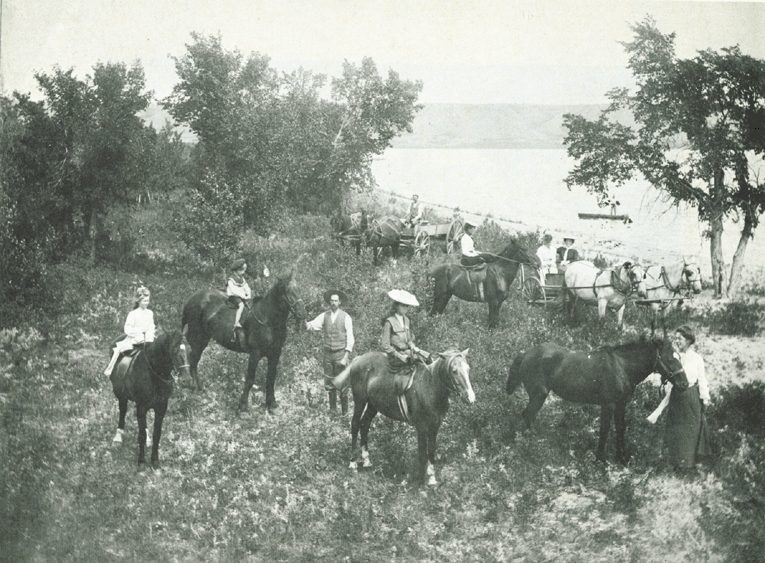
Fort Qu'Appelle, long ago
One old photograph of the town, made before 1950. A tap opens it at full size, with its credit.
Public domain or CC0, made before 1950, from Wikimedia Commons; old views of places can be drawings, prints or maps of their time. Each credit opens the image’s page.
How it began
Back to 1880: Fort Qu'Appelle’s first record
Its oldest recorded station, Fort Qu'Appelle railway station, dates from 1911. Wikidata gives the municipality of Fort Qu'Appelle the date 1880, which can mark a founding, an incorporation or a merger.
Every place on the registers inside the town, by its designation.
Highest designationsProvincial and local listings
Each dot is a place: point at it for the name, tap it for its page.
The 2, by tier
1 Highest designations1 Provincial and local listings
What the map shows is the open record: the federal directory in full, and from provincial or municipal lists only the places Wikidata ties to an encyclopedia article.
Points from Wikidata (Parks Canada’s files carry none) and from Québec’s register, as mapped there.
Highest designations
One place in Fort Qu'Appelle with the highest designation
National Historic Sites and Classified Federal Heritage Buildings, Canada’s highest federal recognition. Each one opens its own page.
10 historic places within 100 km of Fort Qu'Appelle
By age, Government House leads, from 1889, at 70 km. “Former Canadian Pacific Railway Station, Regina, Saskatchewan” in Downtown is the nearest, 67 km away. Among them are 6 provincial or municipal listings, 2 heritage railway stations and 2 National Historic Sites.
Little new building in Fort Qu'Appelle: 2.4% of homes date from 2016 to 2021, against 4.1%
At 25%, Fort Qu'Appelle’s share of pre-1961 homes is above the typical town’s 18%. Fort Qu'Appelle’s largest group of homes, 39%, went up from 1961 to 1980. Count back from today and half of Fort Qu'Appelle’s homes are older than 1981.
25%
Before 1961
39%
1961–80
21%
1981–2000
12%
2001–15
2.4%
2016–21
Fort Qu'AppelleTypical town
2021 Census, private dwellings by period of construction (Statistics Canada); the typical town is the middle Canadian town of 2,500 or more.
Born here
3 Fort Qu'Appelle births on record from before 1914
Frank Waite closes the list, born in 1905. The earliest is William Antrobus Griesbach, born in 1878. 16 Wikipedias cover Eddie Shore, the most of anyone here. Of them all, Frank Waite lived longest: 84 years, until 1989.
William Antrobus Griesbach
Eddie Shore
Frank Waite
18501875190019251950
ES
Eddie Shore1902–1985 · Canadian ice hockey player
WG
William Antrobus Griesbach1878–1945 · Canadian politician
FW
Frank Waite1905–1989 · Canadian ice hockey player
Everyone born in Fort Qu'Appelle → Born before 1914 (the page’s periods: Confederation to the First World War). Birthplaces from Wikidata, each checked against the person’s Wikipedia article.
Fort Qu'Appelle has 25% of its homes from before 1961, against 18% in the typical town. Together that makes 2 historic places, one with the highest designation, led by Fort Qu'Appelle. The town’s people of the past are Eddie Shore (1902), William Antrobus Griesbach (1878) and Frank Waite (1905). Beyond that, its one place was designated in 1953.
How to read these numbers
What this data can and can’t tell you
•
People and events. Persons of national historic significance come with no location; a town gets one only by birthplace (name and both life years agreeing) or by one of its own places that bears the name and whose record tells the story. Events, which can’t be tied, are left out.
•
Protection. Being on these registers doesn’t mean a building can’t change. Federal designation commemorates; protection is provincial or municipal, and those lists aren’t open here.
•
The federal register. Federal places come from Parks Canada’s directory, which counts National Historic Sites, federal heritage buildings, stations and lighthouses; their statements are the register’s own.
•
The tiers. Three tiers: the top for National Historic Sites, classified federal buildings and Québec’s classements, a second for the other federal designations, a third for provincial and municipal listings.
•
Map points. Parks Canada publishes no coordinates, so federal places are pinned where Wikidata puts them.
•
Provincial and municipal lists. Provincial and municipal listings here come from Wikidata alone, since the provinces’ own registers can’t be reused; a listing needs an encyclopedia article to get a page.
•
The grade. History is described, not graded, for every Canadian town.
Questions about Fort Qu'Appelle’s history
Which places in Fort Qu'Appelle have the highest designation?
Fort Qu'Appelle.
What is the oldest building in Fort Qu'Appelle?
Fort Qu'Appelle (National Historic Site): the first construction date on its record is 1864.
How old are the homes in Fort Qu'Appelle?
25% of its homes were built before 1961, against 18% in the typical Canadian town.
Contains information licensed under the Open Government Licence – Canada (Parks Canada).
Sources: Parks Canada, Directory of Federal Heritage Designations · Canadian Register of Historic Places (federal extract) · Wikidata (CC0) for map points, other names and articles · Statistics Canada, 2021 Census (homes by period of construction). Under the Statistics Canada Open Licence.

 1904
 Top
 Local