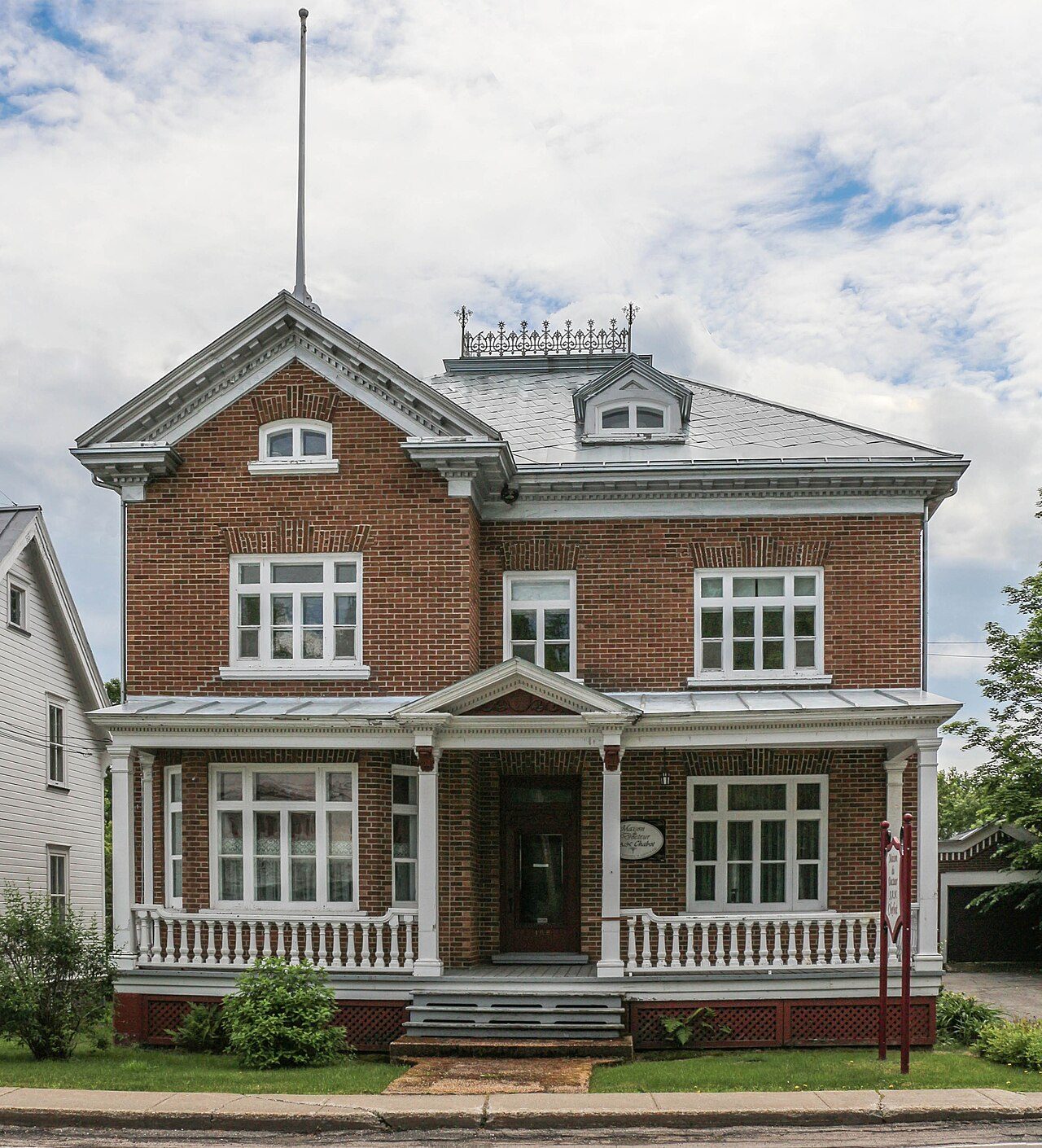
Maison Prévost · Photo: Cantons-de-l'Est · CC BY-SA 4.0
3historic places on the registers
History of Sainte-Claire · Canada’s heritage registers
Canada’s registers list 3 historic places in Sainte-Claire
For its size Sainte-Claire is rich ground: 8.1 per 10,000 residents, ahead of 97% of Canadian towns. The oldest dated place, Maison Prévost, goes back to 1911. Designations here include 3 municipal citations.
National Historic Sites, classified federal buildings and Québec’s classements
Provincial and local listings
3
municipal citations on Québec’s register
Oldest building
1911
the first construction date on its record
Homes built before 1961
28%
typical town: 18%
In pictures
Look around Sainte-Claire: 2 photos
Among them: Maison Prévost and Maison du Docteur-Joseph-Arthur-Noé-Chabot. Photos show 2 of the places Sainte-Claire’s registers name; the others show their record instead.
Photos from Wikimedia Commons, each credited to its photographer with its licence; names open the place’s page. Tap a photo to step through them full screen.
How it began
Sainte-Claire’s early dates, from 1977
The municipality succeeded Louis-Joliette and Sainte-Claire in 1977. On the open record, Sainte-Claire as a municipality goes back to October 1, 1977, though that may be a charter rather than a first settlement.
Every place on the registers inside the town, by its designation.
Provincial and local listings
Dots open their places’ pages; hover first to read the name.
The 3, by tier
3 Provincial and local listings
Federal designations come from Parks Canada; Québec’s own register adds what the province has classified and what the municipality has cited.
Points from Wikidata (Parks Canada’s files carry none) and from Québec’s register, as mapped there.
Provincial and local listings
On provincial and local lists in Sainte-Claire: 3 places
Designations came from 1999 to 2013. Citations the municipality has made, registered with Québec’s ministry of culture. They date from 1911 (Maison Prévost) to 1960. Each one opens its own page.
Sainte-Claire is still building: 8.8% of homes date from 2016 to 2021, against 4.1%
Homes built from 1961 to 1980 make up just 21% of Sainte-Claire’s, against 27% in the typical town. Before 1961: 28% of Sainte-Claire’s homes, against 18% in most towns. 18% of Sainte-Claire’s homes were built from 2001 to 2015, more than the typical town’s 15%.
28%
Before 1961
21%
1961–80
24%
1981–2000
18%
2001–15
8.8%
2016–21
Sainte-ClaireTypical town
2021 Census, private dwellings by period of construction (Statistics Canada); the typical town is the middle Canadian town of 2,500 or more.
Born here
Born in Sainte-Claire, 1849 to 1913
Of the 5, 3 were born in the decades after Confederation. Fame, by Wikipedia: François Fortunat Rouleau first, in 4 languages. The record holds 5 people born here before 1914. Longest lived was J.-Eugène Bissonnette, 88 years in all (1980).
François Fortunat Rouleau
Réal Cayouette
J.-Eugène Bissonnette
Eugène Prévost
Gustave Côté
1800182518501875190019251950
François Fortunat Rouleau1849–1907 · Canadian politician
JB
J.-Eugène Bissonnette1892–1980 · Canadian politician
GC
Gustave Côté1913–2001 · Canadian politician
EP
Eugène Prévost1898–1965 · Canadian coachbuilder and politician
RC
Réal Cayouette1862–1919 · Canadian catholic priest
Everyone born in Sainte-Claire → Born before 1914 (the page’s periods: Confederation to the First World War). Birthplaces from Wikidata, each checked against the person’s Wikipedia article.
Towns its size
Sainte-Claire has the most of 16 towns its size
Towns of 3,700 to 3,700 residents, by places on the registers.
Sainte-Claire has 28% of its homes from before 1961, against 18% in the typical town. All told, the registers hold 3 historic places. Of the 16 towns closest in size, it has the most historic places. Of its people of the past, the best known are François Fortunat Rouleau (1849), J.-Eugène Bissonnette (1892) and Gustave Côté (1913). Otherwise the figures are ordinary: the list grew between 1999 and 2013.
How to read these numbers
What this data can and can’t tell you
•
The grade. History is described, not graded, for every Canadian town.
•
The tiers. Three tiers: the top for National Historic Sites, classified federal buildings and Québec’s classements, a second for the other federal designations, a third for provincial and municipal listings.
•
Québec’s register. In Québec the ministry of culture publishes its register openly: provincial classements, declared sites and the municipalities’ citations all appear, with their descriptions.
•
The federal register. The federal list is complete and open: Parks Canada’s directory for the designations, the Canadian Register of Historic Places for what each one is and why it matters.
•
People and events. National historic persons carry no place in the open file. They appear on a town’s page when born there (same name, same birth and death years) or when a historic place inside it carries their name and its record names them with their dates; national historic events don’t appear.
•
Protection. Here the register is also the protection: classement and citation under Québec’s cultural heritage law control changes, while federal recognition does not.
Questions about Sainte-Claire’s history
How many historic places does Sainte-Claire have on the registers?
3 historic places inside Sainte-Claire, by the federal, Québec and Wikidata-known registers.
What is the oldest building in Sainte-Claire?
By its record, Maison Prévost, from 1911 (Municipal citation (Québec)).
How old are the homes in Sainte-Claire?
28% of its homes were built before 1961, against 18% in the typical Canadian town.
Contains information licensed under the Open Government Licence – Canada (Parks Canada). Québec register data: Ministère de la Culture et des Communications du Québec, CC BY 4.0.
Sources: Parks Canada, Directory of Federal Heritage Designations · Canadian Register of Historic Places (federal extract) · Répertoire du patrimoine culturel du Québec (MCC, Données Québec) · Wikidata (CC0) for map points, other names and articles · Statistics Canada, 2021 Census (homes by period of construction). Under the Statistics Canada Open Licence.

 Local
 Local
