 Photo: Miguel Tremblay · Public domain
An older town: 40% of Saint-Tite’s homes predate 1961
For Saint-Tite, that is 2.3 times the typical town’s share, 18%. The nearest heritage to Saint-Tite is Caserne Patrick-Douville, 10 km off, one of 11 places within 25 km. Heritage of the first rank begins 19 km away, in Saint-Narcisse. 5 people on record were born in Saint-Tite before 1914, Josaphat Groleau the earliest.
Saint-Tite, long ago
A single old picture: one old photograph of the town. Open it full screen with a tap.
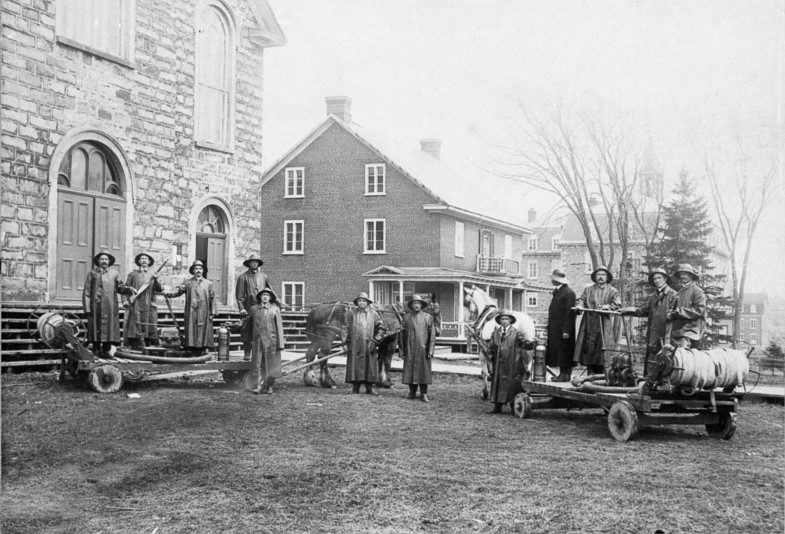 c. 1915
Public domain or CC0, made before 1950, from Wikimedia Commons; old views of places can be drawings, prints or maps of their time. Each credit opens the image’s page.
Around Saint-Tite, within 25 km, most dated places come from the decades after Confederation
No place near Saint-Tite is close: these lie up to 25 km away, each by its first recorded construction date.
Oldest of all: Maison Dupont, Saint-Narcisse, 1871. Within 25 km, building dates exist for 11 places.
11 historic places within 25 km of Saint-Tite
They are 4 municipal citations, 3 places classified by Québec and 2 Recognized Federal Heritage Buildings. The earliest date is Maison Dupont’s, 1871, 19 km away. Closest of all is Caserne Patrick-Douville, in Sainte-Thècle, 10 km off.
The 11 nearest, within 25 km
| Caserne Patrick-DouvilleMunicipal citation (Québec) · 1930 · 10 km away, in Sainte-Thècle |
| Calvaire du rang Saint-JosephMunicipal citation (Québec) · 1910 · 13 km away, in Saint-Ubalde |
| Maison DupontMunicipal citation (Québec) · 1871 · 19 km away, in Saint-Narcisse |
| Former Saint-Narcisse Power StationClassified heritage building (Québec) · 1897 · 22 km away, in Saint-Narcisse |
| Annexe de l'Ancienne-Centrale-Hydroélectrique-de-Saint-NarcisseClassified heritage building (Québec) · 1904 · 22 km away, in Saint-Narcisse |
| Domaine BeauséjourCited heritage site (Québec) · 1885–1950 · 23 km away, in Shawinigan |
| Wabenaki LodgeRecognized Federal Heritage Building · 1886–1915 · 23 km away, in Shawinigan |
| Caserne ChamplainClassified heritage building (Québec) · 1922 · 23 km away, in Shawinigan |
| Andrew LodgeRecognized Federal Heritage Building · 1920–1929 · 24 km away, in Shawinigan |
| Canadian National Railways Station, Shawinigan, QuebecHeritage Railway Station · 1929–1930 · 24 km away, in Shawinigan |
| Canadian Pacific Railway Station, Shawinigan, QuebecHeritage Railway Station · 1927–1928 · 25 km away, in Shawinigan |
A growing town: 5.7% of Saint-Tite’s homes went up from 2016 to 2021, against 4.1%
Homes built from 2001 to 2015 make up just 7% of Saint-Tite’s, against 15% in the typical town. Saint-Tite built little from 1981 to 2000: 17% of its homes, where most towns have 23%. More than half of Saint-Tite’s housing predates 1981.
2021 Census, private dwellings by period of construction (Statistics Canada); the typical town is the middle Canadian town of 2,500 or more.
5 lives that began in Saint-Tite before 1914
The widest known is Gratien Gélinas: 8 Wikipedia editions. It starts with Josaphat Groleau, born in 1893. Albert Sanschagrin closes the list, born in 1911. Of them all, Josaphat Groleau lived longest: 100 years, until 1993.

Everyone born in Saint-Tite → Born before 1914 (the page’s periods: Confederation to the First World War). Birthplaces from Wikidata, each checked against the person’s Wikipedia article.
How Saint-Tite compares with 16 towns its size
Towns of 3,700 to 3,800 residents, by places on the registers.
Just one has more: East Hawkesbury. Their median is 0. For 15, the registers list nothing.
Saint-Tite and its neighbours
| Town | People | Places | Highest | Oldest |
|---|---|---|---|---|
| Saint-Tite | 3,759 | 0 | 0 | — |
| Hérouxville | 1,570 | 0 | 0 | — |
| Sainte-Thècle | 2,422 | 0 | 0 | — |
| Saint-Stanislas | 1,040 | 0 | 0 | — |
| Saint-Narcisse | 1,848 | 3 | 2 | 1871 |
Saint-Tite in brief
In Saint-Tite, 40% of homes were built before 1961, against 18% in the typical town. Among the lives from its past: Gratien Gélinas (1909), Joseph-Alfred Mongrain (1908) and Albert Sanschagrin (1911). Towns its size usually have more historic places; the middle one has 0.
What this data can and can’t tell you
- People and events. The open directory puts its national historic persons nowhere, so a town shows one only on firm ground: a birth there, matched by name and life years, or a historic place there named for the person whose record says so. Events are left out.
- Protection. In Québec, a classement or a municipal citation under the Loi sur le patrimoine culturel protects the building in law; a federal designation recognises significance and binds only federal owners.
- The grade. There is no history grade: the page sets out the record and compares it with other towns.
- The federal register. Parks Canada’s Directory of Federal Heritage Designations lists every National Historic Site, federal heritage building, heritage railway station and lighthouse; the Canadian Register of Historic Places adds their statements in English and French.
- The tiers. Tiers follow the designation: national recognition and classement first, other federal designations next, provincial and local listings last.
- Québec’s register. Québec is the one province whose register is open: classements, declarations and municipal citations, described by the ministry in French.
Questions about Saint-Tite’s history
How many historic places does Saint-Tite have on the registers?
None within Saint-Tite itself; the nearest is 10 km off: Caserne Patrick-Douville, in Sainte-Thècle.
When did Saint-Tite become a municipality?
By Wikidata, Saint-Tite dates from 1833; the record doesn’t say whether that is a founding, an incorporation or a merger.
How old are the homes in Saint-Tite?
The 2021 Census dates 40% of its homes before 1961 (18% in the typical town).
Contains information licensed under the Open Government Licence – Canada (Parks Canada).
Sources: Parks Canada, Directory of Federal Heritage Designations · Canadian Register of Historic Places (federal extract) · Wikidata (CC0) for map points, other names and articles · Statistics Canada, 2021 Census (homes by period of construction). Under the Statistics Canada Open Licence.
Adapted from Statistics Canada (Census of Population 2021, population estimates 2025, 2021 census boundaries) under the Statistics Canada Open Licence; this does not constitute an endorsement by Statistics Canada. Neighbourhood names in some cities © OpenStreetMap contributors (ODbL).