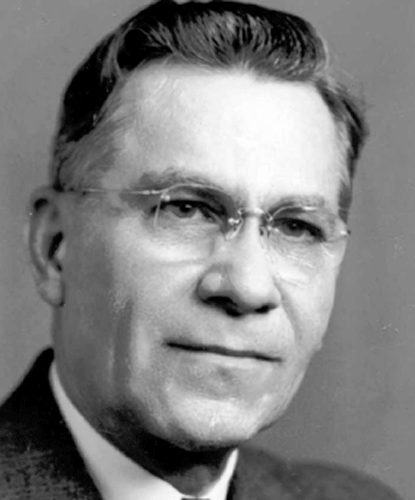
 #1
Writing & Arts
John Garand
1888–1974Canadian firearm designer
18 Wikipedia and sister-site articlesWikipedia ↗
Each edition grades its towns against each other only.
Articles in 18 languages make the Canadian firearm designer John Garand the best known. Close behind are Chantal Soucy and Agnès Lefort. 5 of them were born before Confederation, more than in any other period. The list reaches back to Pierre-Rémi Narbonne, born in 1806, one of 5 born before Confederation.
Compared with the usual town, leaders are the most over-represented field, at 2.5 times.
Compared with the usual town (everyone listed in Canadian towns, split by field). Tap a field to see the people in it.
The 1880s saw the most births of any decade: 2.
Dots are people, stacked in the decade of their birth.
The three are covered in 18, 4 and 3 languages: John Garand, Chantal Soucy and Agnès Lefort.
#1Canadian firearm designer
 #2
Canadian politician
Still to come: 8 more, from 1806 to 1982.


No one matches both filters.
Of the towns nearby, Châteauguay lists the most people: 25.
 Châteauguay · 14 kmVanessa Gilles & 24 moreDJKahnawake · 15 kmDevery Jacobs & 18 moreMCSaint-Constant · 13 kmMelissa Citrini-Beaulieu & 15 moreDBSainte-Martine · 13 kmDenis Brière & 8 moreGSSaint-Isidore · 5 kmGeorges St-Pierre & 6 moreCTSaint-Michel · 4 kmCharles Trudeau & 5 moreCHSaint-Édouard · 9 kmClaude Hamelin & 3 moreABSaint-Mathieu · 10 kmAbraham Bernard & 3 more
The top name is John Garand (Canadian firearm designer), going by Wikipedia coverage. Next come Chantal Soucy and Agnès Lefort.
Wikidata has 14 born here; the ones not shown have no article that agrees, or none at all.
That is 55% of the town’s list, against 22% across Canadian towns.
Pierre-Rémi Narbonne, born in 1806. The youngest on the list was born in 1982.
Wikidata’s record must put the birth inside Saint-Rémi’s municipal boundary (Statistics Canada’s 2021 census subdivision) or one of its hospitals or districts, and an English or French Wikipedia article must agree. The list leaves out adult performers, people known mainly for crimes and anyone born elsewhere.
The likeliest reasons: a birthplace recorded only as a province or as Canada, a hamlet or rural area with no page of its own, or an article that gives another place or none. Fixing Wikidata or Wikipedia brings them onto the list at the next refresh, as long as the two then agree.
Birthplaces, descriptions, years, occupations and the count of Wikipedia and sister-site articles come from Wikidata (CC0). Each birthplace is checked against the person’s English Wikipedia article, or the French one where English says nothing or has no article; the articles are linked, never quoted. Wikidata’s Statistics Canada code, the place’s name or its point inside the 2021 census outline puts a birth in a town, and a birth given only as a split city stays on that city’s page. Fields are read from the description and occupations, and the list runs by number of articles. “The usual town” is everyone listed across Canadian towns. Portraits: each person’s Wikidata image, from Wikimedia Commons under the licence below (our copy, resized).
Adapted from Statistics Canada (Census of Population 2021, population estimates 2025, 2021 census boundaries) under the Statistics Canada Open Licence; this does not constitute an endorsement by Statistics Canada. Neighbourhood names in some cities © OpenStreetMap contributors (ODbL).