Photo: art_inthecity from Montréal, CA · CC BY 2.0
1historic place on the registers
History of Granby · Canada’s heritage registers
Granby has 1 historic place on the registers
Église Sainte-Famille de Granby, from 1930, is Granby’s municipal citation (québec). Relative to its size Granby has 0.1 per 10,000 residents, more than 71% of Canadian towns.
Photos from Wikimedia Commons, each credited to its photographer with its licence; names open the place’s page. Tap a photo to step through them full screen.
Through time
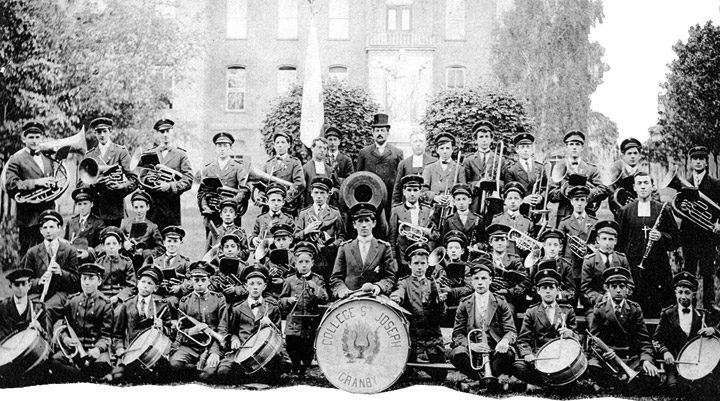
Granby, 1900 to 1948
4 old photographs of the town, from oldest to latest. Each dot on the line is a picture; tap one to open it full screen.
1890190019101920193019401950Confederation to 1900Boom yearsThe wars and betweenAfter the war
Public domain or CC0, made before 1950, from Wikimedia Commons; old views of places can be drawings, prints or maps of their time. Each credit opens the image’s page.
How it began
Granby’s milestones, starting in 1859
On paper, Granby became a village in 1859. January 1, 1859 is the date of Granby’s municipality in Wikidata, and like many such dates it may record a charter, not the first homes.
Every place on the registers inside the town, by its designation.
Provincial and local listings
Hover a dot for its name; tap one to open its page.
The 1, by tier
1 Provincial and local listings
The federal directory and the Répertoire du patrimoine culturel du Québec are both open, so every federal, provincial and municipal designation here has its point.
Points from Wikidata (Parks Canada’s files carry none) and from Québec’s register, as mapped there.
Provincial and local listings
One more place Granby or its province protects
Citations the municipality has made, registered with Québec’s ministry of culture. Each one opens its own page.
The closest heritage to Granby is Ensemble religieux de Saint-Paul-d'Abbotsford, 13 km off
They are 8 municipal citations, 2 places classified by Québec and a heritage railway station. The oldest, Moulin à eau de la Grande Barbue, dates from 1829, 16 km away. Count to 25 km and there are 11.
A growing town: 7.4% of Granby’s homes went up from 2016 to 2021, against 4.1%
More than half of Granby’s housing predates 2001. Granby’s largest group of homes, 27%, went up from 1961 to 1980. Before 1961: 19% of Granby’s homes, near the usual 18%.
19%
Before 1961
27%
1961–80
27%
1981–2000
20%
2001–15
7.4%
2016–21
GranbyTypical town
2021 Census, private dwellings by period of construction (Statistics Canada); the typical town is the middle Canadian town of 2,500 or more.
Born here
10 lives that began in Granby before 1914
Isabel Meighen lived longest, to 103, dying in 1985. The earliest is Philip K. Gleed, born in 1834. At the other end is Marcel Boivin, from 1912. Of the 10, 6 were born in the decades after Confederation.
Philip K. Gleed
Palmer Cox
Michael Felix Hackett
Statira Elizabeth Frame
Isabel Meighen
Georges Cabana
René Saint-Pierre
Lorenzo Cadieux
Jean-Claude Lessard
Marcel Boivin
1800182518501875190019251950
Palmer Cox1840–1924 · Canadian illustrator and author
GC
Georges Cabana1894–1986 · Canadian Roman-Catholic archbishop
MB
Marcel Boivin1912–1974 · Canadian politician
Philip K. Gleed1834–1897 · American politician
Michael Felix Hackett1851–1926 · Canadian politician
LC
Lorenzo Cadieux1903–1976 · Canadian historian
SF
Statira Elizabeth Frame1858–1935 · Canadian painter
Isabel Meighen1882–1985 · Wife of Canadian Prime Minister
Everyone born in Granby → Born before 1914 (the page’s periods: Confederation to the First World War). Birthplaces from Wikidata, each checked against the person’s Wikipedia article.
Older stock first: 19% of homes in Granby were standing by 1961, against 18% in the typical town. The count is 1 historic place. Palmer Cox (1840), Georges Cabana (1894) and Marcel Boivin (1912) lead its people of the past. Everything else is close to the norm: it has one historic place, about typical for a town its size (the middle one has 2); and its one place was designated in 2014.
How to read these numbers
What this data can and can’t tell you
•
Protection. In Québec, a classement or a municipal citation under the Loi sur le patrimoine culturel protects the building in law; a federal designation recognises significance and binds only federal owners.
•
The grade. There is no history grade: the page sets out the record and compares it with other towns.
•
Québec’s register. In Québec the ministry of culture publishes its register openly: provincial classements, declared sites and the municipalities’ citations all appear, with their descriptions.
•
The federal register. Federal places come from Parks Canada’s directory, which counts National Historic Sites, federal heritage buildings, stations and lighthouses; their statements are the register’s own.
•
The tiers. Tiers follow the designation: national recognition and classement first, other federal designations next, provincial and local listings last.
•
People and events. Persons of national historic significance come with no location; a town gets one only by birthplace (name and both life years agreeing) or by one of its own places that bears the name and whose record tells the story. Events, which can’t be tied, are left out.
Questions about Granby’s history
How many historic places does Granby have on the registers?
Inside Granby: 1 historic place.
What is the oldest building in Granby?
By its record, Église Sainte-Famille de Granby, from 1930 (Municipal citation (Québec)).
How old are the homes in Granby?
Before 1961: 19% of its homes; the typical town has 18%.
Contains information licensed under the Open Government Licence – Canada (Parks Canada). Québec register data: Ministère de la Culture et des Communications du Québec, CC BY 4.0.
Sources: Parks Canada, Directory of Federal Heritage Designations · Canadian Register of Historic Places (federal extract) · Répertoire du patrimoine culturel du Québec (MCC, Données Québec) · Wikidata (CC0) for map points, other names and articles · Statistics Canada, 2021 Census (homes by period of construction). Under the Statistics Canada Open Licence.


 c. 1900
 c. 1916
 1948
 1948
 Local


