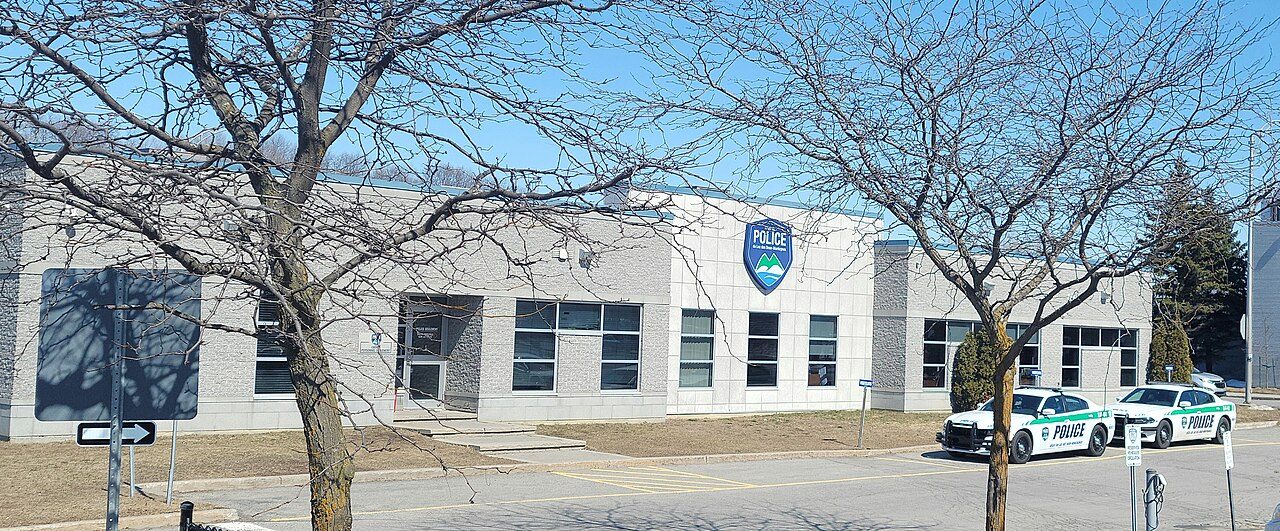
 Photo: Gaétan Veillette · CC BY-SA 4.0
With 0.4 jobs for each resident in work, most of Deux-Montagnes commutes out
When the 2021 census was taken, 6.3% of people in Deux-Montagnes who wanted a job had none; the middle of Canadian towns is 9.9%. Getting to work from Deux-Montagnes takes 31.2 minutes on average, an hour or more for 11%. Half the households in Deux-Montagnes had more than $84,900 in 2020, before tax, next to $85,900 for the middle of Canadian towns.
Deux-Montagnes at work: what stands out
More people in work than most towns
At the 2021 census 79% of the 15-to-64s were in work (73% in the middle of Canadian towns); across all ages 15 and over, 64%. In work ↓
Less unemployment than most towns
Unemployment was 6.3% at the 2021 census, against 9.9% in the middle of Canadian towns. The Labour Force Survey for the wider area read 6.9% in October 2026. Unemployment ↓
Longer trips than most towns
Commutes take 31.2 minutes on average, against 26 in the middle of Canadian towns; 11% take an hour or more. The trip to work ↓
Written from the data on this page: Statistics Canada’s 2021 Census, its commuting tables, Employment Insurance and the Labour Force Survey.
Jobs & income in Deux-Montagnes: graded B−
Better than 47% of Canadian towns on three measures together, #279 of 507 in Quebec.
Its strongest measure is the share of 15-to-64s in work; its weakest, trip times.
Graded against Canadian towns of 2,500 people or more; less unemployment and a shorter commute count in its favour.
How the grade works
Census 2021 measures, weighed equally against every Canadian town and neighbourhood of 2,500 people or more: the share of residents aged 15 to 64 in work, median household income (2020), the unemployment rate and the average commute. Each becomes a percentile; their average sets the letter.
Work for 79% of 15-to-64s in Deux-Montagnes
Of the 5 other places of 2,500 people or more in the Deux-Montagnes census division, one has a smaller share of 15-to-64s in work.
Take in all adults, retirees with them, and only 64% were working. The Labour Force Survey’s employment rate for the wider area was 62% in October 2026. 69% of residents aged 15 and over were in the labour force, in work or seeking it. These are census figures from May 2021, during COVID’s third wave; jobs have recovered since, which the Labour Force Survey shows.
Statistics Canada, 2021 Census: people in work of any age over residents aged 15 to 64, and the census unemployment rate (15 and over); the 25-to-54 rate is Statistics Canada’s own (98-10-0485). The Labour Force Survey and business counts are context, not grade inputs.
Time on the road to work from Deux-Montagnes
Only 23% get to work within a quarter-hour, against 31% in the middle of Quebec’s towns. Statistics Canada’s own average, timed exactly rather than by band, is 28.4 minutes. In the middle of Quebec’s towns, the average commute is 26.5 minutes.
Statistics Canada, 2021 Census: commuting duration in five bands; our average uses each band’s middle (75 minutes for an hour or more), so it runs about two minutes above Statistics Canada’s own.
More workers leave Deux-Montagnes each day than arrive
Outbound commuters outnumber inbound ones about 3 to 1. Of those who commute, 12% stay within the municipality; the middle of Canadian towns is 70%.
People with no fixed workplace are in neither count.
88% of Deux-Montagnes’ residents in work leave it to work; Montréal takes the most
- Montréal1,320
- Saint-Eustache1,215
- Laval1,005
- Sainte-Marthe-sur-le-Lac290
- Boisbriand205
- Mirabel165
- Dorval125
- Blainville100
- Terrebonne95
- Saint-Jérôme80
Of those coming in, Saint-Eustache supplies the most: 305.
Statistics Canada, 2021 Census (98-10-0459): commuting flows between municipalities (census subdivisions), rounded to 5; linked names have their own pages.
Household income in Deux-Montagnes
Before tax, 2020: higher than in 66% of Canadian towns.
The middle of Quebec’s towns is $74,100, and Deux-Montagnes is 15% above it. Of the 5 other places of 2,500 or more in the Deux-Montagnes census division, 3 have a higher median. In 2020 emergency benefits topped up many low incomes, and the census counts them here.
Statistics Canada, 2021 Census: median total income of households in 2020, before tax (a neighbourhood’s estimated from its dissemination areas’ income groups).
Without a car, 13% of Deux-Montagnes’ commuters get to work
By transit: 8.1% of commuters, well above the 1.5% in the middle of Quebec’s towns. 86% drive to work, fewer than the 90% in the middle of Quebec’s towns. Home was the workplace for 25%, where the middle of Canadian towns has 21%.
Statistics Canada, 2021 Census: main mode of commuting; average durations by mode from table 98-10-0458 (whole municipalities only).
EI claims in the Deux-Montagnes census division run 39% above their 2019 level
The count topped out in January 2021 at 6,100 people, 3.9 times the 2019 average. Roughly 3.7 in every 100 people aged 15 to 64 in the division draw EI. In the twelve months to August 2026 the number rose by 1%.
Statistics Canada, Employment Insurance beneficiaries by census division (14-10-0323): all income benefits, not seasonally adjusted. EI counts are context, not part of any grade.
People receiving Employment Insurance each month, as a share of the 2019 average (100). For EI beneficiaries, the only official count covers all of the Deux-Montagnes census division, Deux-Montagnes included.
Walking in Deux-Montagnes earns A
Better than 94% of Canadian towns on two measures together, #140 of 507 in Quebec.
OpenStreetMap (© OpenStreetMap contributors, ODbL); active commuting from the 2021 Census.
How Deux-Montagnes ranks: 223rd of 498 Canadian towns of 13,000 to 25,000
| # | Place | People | In work, 15–64 | Unemployment | Household income | Grade |
|---|---|---|---|---|---|---|
| 1 | Yellowknife Northwest Territories | 22,858 | 80% | 5.8% | $148K | A+ |
| 2 | Sillery Quebec | 13,950 | 81% | 6.2% | $120K | A+ |
| 3 | Central Saanich British Columbia | 18,184 | 85% | 4.9% | $103K | A+ |
| 4 | Cap-Rouge Quebec | 17,139 | 81% | 4.3% | $126K | A+ |
| … | ||||||
| 7 | L'Aéroport Quebec | 13,630 | 84% | 5.2% | $90K | A+ |
| … | ||||||
| 221 | Parksville British Columbia | 15,371 | 75% | 6.7% | $67K | B− |
| 222 | Edgemont Alberta | 15,359 | 68% | 13% | $125K | B− |
| 223 | Deux-Montagnes Quebec | 18,516 | 79% | 6.3% | $85K | B− |
| 224 | Strathmore Alberta | 16,416 | 74% | 9.8% | $91K | B− |
| 225 | Woodbridge Ontario | 18,835 | 73% | 13% | $96K | B− |
| … | ||||||
| 498 | Oakridge Ontario | 13,913 | 51% | 21% | $60K | D− |
Ordered by Jobs & income Grade: the top three, the places either side of Deux-Montagnes, and others among Quebec’s towns.
Work in the places around Deux-Montagnes
| Place | In work, 15–64 | Unemployment | Household income | Average trip | Jobs | Walk |
|---|---|---|---|---|---|---|
| Deux-Montagnes | 79% | 6.3% | $85K | 31.2 min | B− | A |
| Laval-Ouest 2.3 km | 73% | 8.6% | $87K | 31.9 min | C | A |
| Saint-Eustache 3.1 km | 80% | 6% | $80K | 27.2 min | B | A− |
| Sainte-Marthe-sur-le-Lac 3.5 km | 82% | 5.2% | $97K | 31.3 min | B+ | A− |
| L'Île-Bizard–Sainte-Geneviève 5.7 km | 78% | 7.5% | $99K | 30.7 min | B | A |
| Fabreville 6.8 km | 77% | 7.7% | $95K | 29.2 min | B | A− |
| Sainte-Dorothée 6.9 km | 78% | 8.4% | $116K | 28.5 min | B+ | A |
The people of each place: the share in work, unemployment, household income and the average commute, with both grades once they come.
What this data can and can’t tell you
What each figure measures for Deux-Montagnes, where it comes from, and what it leaves out.
- In work. Everyone with a job, whatever their age, divided by the residents aged 15 to 64 at the 2021 Census: below the municipality the census doesn’t split work by age, and this is the one rate every town and neighbourhood can be given.
- Unemployment. Unemployed people over the labour force (in work or looking), aged 15 and over, on census day.
- Household income. The census median total income of households in 2020, before tax; a neighbourhood’s is estimated from its dissemination areas’ income groups.
- Trip times. Commuters picked a band for their usual trip (under 15 minutes, 15 to 29, and so on). We place each person at the middle of their band, which lands a little above Statistics Canada’s own timed average.
- Where people commute. Who travels where, from the census: workers with a regular workplace, sorted by the municipality they live in and the one they work in.
- Employment Insurance. People receiving EI benefits each month, counted for the census division. It follows the local job market; it isn’t an unemployment rate.
- The Labour Force Survey. The most recent unemployment rate on the page comes from this monthly survey, which covers the wider metro area or economic region, not the town.
- Which towns we compare. Towns and city neighbourhoods of 2,500 people or more, never a whole city and never a First Nations reserve. Middles are medians.
Questions about work in Deux-Montagnes
Where do people in Deux-Montagnes work?
Only 12% work in Deux-Montagnes itself; the rest go first to Montréal (1,320) and Saint-Eustache (1,215).
How many jobs are there in Deux-Montagnes?
Statistics Canada counted 277 businesses with employees in June 2026.
What is the unemployment rate in Deux-Montagnes?
The census put unemployment at 6.3% in May 2021, where the middle of Canadian towns was 9.9%. More recently, in October 2026, the Labour Force Survey had the Montréal metro area at 6.9%.
What is the average household income in Deux-Montagnes?
The median household in Deux-Montagnes had $84,900 before tax in 2020, against $85,900 in the middle of Canadian towns.
How do people in Deux-Montagnes get to work?
By car: 86% of commuters, 8.1% take public transit, 3.6% walk and 1.2% cycle; on census day 25% of those in work worked from home.
How long is the commute from Deux-Montagnes?
31.2 minutes is the average trip, with 23% of commuters there in under 15 minutes and 11% taking an hour or more.
Sources: Statistics Canada, 2021 Census of Population (Census Profile) · Statistics Canada, tables 98-10-0458 and 98-10-0459 (commuting) · Statistics Canada, table 14-10-0323 (EI beneficiaries) · Statistics Canada, Labour Force Survey (14-10-0459, 14-10-0462) · Statistics Canada, Canadian Business Counts (33-10-1176) · grades: TownRatings. Under the Statistics Canada Open Licence.
Adapted from Statistics Canada (Census of Population 2021, population estimates 2025, 2021 census boundaries) under the Statistics Canada Open Licence; this does not constitute an endorsement by Statistics Canada. Neighbourhood names in some cities © OpenStreetMap contributors (ODbL).