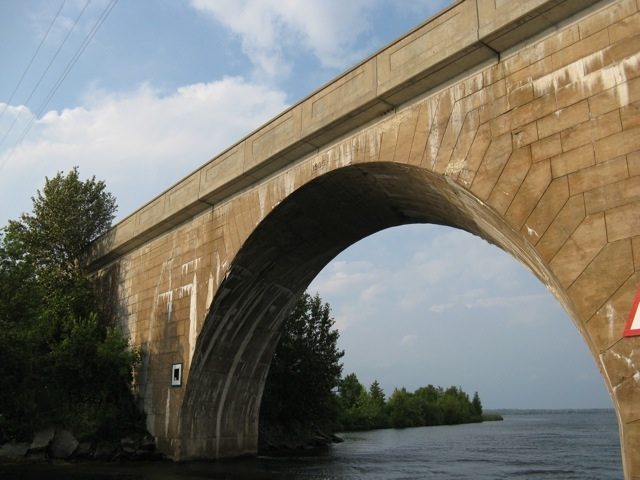
Lindsay’s entry is Canal Lake Concrete Arch Bridge (1905), a national historic site. Relative to its size Lindsay has 0.1 per 10,000 residents, more than 71% of Canadian towns.
Photos from Wikimedia Commons, each credited to its photographer with its licence; names open the place’s page. Tap a photo to step through them full screen.
Through time
The old face of Lindsay
The past in one picture: one old photograph of the town. A tap opens it at full size, with its credit.
Public domain or CC0, made before 1950, from Wikimedia Commons; old views of places can be drawings, prints or maps of their time. Each credit opens the image’s page.
How it began
Lindsay on record since 1889
For the municipality of Lindsay itself, Wikidata records 2001, a date that can be a founding as much as a merger. Rail service is on record from 1889, when Fenelon Falls station opened.
Every place on the registers inside the town, by its designation.
Highest designations
Each dot is a place: point at it for the name, tap it for its page.
The 1, by tier
1 Highest designations
Most entries are federal, from Parks Canada’s Directory of Federal Heritage Designations; local listings outside Québec are known only through Wikidata items with an article.
Points from Wikidata (Parks Canada’s files carry none) and from Québec’s register, as mapped there.
Highest designations
One place in Lindsay with the highest designation
National Historic Sites and Classified Federal Heritage Buildings, Canada’s highest federal recognition. Each one opens its own page.
Leave Lindsay and the first historic place is Old Stone Church, 31 km away
Among them are 6 National Historic Sites and 3 provincial or municipal listings. The oldest, Cathedral of Saint Peter-in-Chains, dates from 1837, 34 km away. Between them, 4 towns share them, mainly Peterborough, Beaverton and Port Perry.
The 9 nearest, within 50 km
Old Stone ChurchNational Historic Site · 1840–1854 · 31 km away, in Beaverton
Leaskdale ManseNational Historic Site · 1886–1887 · 42 km away, in Uxbridge
Homes by age
A town of older homes: 27% of Lindsay’s were built before 1961 (18% is typical)
Count back from today and half of Lindsay’s homes are older than 1981. Lindsay’s largest group of homes, 29%, went up from 1961 to 1980. From 2016 on, Lindsay built 3.8% of its homes, near the typical 4.1%.
27%
Before 1961
29%
1961–80
27%
1981–2000
14%
2001–15
3.8%
2016–21
LindsayTypical town
2021 Census, private dwellings by period of construction (Statistics Canada); the typical town is the middle Canadian town of 2,500 or more.
Born here
Lindsay’s people of the past, born 1844–1913
Before 1914, 28 births here made the record. Most of them, 25 of 28, came into the world in the decades after Confederation. 10 Wikipedias cover J. Carson Mark, the most of anyone here. Longest lived was Elizabeth Bagshaw, 101 years in all (1982). The timeline keeps to the 20 best known.
Denis Buckley
William Alfred Preston
Fergus Patrick McEvay
Wilbert McIntyre
Robert Charles Matthews
Archie McEachern
J. K. L. Ross
Billy McGimsie
Flora Eaton
Elizabeth Bagshaw
Charles Norris Cochrane
Speed Moynes
James Henry Forman
Clayton Hodgson
Dick Sutton
Jack Smith
Joe Primeau
Patricia Blomfield Holt
Bruce Beer
J. Carson Mark
1800182518501875190019251950
JM
J. Carson Mark1913–1997 · Canadian-American mathematician
Fergus Patrick McEvay1852–1911 · Canadian archbishop
Joe Primeau1906–1989 · Canadian ice hockey player
J. K. L. Ross1876–1951 · Canadian businessman
EB
Elizabeth Bagshaw1881–1982 · Canadian doctor
CC
Charles Norris Cochrane1889–1945 · Canadian historian and philosopher
PH
Patricia Blomfield Holt1910–2003 · Canadian musician
RM
Robert Charles Matthews1871–1952 · Canadian politician
Everyone born in Lindsay → Born before 1914 (the page’s periods: Confederation to the First World War). Birthplaces from Wikidata, each checked against the person’s Wikipedia article.
In brief
Lindsay in brief
Lindsay’s homes from before 1961 come to 27%, against 18% in the typical town. There are 1 historic place in all, one with the highest designation; Canal Lake Concrete Arch Bridge heads them. Of its people of the past, the best known are J. Carson Mark (1913), Fergus Patrick McEvay (1852) and Joe Primeau (1906). The other figures are unremarkable: it has one historic place, about typical for a town its size (the middle one has 3); and its one place was designated in 1988.
How to read these numbers
What this data can and can’t tell you
•
The grade. History is described, not graded, for every Canadian town.
•
People and events. National historic persons carry no place in the open file. They appear on a town’s page when born there (same name, same birth and death years) or when a historic place inside it carries their name and its record names them with their dates; national historic events don’t appear.
•
The tiers. Three tiers: the top for National Historic Sites, classified federal buildings and Québec’s classements, a second for the other federal designations, a third for provincial and municipal listings.
•
Map points. Federal places get their map points from Wikidata, since Parks Canada’s files carry none; they are as mapped there.
•
The federal register. The federal list is complete and open: Parks Canada’s directory for the designations, the Canadian Register of Historic Places for what each one is and why it matters.
•
Provincial and municipal lists. Only Wikidata gives open access to listings on provincial and municipal registers outside Québec; without an article such a place is counted but not paged.
•
Protection. National historic designation honours a place but binds only federal owners; a private building’s protection depends on its province or municipality.
Questions about Lindsay’s history
Which places in Lindsay have the highest designation?
It is Canal Lake Concrete Arch Bridge.
What is the oldest building in Lindsay?
Canal Lake Concrete Arch Bridge (National Historic Site): the first construction date on its record is 1905.
How old are the homes in Lindsay?
The 2021 Census dates 27% of its homes before 1961 (18% in the typical town).
Contains information licensed under the Open Government Licence – Canada (Parks Canada).
Sources: Parks Canada, Directory of Federal Heritage Designations · Canadian Register of Historic Places (federal extract) · Wikidata (CC0) for map points, other names and articles · Statistics Canada, 2021 Census (homes by period of construction). Under the Statistics Canada Open Licence.

 1911
 Top


