
 Fed
Heritage Railway Station · 1855–1857VIA Rail/Canadian National Railways Station, Georgetown, Ontario55 Queen StreetPhoto: Balcer · CC BY 2.5 · Commons file
 VIA Rail/Canadian National Railways Station, Georgetown, Ontario · Photo: Balcer · CC BY 2.5
2historic places on the registers
History of Georgetown · Canada’s heritage registers
2 historic places on the heritage registers in Georgetown
The list takes in a provincial or municipal listing and a heritage railway station. VIA Rail/Canadian National Railways Station, Georgetown, Ontario, begun in 1855, is the oldest by its record. Georgetown has 0.3 for every 10,000 people, a higher rate than 72% of Canadian towns. There are also 11 listings on provincial or municipal registers with no open description, so no pages.
Historic places
2
0.3 per 10,000 residents
Highest designations
0
National Historic Sites and Classified Federal Heritage Buildings
Other federal designations
1
Recognized buildings, railway stations, lighthouses
Provincial and local listings
1
provincial and municipal listings with an encyclopedia article
Oldest building
1855
the first construction date on its record
Homes built before 1961
20%
typical town: 18%
In pictures
Georgetown’s historic places in 2 photos
Both places on Georgetown’s registers have a photo here. Up first are “VIA Rail/Canadian National Railways Station, Georgetown, Ontario” and Boston Presbyterian Church.
Photos from Wikimedia Commons, each credited to its photographer with its licence; names open the place’s page. Tap a photo to step through them full screen.
The map
Where Georgetown’s history is
Every place on the registers inside the town, by its designation.
Other federal designationsProvincial and local listings
Each dot is a place: point at it for the name, tap it for its page.
The 2, by tier
1 Other federal designations1 Provincial and local listings
The federal directory kept by Parks Canada supplies most of these places; provincial and municipal lists outside Québec aren’t open data, so only the ones Wikidata documents with an article appear.
Points from Wikidata (Parks Canada’s files carry none) and from Québec’s register, as mapped there.
Other federal designations
One more federal designation in Georgetown
Recognized Federal Heritage Buildings, heritage railway stations and lighthouses. Each one opens its own page.
Provincial and local listings
On a provincial or local list in Georgetown: one place
Provincial and municipal listings that Wikidata records and an encyclopedia describes. Each one opens its own page.
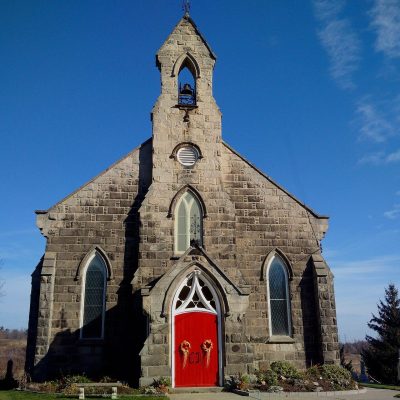 Local
Designated heritage property (part IV) · 1868Boston Presbyterian ChurchPhoto: Johnarobb · CC BY-SA 4.0 · Commons file
Around the town
The closest heritage to Georgetown is “Former Canadian National Railways (VIA Rail/GO Transit) Station, Brampton, Ontario”, 14 km off
By designation: 2 provincial or municipal listings and a heritage railway station. The radius of 25 km holds 3. Oldest of them is Rockwood Academy (1850), 17 km off.
The 3 nearest, within 25 km
| Former Canadian National Railways (VIA Rail/GO Transit) Station, Brampton, OntarioHeritage Railway Station · 1907–1908 · 14 km away, in Downtown |
| Rockwood AcademyOntario Heritage Trust property · 1850 · 17 km away, in Rockwood |
| LislehurstDesignated heritage property (part IV) · 1885 · 23 km away, in Erin Mills |
Homes by age
Most of Georgetown’s homes went up from 1961 to 1980: 26%
24% of Georgetown’s homes were built from 2001 to 2015, more than the typical town’s 15%. Like the typical town (18%), Georgetown has 20% of its homes from before 1961. From 2016 on, Georgetown built 4.1% of its homes, near the typical 4.1%.
20%
Before 1961
26%
1961–80
26%
1981–2000
24%
2001–15
4.1%
2016–21
GeorgetownTypical town
2021 Census, private dwellings by period of construction (Statistics Canada); the typical town is the middle Canadian town of 2,500 or more.
Born here
Georgetown’s past in lives: one nationally designated
5 of the 10 were born in the years before Confederation. 14 Wikipedias cover William Ross, the most of anyone here. There are 10 people born here before 1914 with an article to show for it. John Roaf Barber comes first, born in 1841.
John Roaf Barber
Robert Walter
Thomas Chisholm
John Wycliffe Lowes Forster
Donald Mann
Arthur A. C. Moore
W. Stewart Wallace
Karl Clark
William Ross
John Watkins
1800182518501875190019251950
WR
William Ross1900–1992 · Canadian rower

Karl Clark1888–1966 · Canadian chemist

W. Stewart Wallace1884–1970 · Canadian historian, librarian and editor
JW
John Watkins1902–1964 · Canadian diplomat

John Wycliffe Lowes Forster1850–1938 · Canadian artist

Arthur A. C. Moore1880–1935 · Canadian ice hockey player

Robert Walter1841–1921 · Canadian American physician

Thomas Chisholm1842–1931 · Canadian politician
Everyone born in Georgetown → Born before 1914. Birthplaces from Wikidata, each checked against Wikipedia; national historic persons from Parks Canada’s Directory of Federal Heritage Designations, matched by name and life years.
Neighbours
Georgetown and its neighbours
| Town | People | Places | Highest | Oldest |
|---|---|---|---|---|
| Georgetown | 68,265 | 2 | 0 | 1855 |
| Creditview | 5,598 | 0 | 0 | — |
| Alloa | 29,669 | 0 | 0 | — |
| Spring Valley | 12,564 | 0 | 0 | — |
| Mount Pleasant North | 10,103 | 0 | 0 | — |
| Mount Pleasant Village | 19,719 | 0 | 0 | — |
| New Springbrook | 12,804 | 0 | 0 | — |
In brief
Georgetown in brief
The pre-1961 share of Georgetown’s homes is 20%, against 18% in the typical town. All told, the registers hold 2 historic places. Its people of the past include William Ross (1900), Karl Clark (1888) and W. Stewart Wallace (1884). Beyond that, 2 historic places is about usual for its size (the median is 2); and its designation dates from 1994.
How to read these numbers
What this data can and can’t tell you
- Provincial and municipal lists. Only Wikidata gives open access to listings on provincial and municipal registers outside Québec; without an article such a place is counted but not paged.
- Map points. Where a federal place sits on the map is Wikidata’s placing; the directory itself has no coordinates.
- People and events. Persons of national historic significance come with no location; a town gets one only by birthplace (name and both life years agreeing) or by one of its own places that bears the name and whose record tells the story. Events, which can’t be tied, are left out.
- The federal register. Federal places come from Parks Canada’s directory, which counts National Historic Sites, federal heritage buildings, stations and lighthouses; their statements are the register’s own.
- The grade. History isn’t one of Canada’s graded pillars, so this page describes and compares without a letter.
- Protection. Being on these registers doesn’t mean a building can’t change. Federal designation commemorates; protection is provincial or municipal, and those lists aren’t open here.
- The tiers. National Historic Sites and the most protected buildings form the top tier; recognized federal buildings, stations and lighthouses the second; provincial and municipal listings the third.
Questions about Georgetown’s history
How many historic places does Georgetown have on the registers?
Inside Georgetown: 2 historic places.
What is the oldest building in Georgetown?
VIA Rail/Canadian National Railways Station, Georgetown, Ontario, a Heritage Railway Station, begun in 1855.
Why might a heritage building in Georgetown be missing here?
Only federal designations are fully open outside Québec. 11 more listings in Georgetown are known through Wikidata alone, so they are counted, not paged.
How old are the homes in Georgetown?
The 2021 Census dates 20% of its homes before 1961 (18% in the typical town).
Contains information licensed under the Open Government Licence – Canada (Parks Canada).
Sources: Parks Canada, Directory of Federal Heritage Designations · Canadian Register of Historic Places (federal extract) · Wikidata (CC0) for map points, other names and articles · Statistics Canada, 2021 Census (homes by period of construction). Under the Statistics Canada Open Licence.
Adapted from Statistics Canada (Census of Population 2021, population estimates 2025, 2021 census boundaries) under the Statistics Canada Open Licence; this does not constitute an endorsement by Statistics Canada. Neighbourhood names in some cities © OpenStreetMap contributors (ODbL).