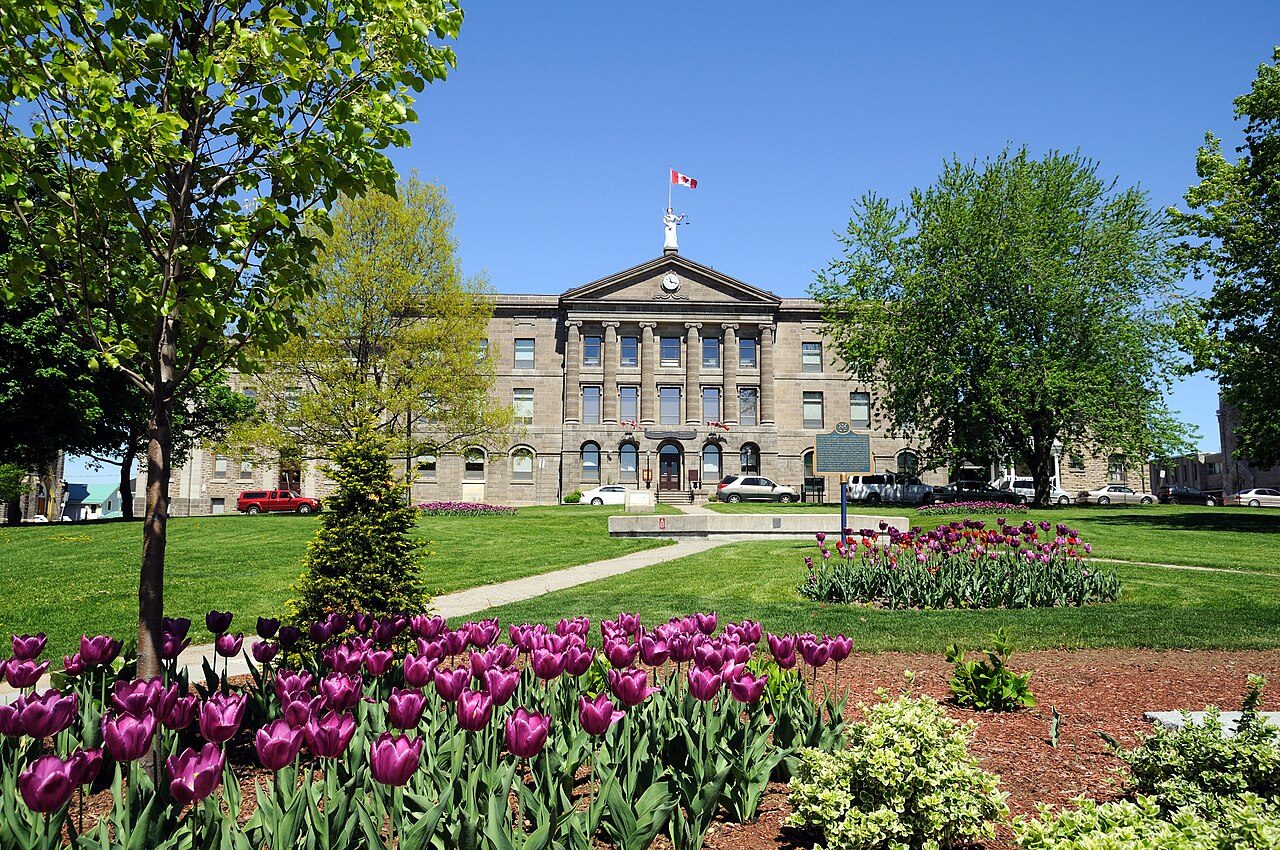
Leeds and Grenville County Court House · Photo: Wladyslaw · CC BY-SA 3.0 de
4historic places on the registers
History of Brockville · Canada’s heritage registers
Before 1961: 39% of the homes in Brockville
Against 18% in the typical town, Brockville has 2.2 times the share. The registers put 4 historic places inside its boundary, 3 of them of the highest rank. Go back to 1842 and you reach Leeds and Grenville County Court House, the oldest of them. On the list: a Recognized Federal Heritage Building.
There are photos here of 3 of Brockville’s designated places. Leading off: Leeds and Grenville County Court House and Former Brockville Post Office. 3 photographers took them.
Photos from Wikimedia Commons, each credited to its photographer with its licence; names open the place’s page. Tap a photo to step through them full screen.
Through time
The old face of Brockville
The past in one picture: the oldest view of one of its historic places. Tap it to see it full screen.
1898Confederation to 1900Fulford's boat house, Brockville, OntarioPublic domain
Public domain or CC0, made before 1950, from Wikimedia Commons; old views of places can be drawings, prints or maps of their time. Each credit opens the image’s page.
How it began
Brockville through its dates, from 1784
Brockville railway station, the earliest station on record, opened in 1872. On Wikidata the municipality of Brockville dates to 1784, with no word on whether that was its founding or a later incorporation.
Every place on the registers inside the town, by its designation.
Highest designations
Tap any dot to open that place’s own page; hovering shows its name.
The 4, by tier
3 Highest designations1 Other federal designations
What the map shows is the open record: the federal directory in full, and from provincial or municipal lists only the places Wikidata ties to an encyclopedia article.
Points from Wikidata (Parks Canada’s files carry none) and from Québec’s register, as mapped there. One place, placed by its register’s municipality, has no point and isn’t on the map.
Highest designations
3 places in Brockville with the highest designation
Their designations span 1966 to 1992. National Historic Sites and Classified Federal Heritage Buildings, Canada’s highest federal recognition. They date from 1842 (Leeds and Grenville County Court House) to 1899. Each one opens its own page.
Recognized Federal Heritage Building · 1900–1902Armoury1-9 East Avenue
Homes by age
Little new building in Brockville: 3% of homes date from 2016 to 2021, against 4.1%
Brockville built little from 2001 to 2015: 6.9% of its homes, where most towns have 15%. Count back from today and half of Brockville’s homes are older than 1981. Homes built from 1961 to 1980 make up 33% of Brockville’s, about the typical 27%.
39%
Before 1961
33%
1961–80
18%
1981–2000
6.9%
2001–15
3%
2016–21
BrockvilleTypical town
2021 Census, private dwellings by period of construction (Statistics Canada); the typical town is the middle Canadian town of 2,500 or more.
Born here
Born in Brockville, 1805 to 1903
At 94, Joan Erikson outlived the rest, dying in 1997. Canada counts William Buell Richards among its national historic persons. 40 people on the record were born here before 1914. The widest known is William Buell Richards: 9 Wikipedia editions. Only the 20 best known fit the timeline.
Billa Flint
William Buell Richards
David Ford Jones
Albert Norton Richards
John Scott
Jacob Dockstader Buell
William Jelly
Christopher Finlay Fraser
George Augustus Dana
James Buchanan, 1st Baron Woolavington
Owen Summers
George Taylor Fulford
Alexander Webb Morris
Robert McKechnie
William Henry Schofield
Henry Hague Davis
Albert Kerr
Nathan Phillips
Allen Kearns
Joan Erikson
1800182518501875190019251950
William Buell Richards1815–1889 · National historic person, 1938 · 1st Chief Justice of Canada
Albert Norton Richards1821–1897 · Canadian politician
Nathan Phillips1892–1976 · Canadian politician
Albert Kerr1888–1941 · Canadian ice hockey player
AK
Allen Kearns1894–1956 · Canadian musical theatre actor
JE
Joan Erikson1903–1997 · Canadian psychologist
David Ford Jones1818–1887 · Canadian politician
HD
Henry Hague Davis1885–1944 · Canadian lawyer and Supreme Court justice
Everyone born in Brockville → Born before 1914. Birthplaces from Wikidata, each checked against Wikipedia; national historic persons from Parks Canada’s Directory of Federal Heritage Designations, matched by name and life years.
Towns its size
Brockville has the most of 16 towns its size
Towns of 23,400 to 24,000 residents, by places on the registers.
The 2021 Census dates 39% of Brockville’s homes before 1961, against 18% in the typical town. Together that makes 4 historic places, 3 with the highest designation, led by Leeds and Grenville County Court House. No town its size has more historic places: it leads the 16 nearest in population. Among the lives from its past: William Buell Richards (1815), Albert Norton Richards (1821) and Nathan Phillips (1892). The rest is about typical: its places were designated between 1966 and 1992.
How to read these numbers
What this data can and can’t tell you
•
The tiers. The highest designations are National Historic Sites, Classified Federal Heritage Buildings and Québec’s classements; then come the other federal designations; then provincial and local listings.
•
Protection. National historic designation honours a place but binds only federal owners; a private building’s protection depends on its province or municipality.
•
The grade. This page gives no grade; history doesn’t count toward a Canadian town’s letter.
•
Provincial and municipal lists. The local and provincial lists outside Québec aren’t published openly, so this page counts what Wikidata records and pages only the places an encyclopedia describes.
•
The federal register. Federal places come from Parks Canada’s directory, which counts National Historic Sites, federal heritage buildings, stations and lighthouses; their statements are the register’s own.
•
People and events. Persons of national historic significance come with no location; a town gets one only by birthplace (name and both life years agreeing) or by one of its own places that bears the name and whose record tells the story. Events, which can’t be tied, are left out.
•
Map points. Parks Canada publishes no coordinates, so federal places are pinned where Wikidata puts them.
Questions about Brockville’s history
How old are the homes in Brockville?
39% of its homes were built before 1961, against 18% in the typical Canadian town.
Which places in Brockville have the highest designation?
They are Leeds and Grenville County Court House, Former Brockville Post Office and Fulford Place.
What is the oldest building in Brockville?
Leeds and Grenville County Court House (National Historic Site): the first construction date on its record is 1842.
Contains information licensed under the Open Government Licence – Canada (Parks Canada).
Sources: Parks Canada, Directory of Federal Heritage Designations · Canadian Register of Historic Places (federal extract) · Wikidata (CC0) for map points, other names and articles · Statistics Canada, 2021 Census (homes by period of construction). Under the Statistics Canada Open Licence.


 1898
 Top
 Top
 Top


