
 Top
National Historic Site · 1816Battle of Seven OaksCorner of Main Street and Rupertsland Blvd.Photo: J Hazard · Public domain · Commons file
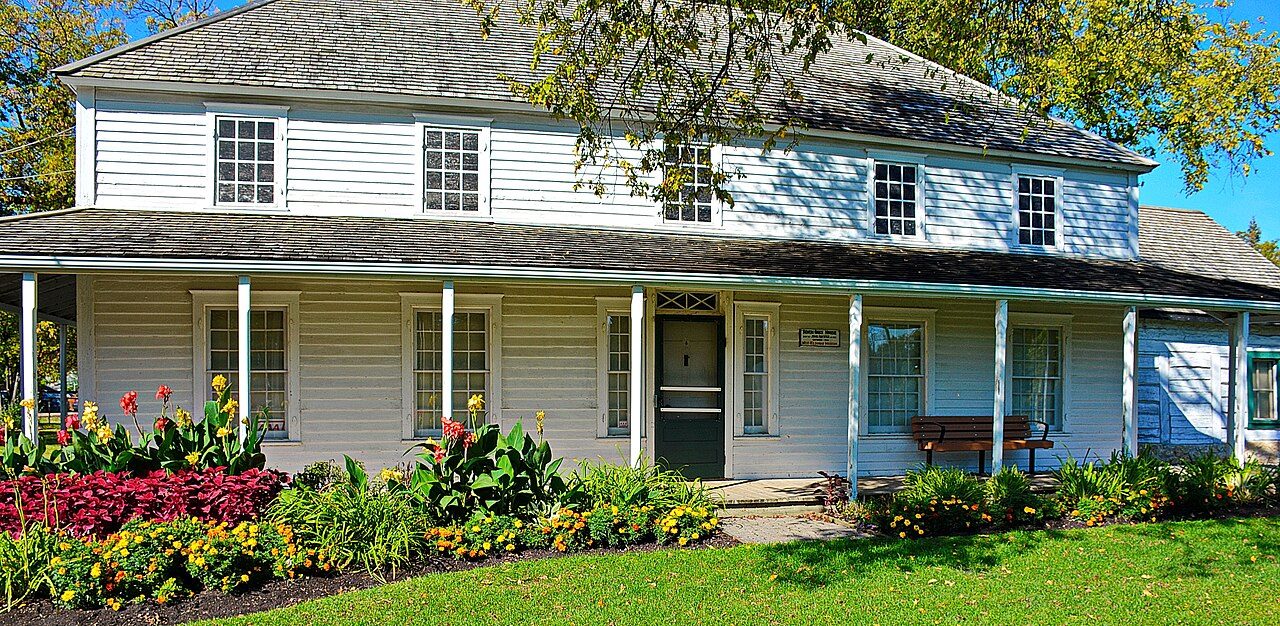 Seven Oaks House Museum · Photo: Stan Kucera · CC BY-SA 4.0
2historic places on the registers
History of Seven Oaks · Canada’s heritage registers
Older housing stands out in Seven Oaks: 79% predates 1961
Seven Oaks’s share is 4.5 times the typical 18%. The lists give 2 historic places here, one in the top tier. Its 6.2 per 10,000 residents puts it ahead of 96% of Canadian towns. Battle of Seven Oaks, begun in 1816, is the oldest by its record.
Historic places
2
6.2 per 10,000 residents
Highest designations
1
National Historic Sites and Classified Federal Heritage Buildings
Provincial and local listings
1
provincial and municipal listings with an encyclopedia article
Oldest building
1816
the first construction date on its record
Homes built before 1961
79%
typical town: 18%
In pictures
2 photographs of Seven Oaks’s designated places
Photos show both of the places Seven Oaks’s registers name. First come Battle of Seven Oaks and Seven Oaks House Museum.
Photos from Wikimedia Commons, each credited to its photographer with its licence; names open the place’s page. Tap a photo to step through them full screen.
The map
Where Seven Oaks’s history is
Every place on the registers inside the town, by its designation.
Highest designationsProvincial and local listings
Names show on hover, and a tap takes you to the place’s page.
The 2, by tier
1 Highest designations1 Provincial and local listings
Federal designations come from Parks Canada’s directory; a province’s or a council’s own listing shows here only when Wikidata holds it and an encyclopedia covers it.
Points from Wikidata (Parks Canada’s files carry none) and from Québec’s register, as mapped there.
Highest designations
The highest rank in Seven Oaks: one place
National Historic Sites and Classified Federal Heritage Buildings, Canada’s highest federal recognition. Each one opens its own page.
Provincial and local listings
One local listing in Seven Oaks
Provincial and municipal listings that Wikidata records and an encyclopedia describes. Each one opens its own page.
 Local
Listed historical resource · 1952Seven Oaks House MuseumPhoto: Stan Kucera · CC BY-SA 4.0 · Commons file
Around the town
10 places of national importance within 5 km of Seven Oaks
By designation: 10 National Historic Sites, 3 provincial or municipal listings and a Recognized Federal Heritage Building. The registers hold 14 within 5 km. Nearest comes Cathedral of St. John, 1.8 km off, in Luxton.
The 12 nearest, within 5 km
| Cathedral of St. JohnProvincial heritage site · 1.8 km away, in Luxton |
| McGregor Street ArmouryRecognized Federal Heritage Building · 1914–1916 · 2 km away, in St. John's |
| Ukrainian Labour TempleNational Historic Site · 1918–1920 · 3.1 km away, in William Whyte |
| Ross House MuseumListed historical resource · 1947 · 3.4 km away, in North Point Douglas |
| Canadian Pacific Railway Station (Winnipeg)National Historic Site · 1904–1907 · 3.7 km away, in North St. Boniface |
| Ukrainian Cultural and Educational CentreListed historical resource · 1944 · 4.1 km away, in North St. Boniface |
| Pantages Playhouse TheatreNational Historic Site · 1913–1915 · 4.4 km away, in North St. Boniface |
| Royal Manitoba Theatre CentreNational Historic Site · 1969–1971 · 4.4 km away, in North St. Boniface |
| Former Union Bank Building and AnnexNational Historic Site · 1903–1905 · 4.5 km away, in West Alexander |
| Confederation BuildingNational Historic Site · 1912–1913 · 4.5 km away, in North St. Boniface |
| Exchange DistrictNational Historic Site · 1880–1914 · 4.5 km away, in West Alexander |
| Early Skyscrapers in WinnipegNational Historic Site · 1912–1919 · 4.6 km away, in North St. Boniface |
Homes by age
Only 1.5% of Seven Oaks’s homes were built from 2016 to 2021 (4.1% is typical)
Only 12% of Seven Oaks’s homes were built from 1961 to 1980, less than the typical town’s 27%. Few of Seven Oaks’s homes date from 1981 to 2000: 5.2%, the norm 23%. Seven Oaks built little from 2001 to 2015: 0.7% of its homes, where most towns have 15%.
79%
Before 1961
12%
1961–80
5.2%
1981–2000
0.7%
2001–15
1.5%
2016–21
Seven OaksTypical town
2021 Census, private dwellings by period of construction (Statistics Canada); the typical town is the middle Canadian town of 2,500 or more.
Towns its size
Seven Oaks has the most of 16 towns its size
Towns of 3,200 to 3,300 residents, by places on the registers.
Seven Oaks2
The typical town its size has 0. 14 of them have none.
Neighbours
Seven Oaks and its neighbours
| Town | People | Places | Highest | Oldest |
|---|---|---|---|---|
| Seven Oaks | 3,244 | 2 | 1 | 1816 |
| Jefferson | 11,524 | 0 | 0 | — |
| Luxton | 3,047 | 1 | 0 | — |
| Kildonan Drive | 5,063 | 0 | 0 | — |
| St. John's | 8,492 | 1 | 0 | 1914 |
| Munroe West | 2,532 | 0 | 0 | — |
| Rossmere-B | 4,732 | 0 | 0 | — |
In brief
Seven Oaks in brief
Seven Oaks has 79% of its homes from before 1961, against 18% in the typical town. There are 2 historic places in all, one with the highest designation; Battle of Seven Oaks heads them. No town its size has more historic places: it leads the 16 nearest in population. For the rest, its one place was designated in 1920.
How to read these numbers
What this data can and can’t tell you
- Map points. Federal places get their map points from Wikidata, since Parks Canada’s files carry none; they are as mapped there.
- The federal register. The federal list is complete and open: Parks Canada’s directory for the designations, the Canadian Register of Historic Places for what each one is and why it matters.
- People and events. National historic persons carry no place in the open file. They appear on a town’s page when born there (same name, same birth and death years) or when a historic place inside it carries their name and its record names them with their dates; national historic events don’t appear.
- Provincial and municipal lists. Outside Québec, provinces’ and municipalities’ heritage registers aren’t open data; their places are known only through Wikidata items with a register number, and only those with an encyclopedia article get a page.
- The grade. This page gives no grade; history doesn’t count toward a Canadian town’s letter.
- Protection. Being on these registers doesn’t mean a building can’t change. Federal designation commemorates; protection is provincial or municipal, and those lists aren’t open here.
- The tiers. The highest designations are National Historic Sites, Classified Federal Heritage Buildings and Québec’s classements; then come the other federal designations; then provincial and local listings.
Questions about Seven Oaks’s history
How old are the homes in Seven Oaks?
79% of its homes were built before 1961, against 18% in the typical Canadian town.
Which places in Seven Oaks have the highest designation?
It is Battle of Seven Oaks.
What is the oldest building in Seven Oaks?
Battle of Seven Oaks, a National Historic Site, begun in 1816.
Contains information licensed under the Open Government Licence – Canada (Parks Canada).
Sources: Parks Canada, Directory of Federal Heritage Designations · Canadian Register of Historic Places (federal extract) · Wikidata (CC0) for map points, other names and articles · Statistics Canada, 2021 Census (homes by period of construction). Under the Statistics Canada Open Licence.
Adapted from Statistics Canada (Census of Population 2021, population estimates 2025, 2021 census boundaries) under the Statistics Canada Open Licence; this does not constitute an endorsement by Statistics Canada. Neighbourhood names in some cities © OpenStreetMap contributors (ODbL).