
 Local
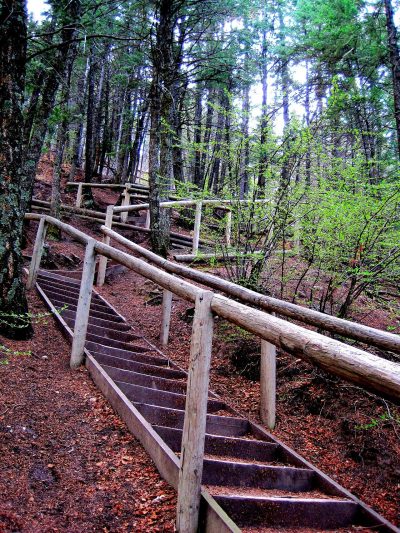
Provincial historic resourceWood's Douglas Fir Tree SanctuaryPhoto: Kellie Chouinard · CC BY-SA 3.0 · Commons file
 Photo: Dwayne Reilander · CC BY-SA 4.0
1historic place on the registers
History of Bowness · Canada’s heritage registers
Bowness has 1 historic place on the registers
Scaled to its population, Bowness’s 0.9 per 10,000 residents beats 78% of Canadian towns. From 2016 to 2021 the town added 6.3% of its homes, against 4.1% in the typical town.
Historic places
1
0.9 per 10,000 residents
Highest designations
0
National Historic Sites and Classified Federal Heritage Buildings
Provincial and local listings
1
provincial and municipal listings with an encyclopedia article
Homes built before 1961
24%
typical town: 18%
In pictures
Landmarks of Bowness
Bowness’s one designated place, Wood's Douglas Fir Tree Sanctuary, is pictured here.
Photos from Wikimedia Commons, each credited to its photographer with its licence; names open the place’s page. Tap a photo to step through them full screen.
The map
Where Bowness’s history is
Every place on the registers inside the town, by its designation.
Provincial and local listings
Dots open their places’ pages; hover first to read the name.
The 1, by tier
1 Provincial and local listings
The federal directory kept by Parks Canada supplies most of these places; provincial and municipal lists outside Québec aren’t open data, so only the ones Wikidata documents with an article appear.
Points from Wikidata (Parks Canada’s files carry none) and from Québec’s register, as mapped there.
Provincial and local listings
On a provincial or local list in Bowness: one place
Provincial and municipal listings that Wikidata records and an encyclopedia describes. Each one opens its own page.
Around the town
Within 10 km of Bowness: 4 places on the registers
By designation: 3 National Historic Sites and a provincial or municipal listing. The first one out is Heritage Hall - Southern Alberta Institute of Technology, 7.9 km away in Hillhurst. Beaulieu, 9.8 km off, is the oldest: 1891.
The 4 nearest, within 10 km
| Heritage Hall - Southern Alberta Institute of TechnologyNational Historic Site · 1921–1923 · 7.9 km away, in Hillhurst |
| Mewata Drill Hall / Calgary Drill HallNational Historic Site · 1917–1919 · 8.8 km away, in Beltline |
| BeaulieuNational Historic Site · 1891–1892 · 9.8 km away, in Beltline |
| Knox United ChurchMunicipal historic resource · 9.8 km away, in Downtown Commercial Core |
Homes by age
Old houses stand out in Bowness: 24% predate 1961, where most towns have 18%
Over half of the homes in Bowness were already standing by 1981. Homes built from 2001 to 2015 make up just 4.9% of Bowness’s, against 15% in the typical town. The largest single period is from 1961 to 1980, with 48% of Bowness’s homes.
24%
Before 1961
48%
1961–80
15%
1981–2000
4.9%
2001–15
6.3%
2016–21
BownessTypical town
2021 Census, private dwellings by period of construction (Statistics Canada); the typical town is the middle Canadian town of 2,500 or more.
Towns its size
Bowness has the 2nd most of 16 towns its size
Towns of 11,500 to 11,600 residents, by places on the registers.
Bowness1
Just one has more: Selkirk. The middle one has 0. 13 of them have nothing on the registers.
Neighbours
Bowness and its neighbours
| Town | People | Places | Highest | Oldest |
|---|---|---|---|---|
| Bowness | 11,548 | 1 | 0 | — |
| Silver Springs | 9,042 | 0 | 0 | — |
| Cougar Ridge | 7,101 | 0 | 0 | — |
| Varsity | 12,605 | 0 | 0 | — |
| Montgomery | 4,456 | 0 | 0 | — |
| Coach Hill | 3,383 | 0 | 0 | — |
| Dalhousie | 8,617 | 0 | 0 | — |
In brief
Bowness in brief
In Bowness, 24% of homes were built before 1961, against 18% in the typical town. The lists come to 1 historic place. Of the 16 towns closest in size, just one has more historic places.
How to read these numbers
What this data can and can’t tell you
- The federal register. The federal list is complete and open: Parks Canada’s directory for the designations, the Canadian Register of Historic Places for what each one is and why it matters.
- Provincial and municipal lists. Outside Québec, provinces’ and municipalities’ heritage registers aren’t open data; their places are known only through Wikidata items with a register number, and only those with an encyclopedia article get a page.
- Map points. Federal places get their map points from Wikidata, since Parks Canada’s files carry none; they are as mapped there.
- Protection. A National Historic Site designation recognises significance; it doesn’t by itself protect a building the federal government doesn’t own. Legal protection comes from provincial and municipal designations, whose own registers aren’t open data outside Québec.
- The grade. History isn’t one of Canada’s graded pillars, so this page describes and compares without a letter.
- The tiers. National Historic Sites and the most protected buildings form the top tier; recognized federal buildings, stations and lighthouses the second; provincial and municipal listings the third.
- People and events. National historic persons carry no place in the open file. They appear on a town’s page when born there (same name, same birth and death years) or when a historic place inside it carries their name and its record names them with their dates; national historic events don’t appear.
Questions about Bowness’s history
How many historic places does Bowness have on the registers?
1 historic place inside Bowness, by the federal, Québec and Wikidata-known registers.
How old are the homes in Bowness?
24% predate 1961, where the typical town has 18%.
Contains information licensed under the Open Government Licence – Canada (Parks Canada).
Sources: Parks Canada, Directory of Federal Heritage Designations · Canadian Register of Historic Places (federal extract) · Wikidata (CC0) for map points, other names and articles · Statistics Canada, 2021 Census (homes by period of construction). Under the Statistics Canada Open Licence.
Adapted from Statistics Canada (Census of Population 2021, population estimates 2025, 2021 census boundaries) under the Statistics Canada Open Licence; this does not constitute an endorsement by Statistics Canada. Neighbourhood names in some cities © OpenStreetMap contributors (ODbL).