Sonoma’s post office opened in 1849, and 7 of its places are on the National Register
More historic than 78% of U.S. towns · #34 of 847 in California. What drives it
Most of Sonoma was built recently: 6% of its homes predate 1940 and the median home dates from 1977. 7 places in town are on the National Register, among them the Sonoma Plaza, a National Historic Landmark, and a historic district with 38 buildings. Below: 6 old photos and papers, maps from 1888 on, and the census since 1890.
Founding year: the first Sonoma post office (Blevins & Helbock, CC0). Wikidata: 1883.The full story ↓
History grade
What drives Sonoma’s History grade
On its age, its old homes and the National Register, Sonoma is more historic than 78% of U.S. towns, #34 of 847 in California. Its National Register listings hold the grade up; its share of homes from before 1940 pulls it down.
A−
HistoryA character grade: shown, never part of Sonoma’s overall grade.
Few California towns list much on the Register (a typical California town has 0.0 per 10,000 residents, the U.S. 2.4), so Sonoma’s 44.0 sits above most of its state (97% of California towns have fewer) while its 47 historic buildings outnumber those of 84% of U.S. towns.
How sure. Graded on any two of the three inputs instead, the letter would range from B− to A. The pre-1940 share (±2.4 points) is firm at this size. The founding year is the first post office, not a stated founding date; Wikidata gives 1883.
Founding year: the first post office (other dates in Quick answers). Homes: Census ACS 2020–24. National Register: National Park Service, May 2026 list; each listing counted once (boundary changes and added documentation belong to their listing), and a historic district counts its contributing buildings. How TownRatings grades history →
What stands out about Sonoma’s past
Read from the archive, the National Register and the record. The page puts what stands out first.
The country’s official list of buildings and places worth saving. One is a National Historic Landmark, the highest tier. Boundary changes and added documentation are counted with their listing.
National Park Service, National Register of Historic Places. Photos from Wikimedia Commons, credited on each place’s page.
Every building
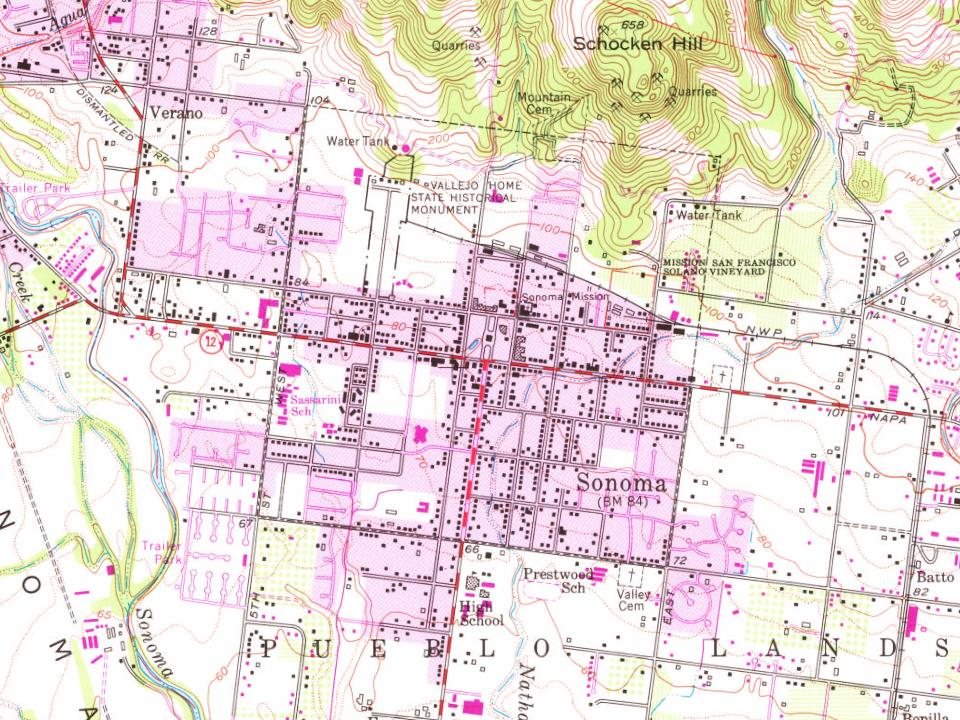
Sonoma, building by building, 1888–1911
Fire insurance maps drew every building, what it was made of and what it was used for, so insurers could price the risk of fire. Pick a year, then a sheet.
When the first Spaniards arrived, the area was near the northeastern corner of the Native Americans / Aboriginal peoples (Indians) of the Coast Miwok territory, with Southern Pomo to the northwest, Wappo to the northeast, Suisun and Patwin peoples to the east.
Passages that mention Sonoma, cut from the printed page as they were published.
An illustrated history of Sonoma County, California. Containing a history of the county of Sonoma from the earliest period of its occupancy to the present time1889 · page 281Read the page →
Read the text
The Sonoma Bulletin. — This was the first periodical published in Sonoma County, its initial number being issued June 12, 1852, by A. J. Cox, who had been a resident of the town of Sonoma since 1847, having been a member of a company of Stevenson's regiment, which was stationed there. Mr. Thompson says: It was a very lively sheet for several years, and
Text read by machine from the scan; it may contain errors.
An illustrated history of Sonoma County, California. Containing a history of the county of Sonoma from the earliest period of its occupancy to the present time1889 · page 736Read the page →
Read the text
1850, he arrived in Sonoma County and located in Sonoma Valley, antl engaged in teaming, etc., until the next year. He then purchased a tract of laud about four miles south of the town of Sonoma and commenced his career as a fanner and stock-grower. The rich and fertile soil was then in its wild and uncultivated state, but the energetic and well directed efforts of Mr. Akers
Text read by machine from the scan; it may contain errors.
Historical and descriptive sketch of Sonoma county, California1877 · page 16Read the page →
Read the text
The town of Sonoma was garrisoned from that time until 1851, — a number of officers, since distinguished, having been stationed there. Among them, General Hooker, Lieutenant Derby and General Sherman. The first civil officer was one John Nash, who was commissioned by General Kearny a.s alcalde of Sonoma. Nash had a very exalted idea of the dignity of his oflice ; assumed ministerial as well as judicial powers; signed himself " Chief .Justice of California," and having been removed by the military governor, he refused to recognize the authority and held on to the office. Lieutenant Sherman, —
Text read by machine from the scan; it may contain errors.
Historical and descriptive sketch of Sonoma county, California1877 · page 19Read the page →
Read the text
In 1853 the city of Sonoma stood still, if it did not retrograde, and Petaluma gained in wealth and population. The great Central valley was filling up, and the balance of population, wealth and political power was shifting to the west side of Sonoma mountains. Sonoma had reached the high-water mark of its prosperity, and the ebb set outward, very slowly, so slowly that those who drifted were nol conscious of it, but surely it was going down. At the meeting of the board of supervisors in March of this year, Joe Hooker, " fighting .Joe," was appointed road-overseer. Washington township was created this year,
Text read by machine from the scan; it may contain errors.
Scans and text from the Internet Archive. Books published in 1930 or earlier, which are in the public domain.
Timeline
Sonoma, 1849 to 1986
Woven from the archive, old maps, post office records, the National Register and the people born here.
Nothing in the archives for these yearsWeddings on Main Street, storms, parades, school pictures, the old store. If it’s in your family album, it belongs here.
The Sonoma post office opened in 1849, the earliest record of the town by name (U.S. post office records). Wikidata gives 1883.
How does Sonoma rank for history?
Sonoma is more historic than 78% of U.S. towns, #34 of 847 in California. The History grade combines the town’s founding era, the share of homes built before 1940 and its National Register listings. It’s a character grade, so it isn’t part of the overall grade. How it works.
What is on the National Register in Sonoma?
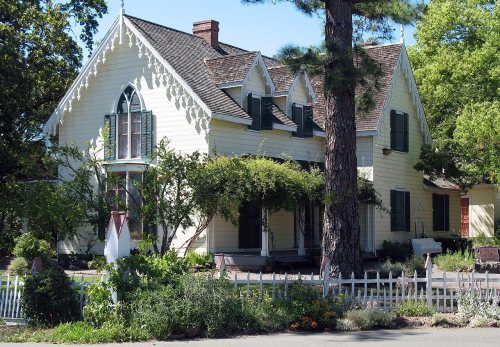
7 listings: 6 buildings, among them the Vallejo Estate (listed 1972, the first), and 1 historic district, the Sonoma Plaza, with 38 contributing buildings. 47 historic buildings in all.
How old are the homes in Sonoma?
6% of Sonoma’s homes were built before 1940 (Census estimate, ±2.4 points), against a typical 3.4% for a California town; the median home was built in 1977.
Founding dates: Wikidata, Wikipedia, the U.S. post office records of Blevins & Helbock (CC0) and the Census. Homes by year built: Census ACS 2020–24. National Register of Historic Places: National Park Service (list of May 22, 2026). Old photos, postcards and papers: Wikimedia Commons, the Library of Congress and other public archives, credited on each item’s page. Maps: U.S. Geological Survey historical topographic maps (via Esri) and Sanborn fire-insurance maps (Library of Congress). History text and census tables: Wikipedia (CC BY-SA 4.0). Places that used to be: USGS Geographic Names Information System (2021).
From Wikimedia Commons (6), Wikidata (7), the National Register of Historic Places (7), Wikipedia, Wikidata and Wikipedia for famous people, U.S. Geological Survey historical maps, U.S. Census counts (via Wikipedia), the US Post Offices dataset (Blevins & Helbock), the USGS Geographic Names Information System, Sanborn fire insurance maps (Library of Congress) and old county and town histories (Internet Archive). Archive images are copied here with their credits and licenses, shown on each photo’s page. Refreshed monthly.








 1898
 1906