More historic than 8% of U.S. towns · #734 of 847 in California. What drives it
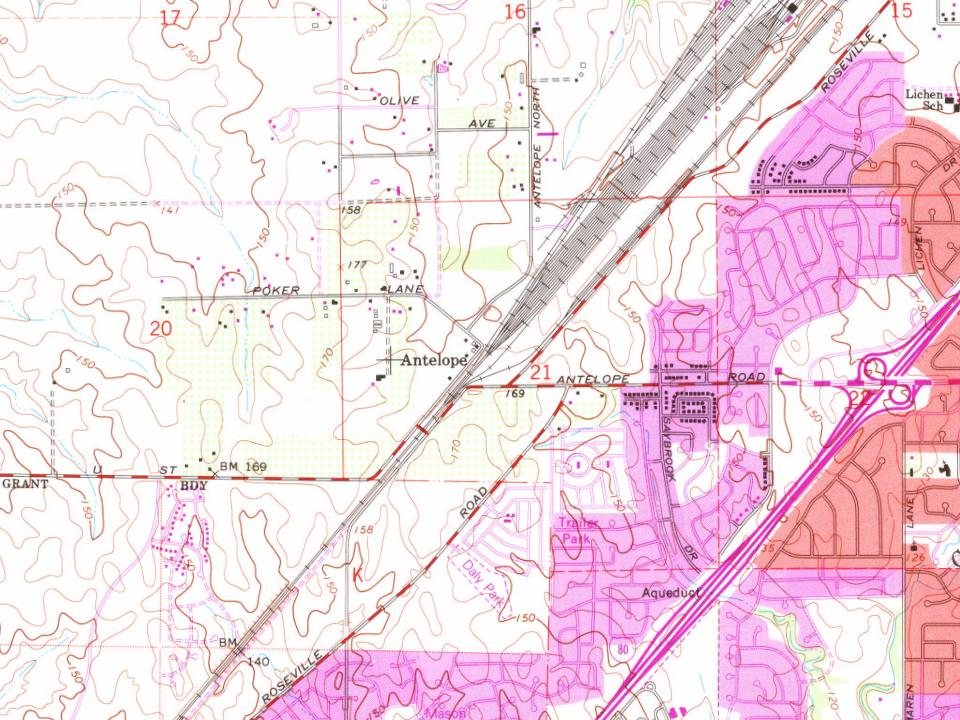
Most of Antelope was built recently: 0.3% of its homes predate 1940 and the median home dates from 1993. Below: maps from 1902 on and old-book passages.
On its age, its old homes and the National Register, Antelope is more historic than 8% of U.S. towns, #734 of 847 in California. Its National Register listings hold the grade up; its share of homes from before 1940 pulls it down.
D
HistoryA character grade: shown, never part of Antelope’s overall grade.
Few California towns list much on the Register (a typical California town has 0.0 per 10,000 residents, the U.S. 2.4), so Antelope’s 0.0 sits below most of its state (31% of California towns have fewer) while its 0 listings outnumber those of 23% of U.S. towns.
How sure. Graded on two of the three inputs, so a change in either one moves the letter more than it would with three. The pre-1940 share (±0.3 points) is firm at this size.
Founding year: our sources. Homes: Census ACS 2020–24. National Register: National Park Service, May 2026 list; each listing counted once (boundary changes and added documentation belong to their listing), and a historic district counts its contributing buildings. How TownRatings grades history →
What stands out about Antelope’s past
Read from the archive, the National Register and the record. The page puts what stands out first.
In the late 1800s, Antelope was the only significant settlement in the Center Township, an area bounded on the North by the Placer county line, on the East by what is now Sunrise Blvd., on the South by the American River, and on the West by the line along 20th St in Rio Linda south to Ethan Way in the Arden-Arcade area. The population of the entire township in 1880 was about 400 people. Many of the railroad workers made their homes here and eventually stayed permanently. Gradually, workers left the area and Antelope became just another small community with little business.
Passages that mention Antelope, cut from the printed page as they were published.
History of Sacramento County, California, with biographical sketches of the leading men and women of the county who have been identified with its growth and development from the early days to the present1913 · page 399Read the page →
Read the text
quantities of cobbles were thrown into the river against the walls until the danger was checked. A special train, while coming from Roeklin for the purpose of bringing stone for this purpose, collided while on its return trip with a wood-train near Antelope station, and the engineer, Roderick McRae, and Joseph Bryan, collector for the gas company, were severely injured. This accident claims the distinction of having been the first collision on the Central Pacific railroad.
Text read by machine from the scan; it may contain errors.
History of Sacramento County, California1913 · page 399Read the page →
Read the text
quantities of cobbles were thrown into the river against the walls until the danger was checked. A special train, while coming from Rocklin for the purpose of bringing stone for this purpose, collided while on its return trip with a wood-train near Antelope station, and the engineer, Roderick McRae, and Joseph Bryan, collector for the gas company, were severely injured. This accident claims the distinction of having been the first collision on the Central Pacific railroad.
Text read by machine from the scan; it may contain errors.
History of Sacramento County, California, with biographical sketches of the leading men and women of the county who have been identified with its growth and development from the early days to the present1923 · page 763Read the page →
Read the text
Gould. Raymond and Arthur are partners in farming near Antelope; Ernest was for some years an assistant in the State Purchasing Department, and is now farming near Antelope; Harvey is farming the home ranch; and Ora Grace is the wife of P. E. Anderson, of Sacramento.
Text read by machine from the scan; it may contain errors.
An illustrated history of Sacramento County, California1890 · page 167Read the page →
Read the text
pose, while on its return trip, collided with a wood-train near Antelope Station, severely injuring the engineer, Roderick McRae, and Joseph Bryan, the collector of the Gas Company. Tliis accident claims the notoriety of havin<>; been tlie first collision on the Central Pacific Railroad.
Text read by machine from the scan; it may contain errors.
Scans and text from the Internet Archive. Books published in 1930 or earlier, which are in the public domain.
Antelope is more historic than 8% of U.S. towns, #734 of 847 in California. The History grade combines the town’s founding era, the share of homes built before 1940 and its National Register listings. It’s a character grade, so it isn’t part of the overall grade. How it works.
How old are the homes in Antelope?
0.3% of Antelope’s homes were built before 1940 (Census estimate), against a typical 3.4% for a California town; the median home was built in 1993.
Founding dates: Wikidata, Wikipedia, the U.S. post office records of Blevins & Helbock (CC0) and the Census. Homes by year built: Census ACS 2020–24. National Register of Historic Places: National Park Service (list of May 22, 2026). Old photos, postcards and papers: Wikimedia Commons, the Library of Congress and other public archives, credited on each item’s page. Maps: U.S. Geological Survey historical topographic maps (via Esri) and Sanborn fire-insurance maps (Library of Congress). History text and census tables: Wikipedia (CC BY-SA 4.0). Places that used to be: USGS Geographic Names Information System (2021).
From Wikimedia Commons (1), Wikipedia, U.S. Geological Survey historical maps, the USGS Geographic Names Information System and old county and town histories (Internet Archive). Archive images are copied here with their credits and licenses, shown on each photo’s page. Refreshed monthly.




 2026


