148 years in pictures
Census counts: 888 in 1970, 3,995 in 2020. The archive holds 1 old photo or paper going back to 2019 and 3 maps from 1970 on.
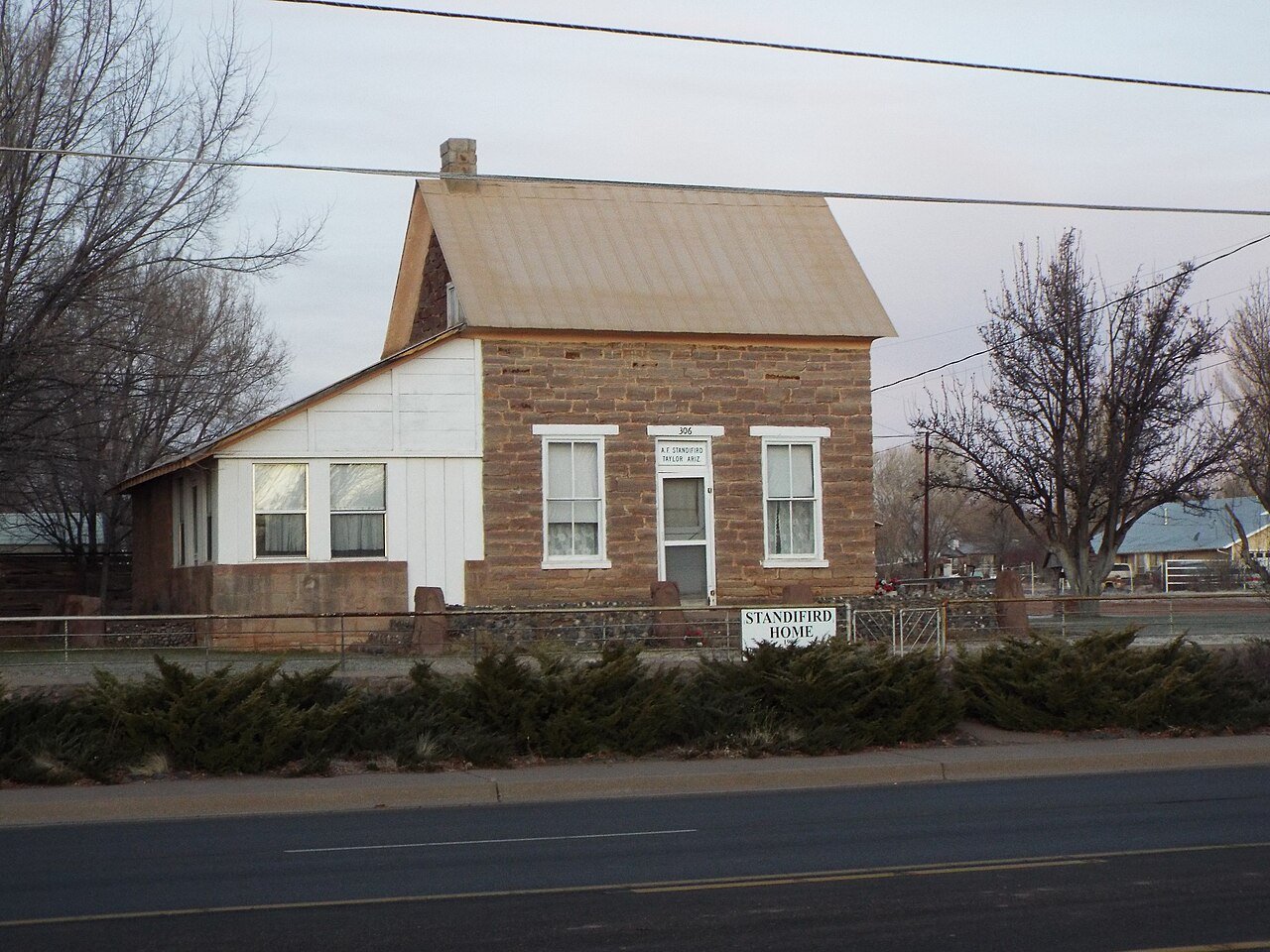
4 places on the National Register of Historic Places.
- 1878Taylor is settled
Each edition grades its towns against each other only.

Public schools that outperform most of Arizona.
Taylor gives you more for your money than most places: a typical home costs about $378K, 6.9 years of the Show Low area’s $55K median household income. It grades A− overall, 11th among Arizona's 139 graded towns. On the plus side, its public schools beat 80% of Arizona towns on state tests and graduation. 21% of the land in Taylor is conserved, against 14% in Arizona’s towns and 4.3% across U.S. towns. Taylor has 4 places on the National Register of Historic Places, among them Jordan Palmer House and Norman Brimhall House. Most errands need a car: it is less walkable than 77% of U.S. towns.
Where Taylor beats most towns.
| School | Grades | Students |
|---|---|---|
| Taylor Elementary School | K–3 | 269 |
| Taylor Intermediate School | K–6 | 234 |
| Northern AZ Academy for Career Dev. - Taylor | 7–12 | 59 |
Each subject compared with towns across the country (schools within Arizona), ordered by how far Taylor is from typical.
How TownRatings grades towns →
Census counts: 888 in 1970, 3,995 in 2020. The archive holds 1 old photo or paper going back to 2019 and 3 maps from 1970 on.
4 places on the National Register of Historic Places.
Who provides power, water and the rest in Taylor, and how to reach them.
EPA SDWIS (Oct 9, 2026) · HIFLD + EIA-861 2025 · Census 2020 ZCTAs · NCES 2024–25 · registration: vote.gov, updated Sep 12, 2025.
Ordered by what stands out in Taylor.
Taylor pairs an A− overall with homes cheaper than the Arizona norm, pairs an A− for schools with modest home prices and carries less natural-hazard risk than most of Arizona (mostly inland flooding).
Its A− for schools comes with a B+ for cost of living: the typical home is worth about $378K.
Its public schools are run by the Snowflake Unified District. Its three schools are below.
| School | Level | Students | Letter |
|---|---|---|---|
| Taylor Elementary SchoolLargest public elementary schoolGrades K–3 | Grades K–3 | 269 | A− |
| Northern AZ Academy for Career Dev. - TaylorLargest public high schoolGrades 7–12 | Grades 7–12 | 59 | C+ |
| Taylor Intermediate SchoolTop results in townGrades K–6 | Grades K–6 | 234 | A− |
NCES · EDFacts · graded within AZ on state tests and graduation
Taylor beats the Arizona average on 3 of 32 CDC measures and trails it on 3. 71% of Taylor adults had a checkup this year, where Arizona’s towns sit at 75% and U.S. towns at 79%. 32% of adults sleep under 7 hours in Taylor.
| Taylor | Arizona towns | U.S. towns | |
|---|---|---|---|
| Yearly checkup (CDC PLACES) | 71% | 75% | 79% |
| Sleep under 7 hours (CDC PLACES) | 32% | 35% | 36% |
| Get no exercise (CDC PLACES) | 20% | 24% | 25% |
| Diabetes (CDC PLACES) | 10% | 13% | 12% |
| What stands out | Taylor | AZ |
|---|---|---|
| Fewer uninsured adults | 9.7% | 13.2% |
| Fewer adults facing food insecurity | 12.9% | 15.8% |
| More adults with asthma | 11.8% | 10.4% |
CDC PLACES 2025 · modeled estimates for adults · CMS · HRSA
19 miles of trail in 0 parks and preserves. The trail density in Taylor is 0.6 miles per square mile.
Trails & parks © OpenStreetMap contributors · Conserved land: USGS PAD-US
Adults 18 to 34 are 14% of residents (23% statewide); adults 35 to 64 are 41% of residents (36% statewide). Taylor has grown 10% since 2020, to 4,408 residents in the Census Bureau’s 2025 estimate. 29% of adults 25 and older have a bachelor’s degree or more, vs 33% across Arizona.
| Taylor | Arizona towns | U.S. towns | |
|---|---|---|---|
| Bachelor’s degree or more, 25+ | 29% | 24% | 29% |
| Median age | 41.6 years | 41.9 years | 40.5 years |
52% women, 48% men
That’s an even split within the survey’s margin of ±5.7 points. Across Arizona, 50.1% of residents are women.
| Taylor | AZ | U.S. | |
|---|---|---|---|
| Under 10 | 13.2% | 11.3% | 11.6% |
| 10 to 17 | 12% | 10.3% | 10.3% |
| 18 to 24 | 6.7% | 9.4% | 9.1% |
| 25 to 34 | 7.5% | 13.8% | 13.7% |
| 35 to 44 | 15.4% | 12.7% | 13.2% |
| 45 to 54 | 9.9% | 11.6% | 12.2% |
| 55 to 64 | 16% | 12% | 12.7% |
| 65 to 74 | 9.4% | 10.8% | 10.2% |
| 75 and older | 9.8% | 8.1% | 7% |
| No diploma | 6.7% | 10.6% | 10.4% |
| High school | 16.8% | 23.5% | 26% |
| Some college | 39.5% | 23.3% | 19.1% |
| Associate’s | 8.3% | 9.3% | 8.8% |
| Bachelor’s | 19.5% | 20.3% | 21.6% |
| Graduate | 9.1% | 13% | 14.1% |
Census population estimates, 2025 · U.S. Census Bureau · ACS 2020-2024 5-year estimates · in a town of 4,400, single groups can be off by several points
The Snowflake weather station, 5 miles away, records that about 48 days a year reach 90°: more than most of the country, but fewer than 83% of Arizona places with climate records. July afternoons average 89.5°: hotter than most of the country, but cooler than 83% of Arizona places with climate records; January nights average 19.6°.
Taylor has chilly winters and warm summers, with very little rain. Taylor’s July high is 90°F. Only 10 of the 140 Arizona towns we compare have a lower January low than Taylor.
| Taylor | Arizona towns | U.S. towns | |
|---|---|---|---|
| July high | 90°F | 100°F | 85°F |
| January low | 20°F | 37°F | 22°F |
NOAA U.S. Climate Normals, 1991–2020
Jobs based here grew from 650 in 2013 to 1,122.
Most working residents leave Taylor for work: only 11% work in town. Jobs based in Taylor grew to 1,122 in 2023, 472 more than in 2013. The top destinations are Snowflake (17%), Show Low (14%) and Phoenix (14%).
| Taylor | Arizona towns | U.S. towns | |
|---|---|---|---|
| Average trip to work | 28 minutes | 24 minutes | 25 minutes |
| Median household income | $90,000 | $68,000 | $80,000 |
| Working residents who work in town | 11% | 10% | 8% |
Census LEHD 2023 · ACS
FEMA rates its natural-hazard risk lower than 87% of Arizona towns, with expected losses of about $209 per resident a year; that rating is what its B for hazard risk is built on.
Since 1978, 8 flood insurance claims have been paid out in Taylor.
FEMA flood insurance claims · FEMA National Risk Index · OpenFEMA
Taylor grades A− overall with a typical home of about $378K, below the Arizona typical value; only 3 of the 9 Arizona towns graded A− or better can say that. Homes are within reach (about $378K for the typical one, B+ for cost of living), but half of working residents commute more than 30 miles.
The typical Taylor home is worth about $378,000, up 1.4% in a year, 9% below the Arizona typical home. 83% of Taylor households own their home.
Census ACS, 2020–24 · Zillow Home Value Index · Redfin Data Center
None within 15 miles of Taylor; the nearest are
About 1 of every 100 Taylor residents are enrolled in college, against 6 across Arizona.
Town in Navajo County, Arizona
Taylor is a town in Navajo County, Arizona, United States. It was founded by settlers of The Church of Jesus Christ of Latter-day Saints in January 1878, several months before the neighboring community of Snowflake. Taylor straddles Silver Creek, flowing from the nearby White Mountains to the Little Colorado River on Arizona's Colorado Plateau. As of the 2020 census, Taylor had a population of 3,995. The town was named for John Taylor, the third president of the Church of Jesus Christ of Latter-day Saints. There is no postal home delivery in Taylor; residents within a certain radius of the Post Office who produce proof of Taylor residency are allocated a small PO box free of charge.
From Wikipedia, licensed CC BY-SA 4.0 · facts via Wikidata (CC0)
2 towns share a border with Taylor.
Taylor and Snowflake report no FBI crime data of their own. Shumway isn’t graded (fewer than 1,000 residents, or not enough data). Compare Taylor with a neighbor →
Short answers, built from the data on this page.
By most measures, yes. Taylor grades A− overall, better than 75% of U.S. towns and #11 of 139 in Arizona. It grades B+ for health and A− for schools. Walkability is its weak spot, with a C−.
Not for the area. Cost of living, which also weighs rents, property taxes and how many households pay 30% or more of their income for housing, grades B+.