
Black Oak AR 001, 2011
Black Oak’s story
124 years in pictures
Census counts: 302 in 1930, 233 in 2020. The archive holds 10 old photos and papers going back to 2005 and 3 maps from 1941 on.
- 1902Black Oak is settled
Each edition grades its towns against each other only.
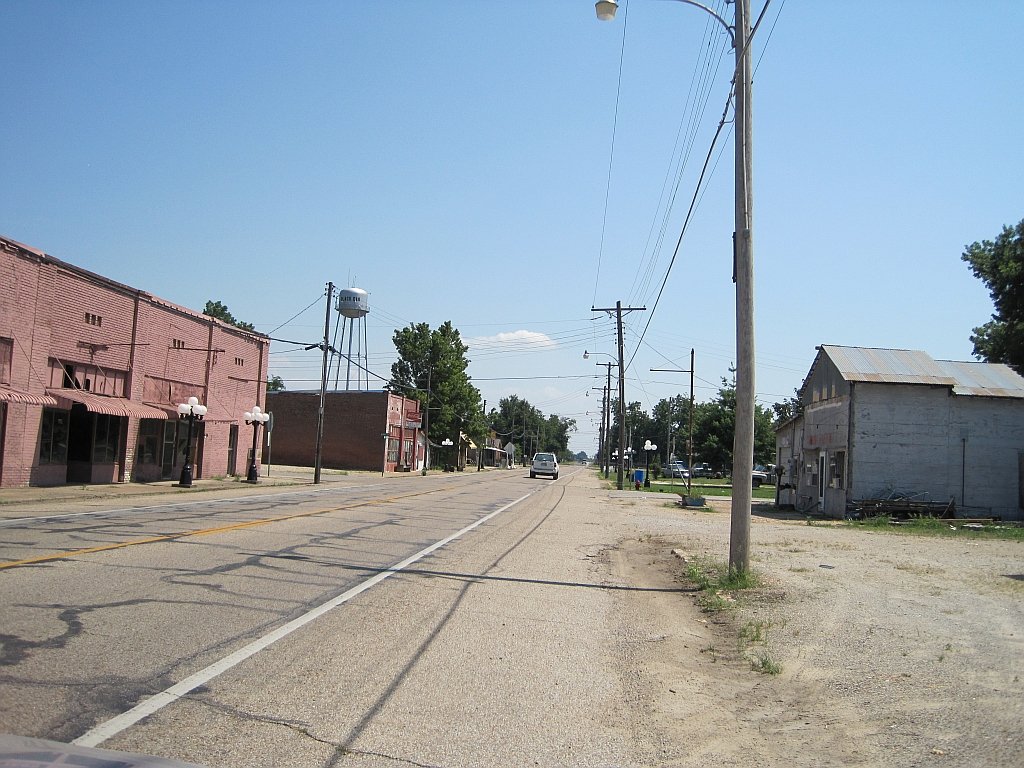
A town of 261, settled in 1902.
34% of residents are under 18 in Black Oak, above both the Arkansas town median (25%) and the median of U.S. towns (22%). Only 2 of the 124 Arkansas towns we compare have a higher share of households owning their home than Black Oak. Black Oak has fewer than 1,000 residents, too few for fair grades; the figures below are still real.
In a town this size, neighbors are the best guide. Ask them anything.
Census counts: 302 in 1930, 233 in 2020. The archive holds 10 old photos and papers going back to 2005 and 3 maps from 1941 on.
Who provides power, water and the rest in Black Oak, and how to reach them.
EPA SDWIS (Oct 9, 2026) · HIFLD + EIA-861 2025 · Census 2020 ZCTAs · NCES 2024–25 · registration: vote.gov, updated Nov 18, 2024.
Ordered by what stands out in Black Oak.
At 88 of 100, Black Oak’s FEMA risk score is above both Arkansas’ towns (66 of 100) and U.S. towns (44 of 100).
FEMA National Risk Index · OpenFEMA
Most working residents leave Black Oak for work: only 0% work in town. 23% of Black Oak residents live below the poverty line. The top destinations are Jonesboro (29%), Monette (5%) and Marion (5%).
| Black Oak | Arkansas towns | U.S. towns | |
|---|---|---|---|
| Below the poverty line | 23% | 18% | 9.6% |
| Average trip to work | 27 minutes | 21 minutes | 25 minutes |
| Median household income | $55,000 | $55,000 | $80,000 |
Census LEHD 2023 · ACS
Black Oak has lost 3.7% of its people since 2020, down to 261 in the Census Bureau’s 2025 estimate. 26% of adults 25 and older have a bachelor’s degree or more, vs 26% across Arkansas. 31% never finished high school.
Somewhere between 35% and 55% women
The Census survey reached too few of Black Oak’s residents to say more: its margin here is ±10.1 points. Across Arkansas, 50.6% of residents are women.
| Black Oak | AR | U.S. | |
|---|---|---|---|
| Under 10 | 17.3% | 12.3% | 11.6% |
| 10 to 17 | 16.2% | 10.8% | 10.3% |
| 18 to 24 | 7.3% | 9.4% | 9.1% |
| 25 to 34 | 4.5% | 13% | 13.7% |
| 35 to 44 | 9.5% | 12.7% | 13.2% |
| 45 to 54 | 22.3% | 11.8% | 12.2% |
| 55 to 64 | 3.9% | 12.5% | 12.7% |
| 65 to 74 | 15.1% | 10.3% | 10.2% |
| 75 and older | 3.9% | 7.2% | 7% |
| No diploma | 31.1% | 11.3% | 10.4% |
| High school | 23.6% | 34.1% | 26% |
| Some college | 14.2% | 20.7% | 19.1% |
| Associate’s | 5.7% | 8.2% | 8.8% |
| Bachelor’s | 5.7% | 16.3% | 21.6% |
| Graduate | 19.8% | 9.5% | 14.1% |
Census population estimates, 2025 · U.S. Census Bureau · ACS 2020-2024 5-year estimates · in a town of 300, single groups can be off by several points
Black Oak has mild winters and warm summers, with plenty of rain. The July high in Black Oak is 91°F.
NOAA U.S. Climate Normals, 1991–2020
Black Oak beats the Arkansas average on 0 of 32 CDC measures and trails it on 1. 19% of adults smoke cigarettes in Black Oak.
| Black Oak | Arkansas towns | U.S. towns | |
|---|---|---|---|
| Smoke cigarettes (CDC PLACES) | 19% | 17% | 14% |
| Fair or poor health (CDC PLACES) | 27% | 25% | 19% |
| Get no exercise (CDC PLACES) | 35% | 34% | 25% |
| Frequent physical distress (CDC PLACES) | 17% | 16% | 14% |
| What stands out | Black Oak | AR |
|---|---|---|
| Fewer adults seeing a dentist | 50.8% | 54.7% |
CDC PLACES 2025 · modeled estimates for adults · CMS · HRSA
None within 15 miles of Black Oak; the nearest are
About 1 of every 100 Black Oak residents are enrolled in college, against 5 across Arkansas.
Where Black Oak’s working residents go each day. Line width shows the share.
Census LEHD 2023
Town in Arkansas, United States
Black Oak is a town in Craighead County, Arkansas, United States. The population was 233 in the 2020 census. It is included in the Jonesboro, Arkansas Metropolitan Statistical Area.
From Wikipedia, licensed CC BY-SA 4.0 · facts via Wikidata (CC0)
Short answers, built from the data on this page.
Black Oak has fewer than 1,000 residents, too few for fair grades; the figures below are still real.