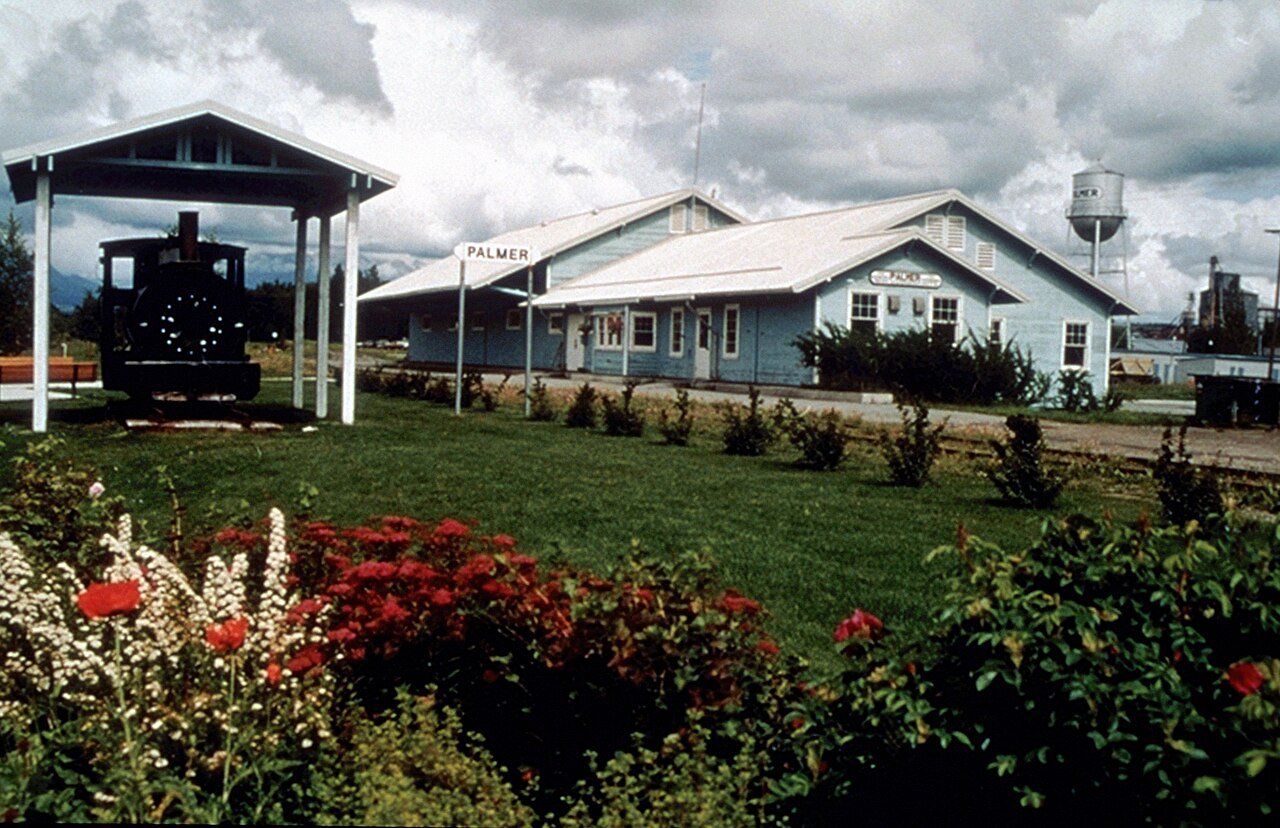
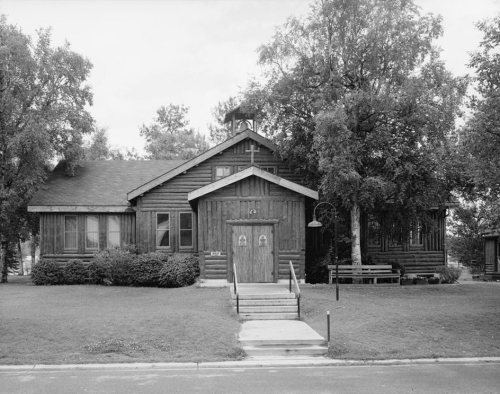
109 years in pictures
Census counts: 150 in 1940, 5,888 in 2020. The archive holds 6 old photos and papers going back to 1907 and 2 maps from 1979 on.
11 places on the National Register of Historic Places.
- 1917Palmer is settled
Each edition grades its towns against each other only.

A town of 6,710, settled in 1917.
Palmer grades B overall, ranked 11th of 41 in Alaska, with clear strengths and some subjects that lag. Its public schools beat 77% of Alaska towns on state tests and graduation and it has 7 miles of trail. On the other side, FEMA rates its natural-hazard risk higher than 91% of U.S. communities, with earthquakes at the top. Palmer’s July high is 66°F, where Alaska’s towns sit at 66°F and U.S. towns at 85°F. Palmer is home to Alaska Bible College. Palmer is more walkable than 81% of U.S. towns.
Where Palmer beats most towns, and one thing worth knowing.
Each subject compared with towns across the country (schools within Alaska), ordered by how far Palmer is from typical.
How TownRatings grades towns →
Census counts: 150 in 1940, 5,888 in 2020. The archive holds 6 old photos and papers going back to 1907 and 2 maps from 1979 on.
11 places on the National Register of Historic Places.
Who provides power, water and the rest in Palmer, and how to reach them.
EPA SDWIS (Oct 9, 2026) · HIFLD + EIA-861 2025 · Census 2020 ZCTAs · NCES 2024–25 · registration: vote.gov, updated Sep 30, 2026.
Ordered by what stands out in Palmer.
Palmer has a shorter frost-free season than nearly all U.S. towns and is healthier than towns with similar incomes.
6.7 miles of trail in 10 parks and preserves. Palmer’s trail density is 1.3 miles per square mile. The biggest park or preserve is Cedar Park, at 88 acres.
| Palmer | Alaska towns | U.S. towns | |
|---|---|---|---|
| Miles of trail per square mile | 1.3 miles per square mile | 0.4 | 0.4 |
| Conserved land | 3.8% | 15% | 4.3% |
| Biggest places to walk | Trails | Acres |
|---|---|---|
| 1. Cedar Park | 0.2 mi | 88 |
| 2. Matanuska River Park | — | 57 |
| 3. Historic Train Depot Park | — | 5 |
Trails & parks © OpenStreetMap contributors · Conserved land: USGS PAD-US
Its public schools are run by the Matanuska-Susitna Borough School District. Three of its 6 schools are below, each with why it’s listed. The largest public high school is Palmer High School, with 616 students.
| School | Level | Students | Letter |
|---|---|---|---|
| Palmer Middle SchoolLargest public middle schoolGrades 6–8 | Grades 6–8 | 563 | B− |
| Palmer High SchoolLargest public high schoolGrades 9–12 | Grades 9–12 | 616 | B− |
| Academy Charter SchoolTop results in townGrades K–8 | Grades K–8 | 268 | A+ |
NCES · EDFacts · graded within AK on state tests and graduation
FEMA National Risk Index · OpenFEMA
The Lazy Mtn weather station records that the frost-free season runs about 114 days, shorter than in 98% of U.S. towns. The Lazy Mtn weather station records that 83 inches of snow fall in a normal winter, more than in 95% of U.S. towns.
Palmer has cold, snowy winters and cool summers, with very little rain. The January low in Palmer is 9°F.
NOAA U.S. Climate Normals, 1991–2020
Against the 10,687 U.S. towns with household incomes like Palmer’s, it is healthier than 80%, so its B+ isn’t only a matter of income. Within Alaska it is less healthy than 65% of the 41 graded towns: Alaska sets a high bar.
Palmer tracks Alaska closely on all 32 CDC measures. 71% of adults had a checkup this year in Palmer.
| Palmer | Alaska towns | U.S. towns | |
|---|---|---|---|
| Yearly checkup (CDC PLACES) | 71% | 68% | 79% |
| Diabetes (CDC PLACES) | 8.6% | 8.8% | 12% |
| High blood pressure (CDC PLACES) | 31% | 32% | 35% |
| Sleep under 7 hours (CDC PLACES) | 33% | 35% | 36% |
CDC PLACES 2025 · modeled estimates for adults · CMS · HRSA
Adults 18 to 34 are 31% of residents (25% statewide); adults 35 to 64 are 31% of residents (37% statewide). Palmer has grown 14% since 2020, to 6,710 residents in the Census Bureau’s 2025 estimate. 25% of adults 25 and older have a bachelor’s degree or more, vs 32% across Alaska.
| Palmer | Alaska towns | U.S. towns | |
|---|---|---|---|
| Median age | 32.9 years | 37 years | 40.5 years |
| Aged 65 or older | 16% | 13% | 18% |
| Under 18 | 22% | 24% | 22% |
| Bachelor’s degree or more, 25+ | 25% | 29% | 29% |
51% women, 49% men
That’s an even split within the survey’s margin of ±2.4 points. Across Alaska, 47.5% of residents are women. Median age: women 35.1, men 31.3.
| Palmer | AK | U.S. | |
|---|---|---|---|
| Under 10 | 10.6% | 13.2% | 11.6% |
| 10 to 17 | 10.9% | 10.9% | 10.3% |
| 18 to 24 | 15.3% | 9.2% | 9.1% |
| 25 to 34 | 16.1% | 15.4% | 13.7% |
| 35 to 44 | 12.8% | 14.2% | 13.2% |
| 45 to 54 | 9.8% | 11.3% | 12.2% |
| 55 to 64 | 8.8% | 11.9% | 12.7% |
| 65 to 74 | 9.6% | 9.2% | 10.2% |
| 75 and older | 6.2% | 4.6% | 7% |
| No diploma | 7% | 6.4% | 10.4% |
| High school | 35.8% | 28.9% | 26% |
| Some college | 23.9% | 24% | 19.1% |
| Associate’s | 8.8% | 9.1% | 8.8% |
| Bachelor’s | 16.7% | 19.8% | 21.6% |
| Graduate | 7.8% | 11.8% | 14.1% |
Census population estimates, 2025 · U.S. Census Bureau · ACS 2020-2024 5-year estimates
The typical Palmer home is worth about $440,000, up 7.2% in a year, 11% above the Alaska typical home. 63% of Palmer households own their home.
| Palmer | Alaska towns | U.S. towns | |
|---|---|---|---|
| Households that own their home | 63% | 69% | 73% |
| Median rent | $1,125 a month | $1,412 a month | $1,185 a month |
Census ACS, 2020–24 · Zillow Home Value Index · Redfin Data Center
Within Alaska, it does better than 76% of towns.
| Palmer | Alaska towns | U.S. towns | |
|---|---|---|---|
| Property crimes per 1,000 (2025) | 13.4 per 1,000 residents | 8.9 | 9.9 |
| Violent crimes per 1,000 (2025) | 1.8 per 1,000 residents | 3.5 | 1.6 |
FBI crime data, 2025 · crimes reported to police
1 within 15 miles of the center of Palmer
About 7 of every 100 Palmer residents are enrolled in college, against 5 across Alaska.
11 places in Palmer on the National Register of Historic Places.
City in the United States
Palmer is a city in and the borough seat of the Matanuska-Susitna Borough, Alaska, United States, located 42 miles (68 km) northeast of Anchorage on the Glenn Highway in the Matanuska Valley. It is the ninth-largest city in Alaska, and forms part of the Anchorage metropolitan statistical area. As of the 2020 census, the population of the city is 5,888, down from 5,937 in 2010. Palmer hosts the annual Alaska State Fair, and is also the headquarters of the National Tsunami Warning Center.
From Wikipedia, licensed CC BY-SA 4.0 · facts via Wikidata (CC0)
One town shares a border with Palmer.
Farm Loop reports no FBI crime data of its own. Compare Palmer with a neighbor →
Short answers, built from the data on this page.
By most measures, yes. Palmer grades B overall, better than 58% of U.S. towns and #11 of 41 in Alaska. It grades B+ for health, B− for safety and A− for schools. Hazard risk is its weak spot, with a D.
Within Alaska, it does better than 76% of towns.
That is 4.4 years of the area's median household income ($100,505 across the Anchorage, AK metro area). Cost of living, which also weighs rents, property taxes and how many households pay 30% or more of their income for housing, grades B.