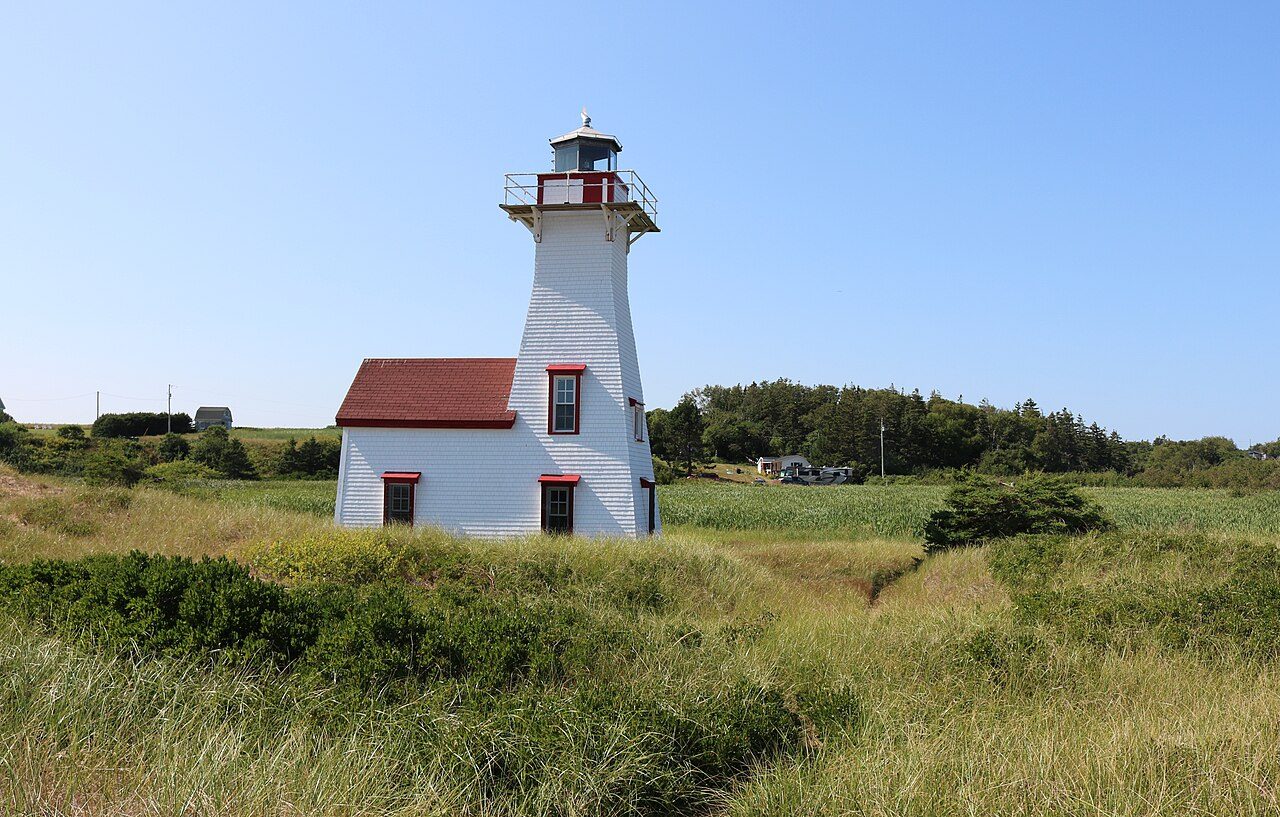
Back Range Light Tower
In French: Phare de New London
About Back Range Light Tower
Back Range Light Tower is the one Recognized Federal Heritage Building in New London. The register gives 1876–1877 for Back Range Light Tower. Its design is credited to Department of Marine and Fisheries.
The attractive Back Range Light Tower with an attached dwelling is located on the flat, coastal landscape of New London. It is comprised of a square tapered, medium-height tower attached to a one-storey, gable-roofed structure. These are clad in white-painted wood shingles with red trim around multi-pane wood windows and the doors. A brick chimney projects from the roof of the dwelling and a red-painted steel and glass, multi-sided lantern crowns the tower. A vertical stripe daymark in red is visible on the tower’s seaside façade. The designation is confined to the footprint of the building.
From the Canadian Register of Historic Places, Back Range Light Tower · Open Government Licence – Canada · quoted as the register has it
The federal government rates the heritage buildings it owns as Classified or Recognized.
Finding Back Range Light Tower
New London


Its nearest historic neighbours are too far for a short walk.
Questions about Back Range Light Tower
Can you visit Back Range Light Tower?
Yes from the outside; whether it opens its doors is for its owner to say.
Is Back Range Light Tower protected?
The federal heritage policy applies while Canada owns it.
When was Back Range Light Tower built?
Work on Back Range Light Tower is recorded as 1876–1877.
What is Back Range Light Tower?
In 1991 the federal government recognized Back Range Light Tower as a heritage building.
Contains information licensed under the Open Government Licence – Canada (Parks Canada).
Sources: Parks Canada, Directory of Federal Heritage Designations · Canadian Register of Historic Places (federal extract) · Photos: Wikimedia Commons, each credited with its licence and copied to our own server · Wikidata (CC0) for map points, other names and articles.
Adapted from Statistics Canada (Census of Population 2021, population estimates 2025, 2021 census boundaries) under the Statistics Canada Open Licence; this does not constitute an endorsement by Statistics Canada. Neighbourhood names in some cities © OpenStreetMap contributors (ODbL).