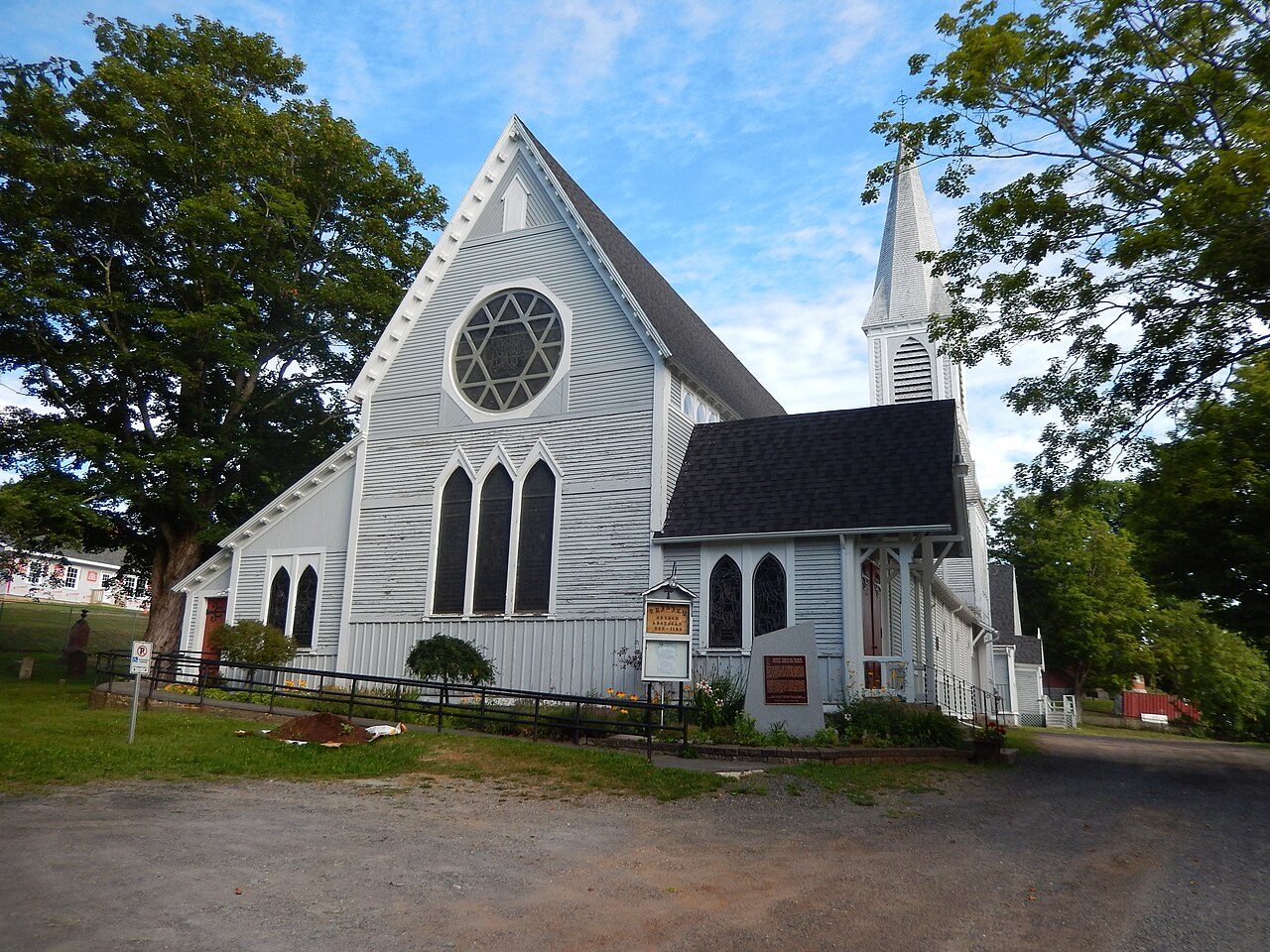
Trinity Anglican Church
In French: Église Trinity
Also known as Trinity Anglican Church National Historic Site of Canada
97 Queen Street, Digby
About Trinity Anglican Church
In Digby, Trinity Anglican Church is the National Historic Site. By its record, Trinity Anglican Church was built in 1878–1879. The register names Stephen C. Earle as its architect.
Trinity Anglican Church National Historic Site of Canada is a large wooden church sited on a treed lot with a nearby cemetery in Digby, Nova Scotia. Boldly designed, the church exhibits the functional and structural rationalism of the Ecclesiological Gothic Revival. Its interior disposition of spaces is clearly articulated in the exterior, in a pyramidal building up of forms climaxing in a steep roof and prominent spire. A surface grid pattern of wood trim around doors and windows and across the surface expresses the wooden construction of the building. The official recognition refers to the church on its legal lot.
From the Canadian Register of Historic Places, Trinity Anglican Church National Historic Site of Canada · Open Government Licence – Canada · the register’s own words, unchanged
The Historic Sites and Monuments Board recommends National Historic Sites; the designation marks national significance, not ownership.
Finding Trinity Anglican Church
Digby


It stands apart from the town’s other historic places.
Questions about Trinity Anglican Church
What is Trinity Anglican Church?
Since 1990, Trinity Anglican Church has been a National Historic Site of Canada.
Can you visit Trinity Anglican Church?
It can be seen from the street; whether you can go inside depends on its owner.
When was Trinity Anglican Church built?
The record of Trinity Anglican Church gives 1878–1879.
Is Trinity Anglican Church protected?
National Historic Site status commemorates; legal protection, where there is any, comes from the province or municipality, or from federal ownership.
Contains information licensed under the Open Government Licence – Canada (Parks Canada).
Sources: Parks Canada, Directory of Federal Heritage Designations · Canadian Register of Historic Places (federal extract) · Photos: Wikimedia Commons, each credited with its licence and copied to our own server · Wikidata (CC0) for map points, other names and articles.
Adapted from Statistics Canada (Census of Population 2021, population estimates 2025, 2021 census boundaries) under the Statistics Canada Open Licence; this does not constitute an endorsement by Statistics Canada. Neighbourhood names in some cities © OpenStreetMap contributors (ODbL).