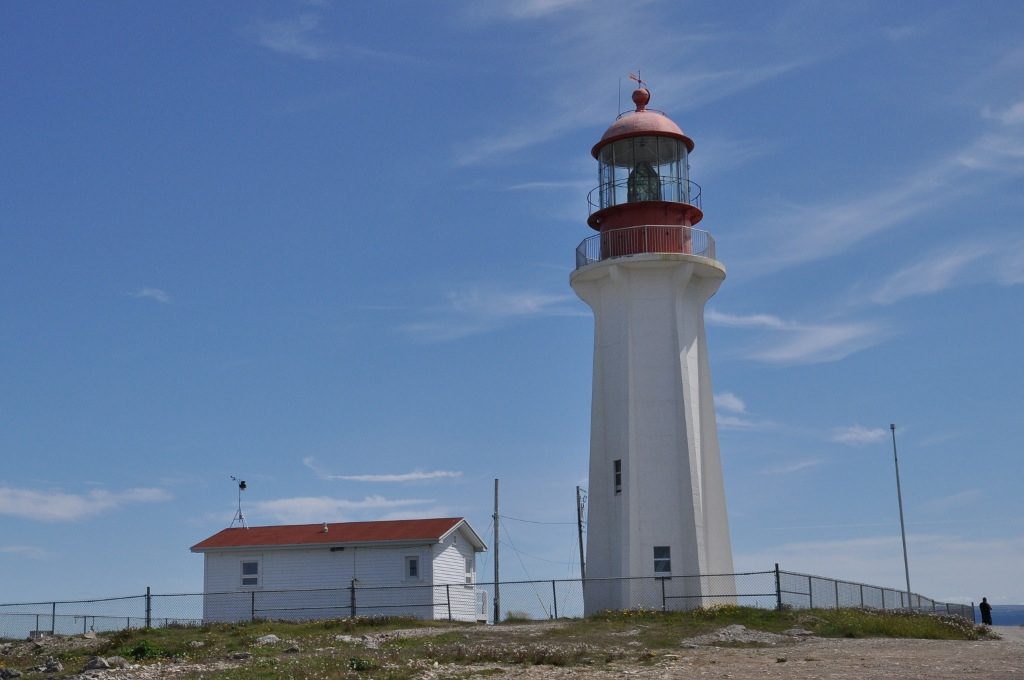
Lighttower
In French: Phare de New Férolle Peninsula
About Lighttower
Lighttower is the one Recognized Federal Heritage Building in Division No. 9, Subdivision C. Construction of Lighttower is recorded as 1912–1915. Its makers on the record: Department of Marine and Fisheries, Chief Engineer, William P. Anderson.
The New Férolle Peninsula Lighthouse is a tapered, hexagonal, reinforced-concrete tower that measures 19.2 metres (63 feet) in height. It is located on a point of land extending out from the shore of Newfoundland’s Great Northern Peninsula into the Strait of Belle Isle. Since its construction in 1913, the tower has guided transatlantic shipping entering the Gulf of St. Lawrence through the Strait of Belle Isle. There is one related building on the site that contributes to the heritage character of the lighthouse: (1) the 1990 Office building.
From the Canadian Register of Historic Places, Lighttower · Open Government Licence – Canada · as published, word for word
Recognized federal heritage buildings are owned by the Government of Canada and reviewed for their heritage value.
Finding Lighttower
Division No. 9, Subdivision C


Nothing else on the registers lies within an easy stroll of it.
Questions about Lighttower
Is Lighttower protected?
While the federal government owns it, changes go through its heritage review.
What is Lighttower?
In 1989 the federal government recognized Lighttower as a heritage building.
When was Lighttower built?
Lighttower went up in 1912–1915, by its record.
Can you visit Lighttower?
You can see it from the street, while entry depends on its current use.
Contains information licensed under the Open Government Licence – Canada (Parks Canada).
Sources: Parks Canada, Directory of Federal Heritage Designations · Canadian Register of Historic Places (federal extract) · Photos: Wikimedia Commons, each credited with its licence and copied to our own server · Wikidata (CC0) for map points, other names and articles.
Adapted from Statistics Canada (Census of Population 2021, population estimates 2025, 2021 census boundaries) under the Statistics Canada Open Licence; this does not constitute an endorsement by Statistics Canada. Neighbourhood names in some cities © OpenStreetMap contributors (ODbL).